Writing Prompts: Write a Movie Scene

movie-theatre

When I’m on a roll, writing is like watching a movie in my mind’s eye and all I have to do is jot down the details. It doesn’t happen often, but when it does I have to try and make it last as long as I can. It’s easy because it’s all right there in front of me: the setting, characters, dialogue, imagery.

This writing prompt takes this amazing writing sensation literally. Instead of writing from your imagination you’ll be writing from something that’s already been created. This exercise plays with the idea of interpretation and representation, getting you to approach writing in a new way.

Write from a movie

Think of one of your favourite movies and pick a scene that you love. It can be a moment that’s very quiet but loaded with emotion, something that’s action packed – anything that takes your fancy. You don’t have to watch the scene again, but you can if you want to.Now write the scene as if it were a piece of prose. Don’t worry about the fact that the scene and characters you’re writing aren’t ‘yours’ – this is just exploration and fun for yourself, not for overt plagiarism or publication. Here are some things to take into account:

  • Creative descriptions of the visual surroundings and characters.
  • Translating dialogue from the aural to the written word.
  • Characters internal thoughts (this is where you can get imaginative).

When you’re done turning your movie scene into a prose piece, try turning it into a poem. Take the narrative and the descriptions and cut them down to their barest forms (yes, this means killing your darlings) and play with line breaks and structure. Even if you’re ‘not a poet’, have a go anyway; broadening your writing horizons is great for keeping your creativity fresh.

This writing prompt is a bit of fun to get you thinking about texts in new ways, considering how to manipulate them into different forms and seeing how you can accurately write what you see (whether you’re seeing it in real life, in a play or film, or in your mind).

Happy writing!

26 Of The Most Inspirational Lines In Literature

1. “We are all in the gutter, but some of us are looking at the stars.” – Oscar Wilde, Lady Windermere’s Fan

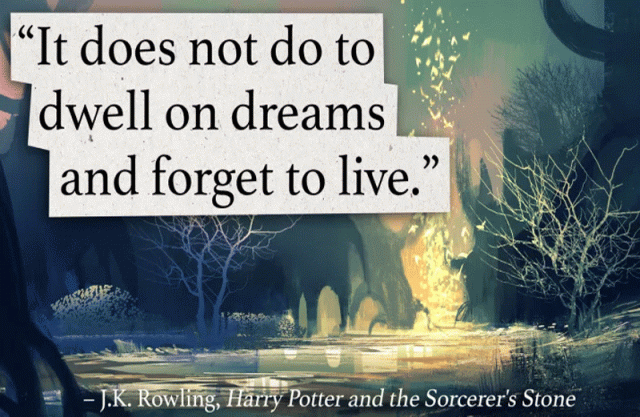
2. Harry-Potter.gif

3. “Isn’t it nice to think that tomorrow is a new day with no mistakes in it yet?” – L.M. Montgomery, Anne of Green Gables

4. “All grown-ups were once children… but only few of them remember it.” – Antoine de Saint-Exupéry, The Little Prince

5. “So it goes.” – Kurt Vonnegut, Slaughterhouse-Five

6. “You have brains in your head. You have feet in your shoes. You can steer yourself any direction you choose.” – Dr. Seuss, Oh, The Places You’ll Go!

7. “If you’re going to try, go all the way. Otherwise, don’t even start.” – Charles Bukowski, Factotum

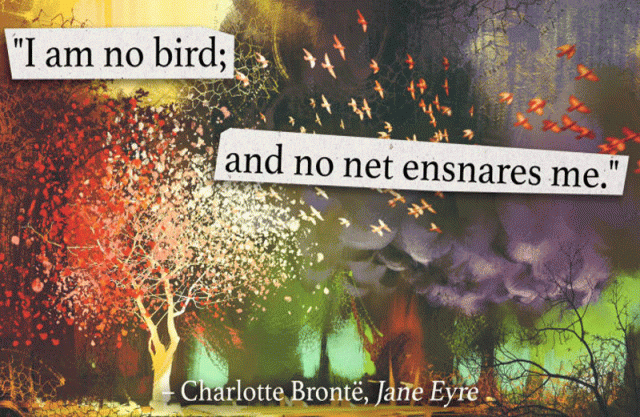
8. Jane-Ere

9. “You never know what worse luck your bad luck has saved you from.” – Cormac McCarthy, No Country for Old Men

10. “if you don’t try at anything, you can’t fail… it takes back bone to lead the life you want.” – Richard Yates, Revolutionary Road

11. “We are more than the parts that form us.” – Patrick Rothfuss, The Name of the Wind

12. “I am not afraid of storms, for I am learning how to sail my ship.” – Louisa May Alcott, Little Women

13. “I may not have gone where I intended to go, but I think I have ended up where I needed to be.” – Douglas Adams, The Long Dark Tea-Time of the Soul

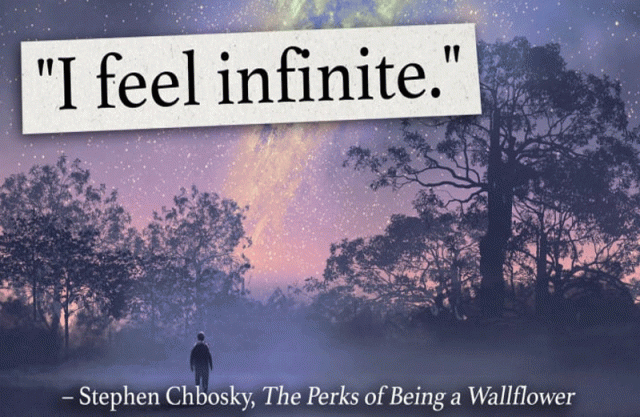
14. Perks-of-Being-a-Wallflower

15. “Never forget what you are, for surely the world will not. Make it your strength. Then it can never be your weakness. Armour yourself in it, and it will never be used to hurt you.” – George R. R. Martin, A Game of Thrones

16. “We need never be hopeless because we can never be irreparably broken.” – John Green, Looking For Alaska

17. “Are you afraid of the good you might do?.” – Victor Hugo, Les Misérables

18. “Life before Death. Strength before Weakness. Journey before Destination.” – Brandon Sanderson, The Way of Kings

19. “Nolite te bastardes carborundorum. Don’t let the bastards grind you down.” – Margaret Atwood, The Handmaid’s Tale

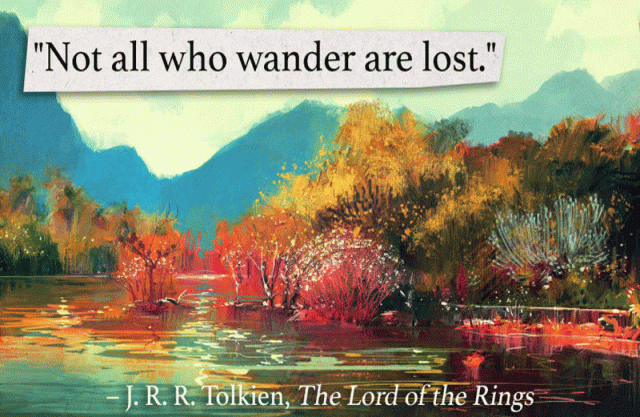
20. Lord-of-the-Rings

21. “I took a deep breath and listened to the old brag of my heart. I am, I am, I am.” – Sylvia Plath, The Bell Jar

22. “I saw that my life was a vast glowing empty page and I could do anything I wanted.” – Jack Kerouac, The Dharma Burns

23. “Everything will turn out right, the world is built on that” – Mikhail Bulgakov, The Master and Margarita

24. “Sometimes you wake up. Sometimes the fall kills you. And sometimes, when you fall, you fly.” – Neil Gaiman, The Sandman, Vol. 6: Fables and Reflections

25. “In the depth of winter, I finally learned that within me there lay an invincible summer.” – Albert Camus. Return to Tipasa

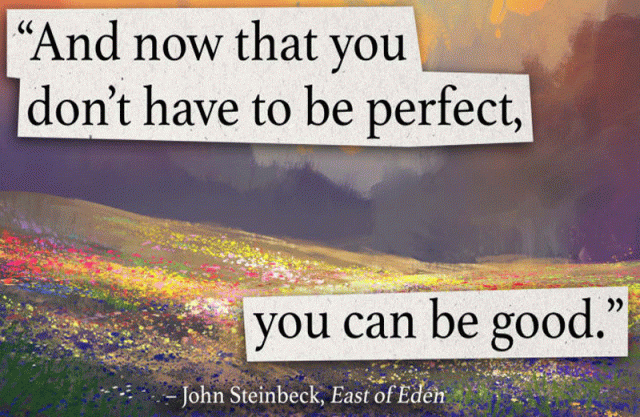
26. East-of-Eden,-John-Steinback

The Books That Made Your Favourite Authors Want To Write

SHOOTING-STAR-1240x529-1

It’s a question that’s asked by interviewers all the time: how did you become a writer? It’s kind of a lob, and for many authors, the answer is obvious. Reading made them into writers. What else? Besides actually, you know, sitting down and doing the work. But while many authors cite a lifetime love of the written word, or a storytelling acumen developed in the womb, or a childhood spent lost in libraries, some can point to a specific book and say: that one. That’s the book that made me who I am today – if only because it opened a door, or gave me permission, or even just a spark. Below, a selection of these: 30 recommendations plucked from interviews and essays the internet over. If you read them all, you’ll probably become a writer instantly!

Zadie Smith: Hurricane, Andrew Salkey

A Jamaican writer called Andrew Salkey… wrote a YA novel called Hurricanebefore YA was a term. I remember it as the book that made me want to write. He was the most wonderful writer for children. I just found what looks to be a sequel, Earthquake, on an old-books stall on West Third, and I intend to read it to my kids. He died in 1995.

Alain Robbe-Grillet: The Stranger, Albert Camus

The two most influential books of the war years were Sartre’s Nausea and Camus’s The Stranger. Other novels by the same authors—for example Sartre’s The Roads to Liberty or Camus’s The Fall—are of little interest. I feel that I decided to become a writer when I read The Stranger, which appeared in 1942, during the Occupation. It was published by Gallimard, a firm very much connected with the Occupiers. By the way, Sartre himself finally confessed that the Occupation hadn’t bothered him much. But my reading of The Stranger, as I explain in the Mirror, is very personal. The murder committed by Mersault was the result of a situation, which is the situation of relationship to the world.

Eileen Myles: Little Women, Louisa May Alcott

Do you remember what books you encountered, growing up in Massachusetts in the 1950s and 60s, that might have inspired you to want to become a writer?

The 50s is childhood up to age ten, so myths, sci-fi. Those didn’t make me want to be a writer. They made me want to do drugs or have adventures, travel. Maybe Little Women made me want to be a writer because Jo, the star of it, was a writer. I didn’t understand yet that that was the author. In the 60s I was a teenager. I liked Franny & Zooey, really everything by J.D. Salinger. I realized it was important who was talking. If you could tap into that you could get a flow going. Henry Miller came to me in the 70s. He said I didn’t ask to be born. He wrote in a complaining, American working class speech. He was from Williamsburg. It was ugly. It reminded me of Somerville, where I came from. He made it clear that an unprivileged American could be a writer and could have a lot to talk about. He switched constantly from speech to surrealism. That shift was important to me because an unstable self was what I had to use.

Jodi Picoult: Gone With the Wind, Margaret Mitchell

My favorite writer is Alice Hoffman; she’s brilliant. One of my favorite books in recent years was Yann Martel’s Life of Pi – I wished I’d written it, which is my highest form of compliment. The book that made me want to be a writer in the first place was Gone with the Wind – I read it and wanted to create a whole world out of words, too.

David Mitchell: The Earthsea Cycle, Ursula K. Le Guin

There was no single epiphany, but I recall a few early flashes. When I was ten I would be transported by certain books – Ursula K. Le Guin’s Earthsea trilogy, Susan Cooper’s fantasy novels, Isaac Asimov – and burn to do to readers what had just been done to me. Sometimes that burning prompted me to start writing, though I never got more than a few pages down. A few years later I would indulge in a visual fantasy that involved imagining my name on the jacket of a book – usually Faber and Faber – and I’d feel a whoosh inside my rib cage.

Emma Donoghue: The Passion, Jeanette Winterson

The book that made me want to write was The Passion by Jeanette Winterson. It made me feel that historical fiction didn’t have to be fusty and all about bodices, that it could be a thrilling novel, which just happened to be set in 1800.

Tom Wolfe: Napoleon, Emil Ludwig

Regarding writing, was there any particular book that influenced you?

I was greatly struck by Emil Ludwig’s biography of Napoleon, which is written in the historical present. It begins as the mother sits suckling her babe in a tent. […] It impressed me so enormously that I began to write the biography of Napoleon myself, though heavily cribbed from Emil Ludwig. I was eight at the time.

Roxane Gay: Beloved, Toni Morrison (and a lot of other books)

My writing ambition was sharpened by Margaret Atwood, The Handmaid’s Tale, an unapologetically political novel that reminds us of what it costs to be a woman in this world or the next. My ambition, that toward which I aspire to write, has long been guided by Toni Morrison, Beloved, and through her words, seeing how a novel can be mysterious and true, mythical and raw, how a novel can honor memory even when we want to look away or forget. My ambition has long been sharpened by Alice Walker, willing to tell the stories of black women without apology, willing to write politically without apology – Possessing the Secret of Joy, a haunting, gorgeous novel about female genital mutilation that keeps me transfixed and heartbroken and helpless each time I read it, because sometimes the only way to tell the truth is to tell a story.

Neil Gaiman: The Chronicles of Narnia, C.S. Lewis

C.S. Lewis was the first person to make me want to be a writer. He made me aware of the writer, that there was someone standing behind the words, that there was someone telling the story. I fell in love with the way he used parentheses – the auctorial asides that were both wise and chatty, and I rejoiced in using such brackets in my own essays and compositions through the rest of my childhood.

I think, perhaps, the genius of Lewis was that he made a world that was more real to me than the one I lived in; and if authors got to write the tales of Narnia, then I wanted to be an author.

Anne Lamott: Nine Stories, J.D. Salinger

What book made you want to become a writer?

You mean, besides Pippi Longstocking?

Nine Stories blew me away‚ I can still remember reading “For Esmé – With Love and Squalor” for the first time, and just weeping with the poignancy of the damaged soldier and the young girl. And “Teddy” – I still remember the moment when the little boy Teddy, who is actually a sadhu, tells the reporter on the ship that he first realized what God was all about when he saw his little sister drink a glass of milk – that it was God, pouring God, into God. Or something like that – maybe I don’t remember it quite as well as I thought. But it changed me both spiritually and as a very young writer, because both the insight and the simplicity of the story were within my reach.

Oh, and “A Perfect Day for Bananafish,” and “Down at the Dinghy,” with the great Boo Boo Glass. And “Uncle Wiggily in Connecticut” – don’t even get me started…

***

For more fantastic recommendations from your favourite writers, check out the original post here: http://lithub.com/the-books-that-made-your-favorite-writers-want-to-write/

Handling Publishing Stress | Janet Kobobel Grant

Stress

A new year is a good time to think about what you wish you could change. One item that immediately came to me was how stressful publishing can be.

Stressful occupations

I remember decades ago reading a survey about the most stressful occupations. Right after fire fighting, police work, and some medical professions, publishing was listed. Since I was just dipping my toes into publishing, I gasped in surprise. How could a simple love of books have landed me in the midst of Stressville!?

What causes publishing stresses?

In case you wonder what is measured to determine stress, here are the job qualities that were evaluated for the 2017 list:

• Travel
• Career Growth Potential
• Physical Demands
• Environmental Conditions
• Hazards Encountered
• Meeting the Public
• Competition
• Risk of Death or Grievous Injury
• Immediate Risk of Another’s Life
• Deadlines
• Working in the Public Eye

I’m seeing several aspects of publishing here!

Why is publishing more stressful than ever?

Over the years, the trend in publishing has been for greater stress and more work. With the economic downturn in ’08, everyone in publishing (who still had a job) had to do the work of everyone who lost his or her job. The workload grew for individuals. And while that’s been alleviated some, publishing’s growth each year since the recession remains relatively flat, resulting in little job growth.

The stress to make right decisions about which books to publish has grown as well. I’ve talked to decision-makers at publishing houses who have literally groaned as they’ve agonized over whether to take a project to committee. Too many wrong choices, and the results become dire both for the person backing the wrong titles and for the publishing house that must bear the financial loss.

Add to the mix the rate of change in the industry via electronic publishing, self-publishing, and the Amazon effect; the demise or potential demise of  formerly stalwart outlets through which to sell books; and the need to figure out how to promote books in the ever-changing online world, the publishing stresses ratchet up another notch or three.

Writers and publishing stresses

Writers, of course, struggle with the limited chances they can maintain a successful career in publishing. It’s the rare author who makes sufficient money not to have to supplement – or completely rely on – other jobs.

Meeting the public and working in the public eye (via social media, book signings, speaking at writers conferences, having your work publicly evaluated via reviews) certainly add to a writer’s stress. That’s especially true when we consider that most writers are introverts by nature.

Competition comprises a significant aspect of publishing, too. Writers compete to get published; to get noticed by readers; for marketing dollars; to make the best-seller list; for awards… Yeah, competition is a constant.

And, of course, deadlines persist in a writer’s life. Not only writing a manuscript on deadline but also meeting production deadlines once the book is given to the publishing house. That’s followed by meeting the marketing and promoting deadlines, some of which are self-imposed while others are imposed by the publisher.

Then we have launching into writing your next book while still promoting your recent release. Yup, writers’ lives are laced with deadlines.

What’s a person caught in this whirlwind to do?

I deal with publishing stresses by setting aside time throughout the week to concentrate on the big picture rather than spending most of my time on the small stuff (which leads to lots of stress since the larger issues never get addressed). Making the big stuff what I dedicate a good portion of my day to helps because I feel like I’m making progress. But if I spend my day responding to emails, while that work is important, it isn’t satisfying–nor is it necessarily the highest priority for me.

Asking oneself, What is the most important part of my job? helps to focus one’s attention on the top-of-the-stack responsibilities.

For me, that’s making sales. If I don’t make sales, I’m not setting everything else in motion that I do–negotiate contracts, intervene when the publishing process goes awry, help to build writing careers, etc.

I also find it helpful to set aside time each month to dream. For with all the changes in the 21st-century version of publishing, opportunities to succeed reside. I want to take time to dream about how to succeed in ways I might not have thought of before. I don’t want to miss out.

Via: http://www.booksandsuch.com/blog/handling-publishing-stresses/

10 Life Lessons from Terry Pratchett

Terry-Pratchett

On April 28 Terry Pratchett would have celebrated his 69th birthday. To mark the special day, we’re remembering the many life lessons learned from the characters of Discworld:

1. How to be brave

Tiffany Aching, Witch of the Chalk, taught us how to see beyond what is in front of us, and how to be brave…

“There wasn’t any real magic, she thought. I just stood my ground. You have to stand your ground, because it’s your ground” – Tiffany Aching

2. Do not fear death

The friendly face of Death taught us that death in itself is nothing to fear…

“Despite rumour, Death isn’t cruel – merely terribly, terribly good at his job”

3. Treat others with respect

Granny Weatherwax taught us to treat others with respect, dignity and decency.

“Evil begins when you begin to treat people as things” – Granny Weatherwax

4. Prejudice isn’t helpful

Rincewind taught us that sandals make the best getaway shoes, and that prejudice is not a helpful approach to life…

“He was a person who divided the world quite simply into people who were trying to kill him and people who weren’t. That didn’t leave much room for fine details like what colour anyone was” – Rincewind

5. The leopard can change his shorts

Moist Von Lipvig, a natural born criminal, a fraudster by vocation, an habitual liar and saviour of the postal service, taught us that the leopard can change his shorts…

“I’ve fallen into good ways. I keep thinking I can give it up at any time I like, but I don’t. But I know if I couldn’t give it up any time I liked, I wouldn’t go on doing it” – Moist Von Lipvig

6. Sometimes it’s good to break the rules

Esk taught us when not to know your place, and when to break the rules.

“If you ignore the rules people will, half the time, quietly rewrite them so that they don’t apply to you” – Esk

7. Politics is always complicated

Vetinarii taught us that the only time politics is ever simple is when it’s tyranny…

“Ankh-Morpork had dallied with many forms of government and had ended up with that form of democracy known as One Man, One Vote. The Patrician was the Man; he had the Vote” – Vetinarii

8. Light a candle in the dark

Captain Carrot taught us that being simple is not the same as being stupid, and to light a candle in the dark…

“Only crimes could take place in darkness. Punishment had to be done in the light. That was the job of a good watchman, Carrot always said. To light a candle in the dark”

9. Don’t tolerate injustice

Samuel Vimes taught us not to tolerate injustice, and that, while candles are all well and good, sometimes it’s better to light a flamethrower than curse the darkness…

“The common people?” said Vimes. “They’re nothing special. They’re no different from the rich and powerful except they’ve got no money or power. But the law should be there to balance things up a bit” – Samuel Vimes

10. Words have power

Susan Sto Helit taught us that words have power, that stories are important and that we want a schoolteacher around when the apocalypse comes…

“Because in this world, after everyone panics, there’s always got to be someone to tip the wee out of the shoe” – Susan Sto Helit

Via: https://www.penguin.co.uk/articles/features/2017/apr/life-lessons-from-terry-pratchett-discworld/

How To Outline Your Novel | Useful Resources

writing10

This week, as an extended Bank Holiday Bonus, we have been looking at how to outline your novel. To close off the week I have prepared a list of the links provided over the week, which will serve as a very nice further reading and useful resources list. I hope you find it useful:

***

Plotting: Constructing Your Story

http://www.scribendi.com/advice/theplotskeleton.en.html

http://terribleminds.com/ramble/2011/09/14/25-ways-to-plot-plan-and-prep-your-story/

http://contemporarylit.about.com/od/literaryterms/g/Narrative-Arc-What-Is-Narrative-Arc-In-Literature.htm

Characters

http://www.narniaweb.com/resources-links/character-ages/

http://www.veronicasicoe.com/blog/2013/04/the-3-types-of-character-arc-change-growth-and-fall/

http://www.writersdigest.com/editor-blogs/there-are-no-rules/11-secrets-to-writing-effective-character-description

Setting

https://writersblog.co/2017/04/19/literary-devices-setting/

http://www.scribophile.com/blog/importance-of-setting-in-a-novel/

http://www.wordstrumpet.com/2012/03/tips-on-writing-prepping-for-the-novel-part-five-setting.html

Theme

http://www.livewritethrive.com/2013/10/09/getting-to-your-core-idea/

https://writersblog.co/2017/04/18/literary-devices-how-to-master-theme/

http://blog.nathanbransford.com/2010/05/how-to-write-one-sentence-pitch.html

http://www.writersedit.com/literary-devices-motif/

Structure

http://classroom.synonym.com/literary-term-nonlinear-narrative-1816.html

http://education.seattlepi.com/circular-narrative-style-5885.html

https://nailyournovel.wordpress.com/2011/09/25/plot-is-linear-story-doesn%e2%80%99t-have-to-be/

http://theeditorsblog.net/2013/04/07/marking-time-with-the-viewpoint-character/

http://www.musik-therapie.at/PederHill/Structure&Plot.htm

http://blog.janicehardy.com/2013/02/three-ways-to-add-tension-during.html

http://www.thewritersjourney.com/hero’s_journey.htm

http://www.dailywritingtips.com/how-to-structure-a-story-the-eight-point-arc/

http://www.huffingtonpost.com/how to make 3 act structure work for you

http://blog.janicehardy.com/2013/10/how-to-plot-with-three-act-structure.html

Act I: The Beginning

http://thescriptlab.com/screenwriting/structure/three-acts/55-act-one-the-beginning

http://rebeccaberto.com/2012/01/15/the-best-advice-ive-learned-on-story-structure-part-2-plot-point-1/

http://digitalwritersfestival.com/2015/event/first-chapter/

http://www.writersedit.com/literary-devices-mood/

http://www.ptmichelle.com/2011/10/21/writing-tips-mini-story-arcs-within-your-storys-arc/

Act II: Midpoint

http://timetowrite.blogs.com/weblog/2015/06/the-three-cs-of-plot-and-how-they-help-you-write-the-middle-of-your-story.html

https://www.profwritingacademy.com/writers-focus-on-the-midpoint-to-nail-your-story/

http://lydiasharp.blogspot.com.au/2012/03/writing-toward-your-midpoint.html

http://livewritebreathe.com/the-black-moment/

http://rebeccaberto.com/2012/01/27/the-best-advice-ive-learned-on-story-structure-part-3-midpoint-second-third-plot-points/

Act III: Climax and Resolution

http://www.writersdigest.com/whats-new/4-ways-to-improve-plotclimax-in-your-writing

http://www.natashalester.com.au/2013/05/15/the-new-love-of-my-life-why-planning-a-book-with-scrivener-makes-writing-easy/

Other Writing Resources

Writing Prompts

http://www.writersedit.com/category/resources-for-writers/writing-prompts-resources-for-writers/

Writing Software

https://www.literatureandlatte.com/scrivener.php

http://www.scribblecode.com/

***

I hope you have found this series of posts useful. Best of luck with your writing! 

You can find the previous parts here: 

Via: http://writersedit.com/how-to-outline-your-novel-11-easy-steps/

How To Outline Your Novel | Part Five

Writing-3.jpg

This week, as an extended Bank Holiday Bonus, we will be looking at how to outline your novel:

Taking the time to outline your novel can save you grief in the long run. An outline helps keep your story on-track and progressing past the initial thrill of beginning your work. Maybe you can’t wait to start writing, or maybe you’ve already started but are running into problems. This guide will explain all the techniques you’ll need to craft an effective outline for your novel.

***

Essential Components Of Your Story’s Middle

The middle is the longest part of your novel and the most likely to sag. Pacing is the key here, since writers often find it had to keep the middle plot moving. Also take care not to race from one plot point to the next. Splitting the middle into equal sections and outlining each of them will help you control the story’s pace.

Although one of the main purposes of the middle is to build up to the climax, it doesn’t mean nothing can happen before this point. Set your protagonist or other characters obstacles, which ideally also lead directly to the final climax. In this outlining stage it may be useful to work on your ending before the middle. Then you have a clear idea of where the middle needs to go.

Minor characters’ and subplots’ arcs may finish, as well as some major characters’ arcs. This doesn’t mean they disappear from the story, it just allows the questions left hanging to focus on the protagonist and antagonist in the ending.

Midpoint

The midpoint is, as it sounds, in the middle of your novel. It’s a very important stage to shake things up so your story doesn’t get too repetitive. The midpoint involves a Shift in the protagonist’s worldview or goal. Whatever propelled them forward in Plot Point 1 has changed or isn’t enough to keep them going.

“Hamlet is another really good example, because the first half of Hamlet is Hamlet’s journey to prove Claudius’ guilt. Exactly halfway through he proves it, then the second half of the story is ‘What do I do with it?’. And, actually, that’s the shape you find in all archetypal narratives.” – John Yorke

The Shift shouldn’t just come out of nowhere. It should be connected to your overall story premise or core message. At the midpoint, the tension should be raised again. This tension can either be sudden and external, leading to the Shift, or be a result of the Shift by making the situation more personal to the protagonist.

The Black Moment and Plot Point 2

At the end of Act 2, the protagonist should come across the Black Moment. Regardless of all the work they’ve done over this Act, they reach a point where their goal seems impossible. Maybe they discover that their new super skill has a fatal weakness, or perhaps the antagonist unlocks the secret to immortality.

Shortly afterwards is Plot Point 2 where something changes to propel the protagonist onto the final confrontation. Perhaps their skill has reached another level, they’ve realised that even with such a slim chance the stakes are too high, or one of the antagonist’s henchmen switches sides.

This Black Moment and Plot Point 2 are integral to the pace of the plot. With their sense of purpose reignited, the next step is the climax.

***

Essential Components of Your Story’s End

Writers want to leave a lasting impression on your reader through the ending. It’s good to go back and reflect on your core message while doing the conclusion. Characters are particularly important to draw your reader’s interest and emotions. Keep your characters active until the final moment.

“The hero must be the catalyst. A passerby in the street can do something ‘enlightening’ but that’s all that moment must be. The protagonist will be the one to use that clue to enable meaning in the development of the story.” – Rebecca Berto

Climax

The climax is the final confrontation between the protagonist and antagonist where the stakes are higher than they’ve ever been before, and the inner and outer conflicts come to a head. It isn’t a simple stand-alone point in your plot. The climax needs to be supported in its lead-up and its resolution.

Sometimes the climax has its own mini Black Moment. The protagonist’s initial plan is failing and they are forced to come up with a new plan under pressure, usually something more risky than they would typically consider.

Final Chapter

Act 3 ends showing the result of the protagonist’s decision at the climax. It’s good to have a scene or two afterwards to give your reader a “breather” from all the tension. Along with this, any loose ends or unanswered questions should be resolved. Novel endings are important, so you want to be sure it’s planned carefully.

***

Reassess and Reorder Your Scenes

With the details of the chapter breakdown, you novel is really starting to take shape. As a final task, consider checking for scenes which require reordering and tweaking. This may involve moving scenes chronologically so plot point B becomes plot point A, or plot point B stays as it is, but plot point A appears after as a flashback.

Perhaps the timing of a revelation isn’t ideal. When outlining you want to get your ideas down as and when they come to you. But now is the time to go back and check if, for the sake of mystery, a scene is better at that point in the plot or at another point. Make sure that the tension is kept and the big reveal appears at the best possible moment.

“Writing in scenes is great because anyone who’s ever published a book knows how often scenes get moved around in the redrafting and editing phase of a book.” – Natasha Lester

Reordering scenes is often done after you’ve finished writing, but it doesn’t hurt to do a mini-version of that edit now. To help identify the best order of scenes, check your plot’s tension by drawing a graph and consult your core message. If you’re uncertain, leave the scene where it is. You can always move things around later.

Outlining your novel is important to keep your writing on-track. While you should keep it handy as you write, you’re not limited by it. Feel free to change things around as you write. Be sure to keep control of tension and keep focused on your core. Now you’re all-set to get writing!

***

If you are enjoying this post and finding it useful, then don’t forget to check back tomorrow for the final instalment…

You can find the previous parts here: 

Via: http://writersedit.com/how-to-outline-your-novel-11-easy-steps/

How To Outline Your Novel | Part Four

Writing-1-650p

This week, as an extended Bank Holiday Bonus, we will be looking at how to outline your novel:

Taking the time to outline your novel can save you grief in the long run. An outline helps keep your story on-track and progressing past the initial thrill of beginning your work. Maybe you can’t wait to start writing, or maybe you’ve already started but are running into problems. This guide will explain all the techniques you’ll need to craft an effective outline for your novel.

***

Segment Your Outline Into Chapters

The timeline has given you a basic outline, but it needs to be more concrete and detailed. The story can be broken down into sections of four or five parts, or individual chapters or scenes.

This helps flesh out your novel and define roughly how many words or pages to allow for a certain plot point, subplot or character introduction. Otherwise your beginning might accidentally end up longer than the middle!

It’s useful to plan a few goals to achieve in each chapter or segment. These goals may be:

  • Character-orientated: “reveal Character B’s low self-confidence”, “introduce character C and their personality”, “show that characters C and D have known each other for years”
  • Plot-orientated: “find murder weapon”, “discover object hidden in ancient ruins”
  • Setting-orientated: “make the marshes seem scary”, “reveal the clock tower’s history”

The goals may seem obvious, but having them clearly defined and written down can help focus you when writing that section.

“Working with story structure is not about ‘getting it right’. It is about making your story as clear and specific as it can be. Focusing on your characters’ desire or goal will lead you directly to the dilemma at the heart of your story.” – Alan Watt

One of the most common structures is the Three-Act Structure. While it’s not the only way a novel can be arranged, there are important aspects to include in the Beginning, Middle and End section.

***

Essential Components of Your Story’s Beginning

The first few chapters or so have a vital role to play, regardless of when in your story’s timeline the novel starts. The purpose of the beginning includes introducing and establishing character, setting and plot.

Character

From the beginning, the protagonist and antagonist must be introduced and clearly identifiable, even if the details of the latter are hazy. The protagonist needs to own what is, essentially, their story. You want to introduce a proactive protagonist and make the reader care about them.

It’s best to introduce all major characters. If your protagonist has to travel for a while before meeting a certain major character, introduce them with a short scene from their perspective, or through rumours that the protagonist hears.

Setting

Before getting into the juicy Act 2, your reader needs to be grounded in your world. Show your reader where and when your story is set, including indications of the socioeconomic status of the location and characters.

You also need to establish the rules of your fictional world, even if that just means establishing that they are the same rules as on Earth-as-we-know-it. This doesn’t mean all of your settings secrets should be revealed at the start. Keep setting details rich but controlled.

Plot

In the early chapters, give your reader an indication of what life is like for the protagonist before the catalyst that propels them onwards. Typically, life is either peaceful or lacking something.

“Life before” doesn’t mean back story. This should be revealed more slowly, if at all. The protagonist may meet their first obstacle, which in itself can help reveal the protagonist’s “life before”.

Act 1 ends when the protagonist decides (willingly or not) to pursue the main goal of the story, known as Plot Point 1. It’s possible at this stage that the protagonist and reader don’t know the full, final goal, such as Frodo agreeing to take the ring to Rivendale, but ends up going all the way to Mordor. Either way, the journey of the main plot needs to be clearly introduced. You may also choose to introduce, imply or foreshadow one or two subplots.

First Chapter

Unless you have a prologue, the first chapter is a reader’s introduction to everything. A novel can start anywhere – even at the end of the story! Because of this, it’s often best to finish your outline before choosing when to start.

There are a range of key aspects to weave together for your opening. At this year’s Digital Writer’s Festival, Euan Mitchell had this advice for first chapters:

“For me, I’d come… with the protagonist straight up. There’s three trialled and tested techniques that authors use. There’s: show them in a situation of suffering or pain, show them with a sense of humour, or show them as a part of a family. There are others, but those are the three main ones.”

Key aspects to include:

  • Introduce protagonist (including a couple of defining physical features)
  • Show protagonist goal / an obstacle / both
  • Establish setting (but don’t overdo details)
  • Define the genre, voice, mood and tone
  • Incorporate core message / main themes
  • Don’t overload with new characters
  • Don’t fill with back story

Advised aspects to include:

  • Introduce main antagonist or idea of antagonist
  • Treat as a mini story arc
  • Have the protagonist make an important decision
  • Start the main plot’s action / journey

To pick out more great ideas for the first chapter, grab a dozen books and read their first chapters. Check what is revealed, what is focused on and what is absent. Then do a more focused study with half a dozen or so books with a similar style or genre to your story.

***

If you are enjoying this post and finding it useful, then don’t forget to check back tomorrow for the next instalment…

You can find the previous parts here: 

Via: http://writersedit.com/how-to-outline-your-novel-11-easy-steps/

How To Outline Your Novel | Part Three

Writing-4

This week, as an extended Bank Holiday Bonus, we will be looking at how to outline your novel:

Taking the time to outline your novel can save you grief in the long run. An outline helps keep your story on-track and progressing past the initial thrill of beginning your work. Maybe you can’t wait to start writing, or maybe you’ve already started but are running into problems. This guide will explain all the techniques you’ll need to craft an effective outline for your novel.

***

Assess Your Plot-in-Progress

While your outline is still in its rough, overview state, it’s good to check that the plot is working. To make sure the plot flows, check for gaps both chronologically and dramatically.

A chronological gap occurs when an underdeveloped story jumps over a period of time. It can be disconcerting for the reader if your character is sweating it out in the middle of summer, and then, in what seems a few days, is at home trying to get closer to the fireplace.

Reassess your plot and check for unaccounted days, months, weeks or years. The significance of missing time is relative. If your story spans a period of a year or more, a few days or weeks won’t matter so much.

To fill the gap, you could think of an event to develop a character or a mini obstacle for your protagonist to overcome. Of course, you always have the option to tell your reader that a few uneventful weeks or a busy month passed with no plot progression. Doing this too often can be distracting, but at the same time you don’t want pages of nothing happening.

“References to time and day (or month or season or year) are necessary to keep readers linked with story events and hold them deep inside the fiction” – Beth Hill

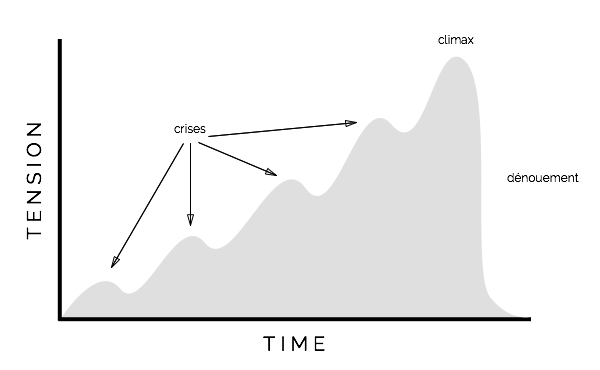
A dramatic gap occurs when the tension of your novel declines when it shouldn’t. The best way to identify these gaps is to draw the story arc as a graph line. Use different colours for subplots to check that the main plot isn’t being overshadowed.

You may encounter lulls in tension shortly after an obstacle is defeated. This is where dramatic lulls are okay as long as they don’t last too long. Overall, the main plot should be increasing in tension as it heads towards the climax.

Tension-and-Time-in-a-Story

If you’ve decided to use 1st person perspective, or are considering it, draw the arc from both a generalised view and then from the 1st person narrator’s perspective. From here you can see whether the delay or lack of knowledge from the narrator’s perspective creates a better dramatic arc. To fill dramatic gaps, build more plot points in strategic places and work on increasing tension.

If it seems that your story isn’t working, trust your instincts. Readers can tell when something is a bit off and, as a writer, you’re a reader too. Be honest if something isn’t working – it’s easier to fix now than later.

If you can’t identify the root of the problem, take a break or ask some trusted writing buddies to look over it. Also research the genre’s conventions. If you’re writing genre fiction, look into a tried and tested outline such as the hero’s journey or the eight-point arc.

***

Identify the Core Message (Theme)

Novels have a core message, whether it’s clear or not. You could successfully write your novel none the wiser of its deeper meanings. Yet, by knowing the core, you can write a stronger novel.

Identifying your core helps when you need to decide between two possibilities, and keeps the novel feeling as one whole piece of work.

“Novelists, just like filmmakers, need to truly understand the story they are trying to tell and what impact or take-home feeling or message they want to leave with their readers” – C. S. Lakin

Your core message and themes emerge naturally with your story and can be a phrase, a word or a question. You’ll instinctively know when you’ve hit on your novel’s core or when you’re getting close to it. Here are a few ways to help identify your core message if you don’t already know it:

  • Identify 1 – 4 central or important themes
  • Look at your protagonist’s goal / desire or main obstacle
  • Sum up your story in one sentence (i.e. “pitch”) keeping note of the above two points
  • Make a list of published novels you think are similar. Can you identify their core messages?
  • Share your story premise with others

Once you’ve identified your core, it’s helpful to go back and tweak plot points or characters to align with this. Be careful to not undermine your story by making the core too obvious or preachy.

Consider if there is a motif or style that is appropriate for your core. There’s a chance that you may not like the core message you identify. At this point you have the option to run with what the story says, or rework the aspects of your story that portray the undesired core message.

***

If you are enjoying this post and finding it useful, then don’t forget to check back tomorrow for the next instalment…

You can find the previous parts here: 

Via: http://writersedit.com/how-to-outline-your-novel-11-easy-steps/

How To Outline Your Novel | Part Two

writing

This week, as an extended Bank Holiday Bonus, we will be looking at how to outline your novel:

Taking the time to outline your novel can save you grief in the long run. An outline helps keep your story on-track and progressing past the initial thrill of beginning your work. Maybe you can’t wait to start writing, or maybe you’ve already started but are running into problems. This guide will explain all the techniques you’ll need to craft an effective outline for your novel.

***

Establish Your Settings

Setting is vital to every story. It helps a reader fall into your fiction world, even if your story is set in Earth-as-we-know-it. It can also be critical to the plot: imagine if Grandma’s house wasn’t deep in the woods. Little Red Riding Hood may never have met the Wolf.

The setting also tells the reader about your characters. If Little Red lived in a castle, she may have been more aware of dangerous people, and the Wolf’s motives may have been more than hunger.

Setting can become vague in writing when the writer doesn’t know their setting well. The same way you have character profiles, settings need profiles too. The process of planning your setting is slightly different if your story is set in a real place, though it follows the same general steps.

Before you get to know your setting, you need to choose your setting. If you’re stumped for ideas, the best place to look is in your plot. Setting is tightly linked to plot, primarily affecting what is possible. Does a character need to be or feel trapped? Go for a fort, boarding school, or a safe house in the middle of nowhere.

Usually your story will take place in more than one setting, so go through your plot and make note of the best setting for each scene.

When you start working on details of your setting, you may already have an idea in your mind – Victorian mansion, sea cliffs, military base, Sydney Opera House. Even if you feel familiar with the setting, go around with a camera or search images online.

Make note of what aspects you notice first: is the colour gaudy, do the edges look harsh, are there hundreds of trees? To mix elements of more than one setting, you can put the images in a document and make notes such as “this roof, but that balcony and a bluer colour”. Create a collage or bring out the sketchbook.

“Tear images out of home magazines or catalogs and put them on your vision board. You can also draw floorplans, which can help when you’re trying to navigate your character” – Charlotte Dixon

As mentioned by Charlotte Dixon, maps and floor plans are also a handy tool. If a character spends a lot of time in a building, you need to know the layout so they don’t come from the kitchen into the dining room one time and from the ballroom another.

Likewise, if they travel a lot or go outside to a certain place frequently, maps will help keep you orientated. Draw the street of your character’s favourite coffee shop; what will they see as they sip on their routine morning hot beverage?

Maps and floorplans can be drawn by hand on plain, lined or grid paper, or done in excel by changing the cell sizes to square. Grid is particularly useful for smaller buildings. It may not matter if your castle is 100 or 110 metres long, but there’s a big difference if a house is 10 or 20 metres.

For smaller buildings, also make sure that it is reasonable to fit all the furniture you describe in a single room. If you want to go the extra mile, there are also free 3D modelling programs such as Sketch Up, but generally simple 2D maps are enough.

You may also want to create a setting arc if it undergoes a serious change in the story. This would likely be either physical damage or a change in emotion or meaning. For the former, make notes of what is damaged, how it is damaged and the differences (such as being able to see through a hole in a wall).

Conversely, perhaps a damaged place was fixed or renovated. If the emotions connected to a place change, pick out the details. A sagging roof that once may have seemed a sign of degradation could simply add character.

***

Choose the Shape and Style of Narration

There are three narration shapes your plot can take: linear, non-linear and circular.

Linear narration is when the novel progresses in the typical chronological order. For example, Little Red leaves her house, meets the Wolf in the forest and then again in Grandma’s house.

Non-linear narration shakes things up a bit. In the case of Little Red Riding Hood, for example, Little Red meets the Wolf at Grandma’s, recalls meeting him earlier, is saved by the woodsman, recalls her mum telling her to be careful, and so on, backwards and forwards. Two well-known non-linear novels to have a look at are Catch-22 by Joseph Heller and The Time Traveler’s Wife by Audrey Niffenegger.

Circular narration starts and ends with the characters in the same place. This “place” can refer to a number of things such as a geographical location, an emotional or mental state, or a hierarchical position.

Whatever “place” means for the beginning and end, it should also be important in the middle. The novel The Chrysalids by John Wyndham starts with telepathic mutants being shunned by normal society. They attempt to create a safe place for themselves. However, when they find a whole town of telepaths, they’re looked down on again because of the weakness of their mutation.

If your novel is to be in a nonlinear or circular shape, it’s best to first craft your outline in a linear form. This makes it easier for you as the author to keep track of the story and helps prevent the plot from becoming confused and lost within itself.

“If you’re timebending or rewinding or flashbacking or Groundhog-daying or getting surreal or showing a series of vignettes that add up to a whole or chopping around like the film Memento, you the writer need to know what the simple order is” – Roz Morris

***

If you are enjoying this post and finding it useful, then don’t forget to check back tomorrow for the next instalment…

You can find the previous part here: 

Via: http://writersedit.com/how-to-outline-your-novel-11-easy-steps/