3 Essential Tips To Make Your Anti-Hero Effective

snape anti hero

“I’m often painted as the bad guy, and the artistic part of me wants to hand out the brush” – Criss Jami, Killosophy

Everyone loves a hero, like Hercules or Superman, who is pure of heart, fights for the good of everyone and always prevails. However, over time these types of characters can become mundane, their victories predictable and hollow. The audience knows the hero can never be defeated so they yearn for more to sink their teeth into. Enter the anti-hero.

The anti-hero is someone who is a protagonist but is lacking traditional heroic qualities. They will still have good intentions at heart for the most part but are afflicted by hamartia, a flaw in their character which dramatically complicates matters.

In some video games, a player can be asked to choose their character’s alignment; lawful good, true neutral, neutral evil, etc. An anti-hero would be classed as chaotic good, a person who will achieve their goals without regard for authority or law.

Because of the distinct character tics that anti-heroes possess they can be significantly more intriguing than a traditional hero who can do no wrong. This is because readers can connect with and relate to the anti-hero on a basic human level. They are how we often envision ourselves, and so they draw us in.

So how does one create an effective anti-hero and what are some examples? Here are 3 tactics to keep in mind when writing an anti-hero.

1. FLAWS

There are many different ways that the anti-hero can raise the ire of the audience.

  • They might be short of moral fibre, with their idea about the right way to do things decidedly different to everyone else’s. This is often the case with detective anti-heroes. The line between police and criminal blurs. An example here would be Inspector Rebus, in Ian Rankin’s novels, who is a borderline alcoholic and is forever being reprimanded for misconduct.
  • Self-doubt may paralyse them into constant failure. When the time comes to prove themselves or help those around them, they are unable to. A good example of this is Ron Weasley in the Harry Potter series. Time and time again Ron miscasts spells or loses his nerve.
  • They may have a massive chip on their shoulder, frowning upon the world. This gives them a cantankerous attitude towards the people around them. Hester Shaw from Mortal Engines personifies this with her fierce and often violent temper.
  • Foolhardy anti-heroes bumble along with positive intent but their actions are often laughable. A classic example is Don Quixote who was following a near impossible vision.
  • An anti-hero is sometimes an actual criminal but one who wants to be a better person than they are. A personal favourite is Driver in Drive by James Sallis which was made into a masterful film of the same name.

2. NOBLE INTENTIONS

Be careful not to push the envelope too far. Instil your character with too many undesirable traits and you risk getting the reader offside or even worse, turning your anti-hero into an outright villain. If your character traipses around hurting people or behaving badly without reason then they are not an anti-hero and the audience will fail to empathise with them. Even if they are seen to be working on the side of evil, such as Severus Snape in Harry Potter, they must have hidden agendas for good and show enough glimpses of this to keep them balanced.

There are many characters who tread a fine line between hero and villain. A very complicated anti-hero is Sula Peace in Sula by Toni Morrison. She is seen as the personification of evil by her hometown when she returns after a long absence. Her apparent disregard for social conventions have the town seething but little do they realise she is actually bringing the town together and improving their lives.

Another quintessential case is Bruce Robertson in Filth by Irvine Welsh. He is an alcoholic, drug addicted, violent, manipulative, masochistic, narcissistic man. A truly vile character that has the saving graces of being a law enforcement officer. He is slightly redeemed by the motivation he has for his family and there is sympathy to be found in his plight.  This brings us to the next consideration.

3. REDEEMING FEATURES

As much as the audience might be frustrated by the anti-hero they must also be delighted, charmed, or moved for the character to be a successful literary feature. Similarly to flaws, there are multiple avenues to explore in order to get the audience behind the heroes back.

  • An easy way to redeem your character is to give them a great sense of humour, be it dry wit, scathingly clever sarcasm, or more outlandish comedy. If the character can make the reader laugh they can’t be all bad. Arthur and Ford from The Hitchhikers Guide to the Galaxy qualify here.
  • The anti-hero can be decidedly charming and reassuring such as Jay Gatsby from The Great Gatsby who is living the American dream despite lying about everything.
  • They can be dashingly handsome and attractively dark. Think Don Draper in Mad Men.
  • They can even be quite brave to make up for other weaknesses. Bilbo in The Hobbit is greedy and his will is unable to withstand the ring causing him to retreat from Gandalf’s confidence but he is the most courageous of the party.

Put ‘simply’ the anti-hero is incredibly conflicted and complicated. Some of their actions would ordinarily mark them as evil but at heart they are always good. It is a difficult and nuanced task to create the perfect anti-hero. Push too far one way and you are left with a more one dimensional character which the audience will find either too pure and thus boring or too vile and thus inaccessible.

Further Reading

Here is a list of all the texts mentioned above (with a bonus extra) to provide plenty of valuable insight into anti-heroes.

  • The Hitchhiker’s Guide to the Galaxy (1979) by Douglas Adams
  • The Great Gatsby (1925) by F. Scott Fitzgerald
  • Sula (1973) by Toni Morrison
  • Inspector Rebus novels (1987-2013) by Ian Rankin
  • Mortal Engines (2001) by Phillip Reeve
  • Harry Potter series (1997- 2007) by J. K. Rowling
  • The Ingenious Gentleman Don Quixote of La Mancha (1612) by Miguel de Cervantes Saavedra
  • Drive (2005) by James Sallis
  • Olive Kitteridge (2008) by Elizabeth Strout
  • The Hobbit (1937) by J. R. R. Tolkien
  • Filth (1998) by Irvine Welsh

Via: https://writersedit.com/3-essential-tips-make-anti-hero-effective/

16 Books That Should Be On Your Radar: August 2017

books-radar-august-2017

Every month, the Writer’s Bone crew reviews or previews books they’ve read or want to read. This series may or may not also serve as a confessional for guilty pleasures and hipster novels only the brave would attempt. Here are their recommendations for August 2017:

  1. Hum If You Don’t Know The Words by Bianca Marais
  2. The Late Show by Michael Connelly
  3. Fierce Kingdom by Gin Phillips
  4. Of Mess And Moxie by Jen Hatmaker
  5. Killerjoy by Jon Negroni
  6. A Clean Kill In Tokyo by Barry Eisler
  7. The Road To Concord by J.L. Bell
  8. All The Bayou Stories End With Drowned by Erica Wright
  9. Mrs. Fletcher by Tom Perrotta
  10. I Was Told To Come Alone by Souad Mekhennet
  11. The Weight Of Blood by Laura Mchugh
  12. Into The Forest by Jean Hegland
  13. A House Among The Trees by Julia Glass
  14. A Distant View Of Everything by Alexander Mccall Smith
  15. The Elephants In My Backyard by Rajiv Surendra
  16. Everybody’s Son by Thrity Umrigar

Click on the links above for a detailed synopsis of each book, or follow the following link to see what the Writer’s Bone crew had to say: http://www.writersbone.com/book-recommendations/2017/8/3/17-books-that-should-be-on-your-radar-august-2017


10 Weird Habits Of Book-Lovers That Non-Readers Don’t Understand

weird habits of readers

We all have unique hobbies that come with their own set of quirks, but sometimes it seems that book lovers have some weird habits. Admit it: If you love to read, you have a long list of little things you do because of this hobby, and your friends who don’t share a love of books just don’t get it. You’ve tried to explain, but for some reason, non-readers sometimes just can’t relate to your bookish struggles. While they’re busy with their own hobbies, they’re staring at you wondering what in the world you’re doing.

Simultaneously, your fellow book lovers are staring at you because they’ve definitely been in your shoes before. I always feel an affinity with fellow readers, because I can’t help thinking that they understand a very important part of me, and I understand an important part of them. Which means we both understand the weirdness that comes with the territory.

Whether you love to read literary fiction, YA, nonfiction, or any other number of genres, just being a book lover puts you in a very special group of people. So never fear. We literature aficionados can completely understand all those weird habits that you have… even if non-readers don’t.

1. Leaving Books In Random Places

You have a bookshelf, but you’ve also left books in other (admittedly weird) places. It’s not unusual for you to wake up, roll over, and disturb a pile of novels you left amidst the covers. And pretty much every nook and cranny of your living space is full of books, because who can fit everything on a bookshelf??

2. Completely Missing A Conversation Because You’re Reading

Some people need peace and quiet to read, but you could lose yourself in a book and miss an entire conversation. Your friend could be abducted by an alien and return… and you’d still be reading when they got back.

3. Being Really Frugal… Except When It Comes To Books

You’re SO good with your money… until you walk into a bookstore. Suddenly, you’re just throwing stacks of bills at the cashier so you can get that beautiful copy of Pride and Prejudice that you NEED. Never mind the fact that you still have a TBR pile to rival the Leaning Tower of Pisa.

4. Spending Hours In A Bookstore Or Library

Speaking of bookstores, you could spend a lot of time in one. And libraries are basically black holes to you, because when you walk in, it’s the morning, and when you walk out, it’s dark outside. Still, you have no better happy place than a room full of books.

5. Talking For A Weirdly Long Time About The Smell Of Books

Every book lover has waxed poetic at one point or another about the smell of books. And when you pick up a new book in the bookstore, the first thing you do is give it a sniff. Ah, l’amour!

6. Talking About Fictional Characters As If They’re Real

You’ve had long, drawn-out conversations with fellow book lovers about fictional characters, as if they’re real people. Because in a way, they are real to you. And when non-readers ask who you’re talking about and you try to explain, they’re completely mystified by your intense dedication to the personal life of someone who exists only on the page. It’s fine; let them be confused. You know how much it matters.

7. Being Very Particular About How You Arrange Your Bookshelf

Maybe you arrange your bookshelf alphabetically, or by colour, or by a complicated system based on your current favourites. Whatever the system, you hate to have it disrupted, and you are very particular about the overall aesthetic of your bookshelf.

8. Getting Into Heated Arguments About Literature

If someone doesn’t like your favourite book, that is complete justification for an all-out argument. In fact, few things get you more heated than arguing about books. You can tolerate most things, but if your partner/friend doesn’t feel the same as you do, that’s grounds for divorce.

9. Having Strong Feelings About Book-To-Movie Adaptations

Speaking of book-related arguments, you’ve had a couple about book-to-movie adaptations. Whether you loved or hated the movie version, if your favourite book was turned into a movie, you probably have very strong feelings about it. (Also, you’re still upset that you weren’t asked to star in it.) You know exactly which bits they cut, and whether the dialogue was used word-for-word.

10. Packing A Suitcase Full Of Books

Yes, it is necessary to have two suitcases: one for clothes, and one for books. Because even if non-readers don’t understand, you know how important it is to always be prepared. And being prepared means having plenty of reading material at the ready.

Via: https://www.bustle.com/articles/172166-10-weird-habits-of-book-lovers-that-non-readers-dont-understand

Writing Prompts: Write A Letter

Letter-Dream-meaning

Make a character write a letter. Not an email. Not a text message. An actual letter. 

Who’s this letter to? Does the letter explain your character’s relationship to its recipient? Does the reader already know the recipient? Or have you used this opportunity to introduce a new character?

What does the letter say? Do you, as the writer, include the letter in full? In snippets? Or do you simply paraphrase what your character is writing and thinking?

Some ideas: 

  • Your protagonist could write a letter to you, the author. What would they say to you? Would they be grateful, or would they have a few bones to pick?;
  • Your protagonist could write to another character or the antagonist;
  • Your antagonist could write you a letter, or write to the protagonist or another character, and so on;
  • The recipient of the letter could also write back.

Make sure that this letter offers your readers something new, what is it that we’re learning? Everything has to happen for a reason in your story, is this purely to show a character trait? Is it a clue as to what happens later? Is it to put new pressure on the relationship between your characters? 

Whatever motivates the letter, make sure you are discovering something deeper about the character or characters involved. 

Happy writing! 

Via: https://writersedit.com/254/resources-for-writers/weekly-writing-prompt-4/

30 Ways To Start A Novel 

30-ways-to-start-a-novel.gif

There are many ways to start a novel, but sometimes how to begin just eludes you. Well, here are 30 possible ways to start a novel (or a scene, for that matter) to give you some inspiration:

1.The arrival of a letter, email, or package. (The Thirteenth Tale, Diane Setterfield.)
This could be momentous. However, it could simply tell the reader about the character’s everyday life, such as a distasteful private message on a dating site.

2. A main character in a frustrating situation.
This can also give the reader a feel for her everyday life, while making them empathise with her right away. Maybe her car has broken down, or her cat is puking.

3. A main character in an awkward or embarrassing situation.
Maybe her cat is puking on the lap of a visitor she was trying to impress.

4. The discovery of a dead body. (Thief of Shadows, Elizabeth Hoyt. Also about a million mysteries.)

5. The death of somebody in the family or the community. (All The Pretty Horses, Cormac McCarthy; The Known World, Edward P. Jones.)
This is a popular one, and understandably so, because an ending is a new beginning.

6. The beginning or the middle of a disaster. (All the Light We Cannot See, Anthony Doerr, kind of.)
It could be a bombing, a plane crash, or a tornado.

7. The aftermath of a disaster. (Their Eyes Were Watching God, Zora Neale Hurston.)

8. A kiss.

9. A performance, or the conclusion of one. (Bel Canto, Ann Patchett. This also has a kiss in it!)

10. A main character in the hospital. (Kindred, Octavia Butler.)

11. A main character declaring that he is in big trouble. (The Martian, Andy Weir.) The first line of The Martian is, “I’m pretty much fucked.” But your character’s situation could be somewhat less dire: “I had no chance of doing well that morning.”

12. A main character who’s clearly in big trouble. (What Is the What, Dave Eggers.)
She might be getting mugged or running from Nazi soldiers. Readers will start caring about her immediately.

13. The arrival of a plane, ship, or train. (The Count of Monte Cristo, Alexander Dumas.)
The character might be on board, or he might be watching it come in.

14. A scene at a party, a bar, or a nightclub. (War and Peace, Leo Tolstoy; The Name of the Wind, Patrick Rothfuss.)

15. A fight. (The Warrior, Zoë Archer.)
The character may be part of the fight, or just witnessing it.

16. A character moving in to a new place.
It could be a neighborhood, a dorm room, or a new country.

17. A broad statement about one’s life. (One For the Money, Janet Evanovich.)
One For the Money begins, “There are some men who enter a woman’s life and screw it up forever. Joseph Morelli did this to me — not forever, but periodically.” That’s a great hook.

18. A dramatic moment in the middle or end of the story. (The Secret History, Donna Tartt.)
You can begin here and then backtrack to explain how they got there. For instance, the prologue of The Secret History begins, “The snow in the mountains was melting and Bunny had been dead for several weeks before we came to understand the gravity of our situation.”

19. A trial in a courtroom. (Snow Falling on Cedars, David Guterson; also an example of #18.)
A milder version of this could be your character faces a judge or jury in the form of a parent, a manager, or a peer.

20. A job interview.
I really like this idea because you could get a lot of information across about your character naturally. She might be giving appropriate answers while her internal monologue tells you the rest of the story. Also, an applicant at a job interview is in a vulnerable position, which I think would create empathy for your heroine right away.

21. A main character meets someone new. (Wuthering Heights, Emily Brontë)
A stray cat? A future lover? Someone important, probably.

22. A street scene. (Perdido Street Station, China Miéville.)
Your character could be getting an errand done or going to visit somebody. For a novel that takes place in an historical, futuristic, or fantasy setting, this can be a good way to establish a sense of place as well as establish your character’s normal life and priorities.

23. A main character in a triumphant situation.
Set her up before you knock her down. She could be giving a speech, winning a race, or accepting an award. It could also be a smaller personal triumph, such as successfully fixing a car or turning in her term paper on time.

24. A character or characters getting dressed, shaving, putting makeup on, or doing their hair. (The Makioka Sisters, Junichiro Tanizaki.)

25. A big, happy occasion such as a wedding or a graduation.
Of course, it might or might not be happy for your main character, who may be a participant or someone in the audience.

26. One character teaching another how to do something.
This is another way to establish your main character’s personality and his everyday life. If he’s a father, he could be teaching his son to hunt or to cook rice properly. If he’s an insurance salesperson, he could be giving the new guy some tips.

27. A visitor showing up at the door. (The Big Sleep, Raymond Chandler.)
The main character might be the visitor or the person answering the door.

28. A main character coming across a significant object.
It could be a photograph of a lover she intended to forget, or strange relic that turns out to be magical.

29. A character committing a crime.
He might be the main character, or he might be the antagonist.

30. A character or characters completing a task. (Our Mutual Friend, Charles Dickens.)
This could be an unusual or startling task, or a more ordinary one with emotional significance.

By now, your creative juices should be spilling over. So hop to it! 🙂

Via: http://bryndonovan.com/

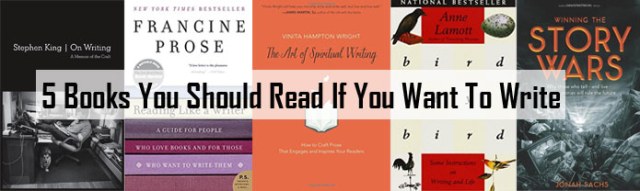
5 Books You Should Read If You Want To Write

5-books-you-should-read-to-write

You have no doubt heard it said over and over again, in order to write, you need to read. Probably the most famous person who says this is Stephen King. And to be fair, if Stephen says it’s true, who am I to argue. The following are 5 top books you should read if you want to write. There are of course many, many others, but these are a good place to start:

1. ON WRITING BY STEPHEN KING

This is a fantastic book on writing. I love Stephen King, and in this book he describes his personal writing process as well as making suggestions for other writers. King is careful to focus mainly on his own journey and not offer blanket statements about writing which may not work for everyone. I really enjoyed the anecdotes and no-nonsense approach to what it takes to be a writer.

2. READING LIKE A WRITER BY FRANCINE PROSE

The premise of this book is firmly founded on the mantra: in order to write, you need to read. Read anything and everything you can get your hands on. Reading the writing of a wide variety of authors allows you to be exposed to different voices, different perspectives, and different ideas. When I was younger, I read nonstop and I’m grateful for the time I put in to each and every one of those books because they taught me how to tell stories.

Prose breaks down her book, Reading Like A Writer, into chapters devoted to different literary devices such as paragraphs, narration, character, dialogue, etc. and offers different excerpts in order for you to read closely and pay attention to what the author is trying to do in his or her work. It’s more of a guidebook than a narration on personal experience, but equally important in order to learn how to focus on all of the different aspects of writing.

3. THE ART OF SPIRITUAL WRITING BY VINITA HAMPTON WRIGHT

I like this book because it is a) short (161 pages) and b) speaks of the importance of authenticity in writing. It is important to share experience and talk about things that are uncomfortable because it’s a way of connecting with others.

Hampton Wright takes her decades of experience as both an editor and an author and lays out a writing manual that describes the best way to write from the heart and inspire other people. It contains both technical writing information as well as advice about what she terms “spiritual writing”.

4. BIRD BY BIRD BY ANNE LAMOTT

This is another great book that contains both suggestions and experiences similar to that of King in On Writing. What I like about it is that it’s even more no-nonsense than King’s book and also goes out of the way to dispel a lot of myths that people have concerning the writing and publishing process.

Be warned, this book does not sugar coats things, which is important in managing expectations. Many people operate under misconceptions that could ultimately harm them if they are seriously trying to make a living as a writer. Lamott is funny, but real, and it’s a quick and entertaining read.

5. WINNING THE STORY WARS BY JONAH SACHS

This book not only appeals to writers, but also marketers and business owners. Sachs writes under the conception that those who tell the best stories will “rule the future”. What he means by that is that in a sea of advertisements, personal stories, social media, and other brand messages, it’s hard for a person or company to get their story out. Writing in a way that breaks through that wall will help your message and your brand gain traction.

Sachs relies on examples from mythology, psychology, the history of advertising, and even biology to push for a revolution of story telling. He offers advice on how to get your story out above the crowd and make others take notice. Along with academia and personal anecdotes, it’s a great book to inspire you to do more with your writing. It’s also a great read for bloggers who are aiming at strengthening their own personal brand and breaking through the noise of millions of other existing blogs.

***

Happy reading! 🙂

Tips for Writing Round Characters

Writing-4

I’ve never had a character come to me fully formed and ready to go. They come to me like ghosts and I have to make them real by getting to know them over time. Creating (good) characters is hard work, but when you take the time and effort to make them ’round’ it’s always worth it.

So what is a ’round’ character? E.M Forster wrote in Aspects of the Novel, that:

“The test of a round character is whether it is capable of surprising in a convincing way. If it never surprises, it is flat… It has an incalculability of life about it – life within the pages of a book.”

Someone once told me that if you can imagine the character existing outside of the novel, if they have lives that reach beyond their role in the book’s plot, they’re round. It’s all about putting life back in those ghostly figures that first appear.

But it’s not always so easy to create a round character. One approach is to let the characters reveal themselves to you, to really sit down and get to know them.

Ask questions.

Write out a set of questions for your character and conduct a kind of interview. This gets your brain thinking about all sorts of random details that you can use for background info to help round out your character. If you’re not sure what to ask, check out this list of possible questions.

HINT: This works even better if you don’t know the questions beforehand. Have a friend do the asking – it’ll keep you on your toes!

Have a chat.

Imagine physically meeting your character for the first time (maybe in a cafe, or at the library – it depends on the character). How does the conversation begin? How do they respond to you? This is great for picking up body language and visualisations about the character.

HINT: It’s not recommended to tell people who aren’t writers that you’ve been ‘talking with your characters’. They just don’t get it. Believe me.

Fill out a job application.

This idea comes from an article on The Write Practice. It’s a great way to work out the facts about a character. Don’t forget the important yet sometimes over looked details like age, date of birth, and previous work history.

HINT: As the article says, don’t hesitate to add more parts to the job application and really scrutinise your character.

Write a letter.

Not many people write letters anymore, so this is a great way to learn more about your character’s motivations, their past, their friends, and so on. It’s a good exercise for creating tone and voice as well as vocabulary.

HINT: Don’t post it!

***

Happy writing 🙂

Via: http://writersedit.com/resources-for-writers/4-tips-writing-round-characters/

13 Struggles Only Unpublished Fiction Writers Understand

unpublished writers srtuggles

First things first. This isn’t an article for all y’all fiction writers who have actually been published. I’m sure you have your problems, but this post is not for you, you beautiful, successful monsters. This post is for the semi-clueless writers whose hearts are still full of hope, with their Word docs full of nonsense plot outlines and six different versions of the same abandoned manuscript. This is for anyone and everyone who is writing a book right now and has no idea what the hell they’re doing, because that’s where I’m at too. If you’re riding on this struggle-bus with me, you know all of these struggles way too well:

1. You never have time to write

Apparently you have to work to pay rent? And see people to maintain friendships? Also, laundry gets dirty, plates don’t wash themselves, and the fridge is not filled by fairies? What! Does not compute???

2. Just kidding — you do have time, and you waste it like nobody’s business

*scrolls into the Twitter abyss*

*calls mum for a catch up*

*finds the lost portal to Narnia*

Oh man, no time to write! Better luck tomorrow.

3. The conditions have to be ‘just so’ when you’re writing

When there’s no pressure, you can write upside down strapped to a rocket. When you’re writing The Novel That Will Make You As Famous As J.K. Rowling, So Help You God, then you need to have a candle burning, a half glass of red wine at your side, and a chimpanzee playing the violin before you’ll even think about opening your laptop.

4. You’re constantly daydreaming about your characters

I’ve apologised to at least ten different stationary objects that I’ve walked into this month alone.

5. You keep getting 40,000 words into something and then immediately want to burn it down

BURN IT ALL DOWN. (Or rename it “ZZZZZ” so it hits the bottom of your Docs folder and you never have to see its ugly mug again.)

6. Whenever someone asks you what kind of story you’re working on, you make this face…

bustle pic 1 face.gif

Which basically says “It’s just this little dumb stupid terrible awful horrible story I’m working on, sort of, kind of, maybe.”

7. And whenever someone asks to read what you’re working on, you make THIS face…

bustle pic 2 face.gif

Whilst thinking “OVER MY DEAD BODY. (Nobody has to read this for it to get published, right? Right??)”.

8. And yet, you’re genuinely concerned about casting the movie for this book you haven’t even finished

Is [insert favourite actor/actress here] available and will they remain available for the next 10-15 years while I’m getting my sh*t together?

9. Friends you didn’t even know were writing a book end up getting published before you do

Congrats, by the way. Can’t wait to read it and love it and eat an entire pack of Oreos consoling myself, you talented pain in the ass.

10. Every 3 weeks or so you are thoroughly convinced that your ideas suck, everything is crap and what the hell were you even thinking?!

Writers are totally emotionally stable, though!! Honestly, we’re fine!! Everything’s great!!!!!!!!! (Help.)

11. Writer’s block is some real sauce

You can stare at that blank page for hours, and end up typing every random word you can think of in the futile quest for inspiration. You start a sentence, and delete it. Get up and make a drink. Type another sentence. Delete it. At the end of the day you have a blank page and a headache from banging your head on the wall. And it’s not like you can talk to anybody about it, because then you’d have to actually admit that you were writing something in the first place.

12. Nobody but you actually cares

Like, you’re a nobody. You have no deadlines, no expectations, and no cheerleaders to provide that much needed praise and admiration for the stinking pile of dog-poop you’re writing. So you are forced to plod on, without reward. Most likely most days you feel dead inside. TELL ME I’M PRETTY, INTERNET.

13. You actually have no freaking idea what to do when you’re done with this giant thing you made

bustle pic 3 face

Click your heels three times, blow some glitter on your manuscript and hope for the best! According to the internet, the “real work” in getting published hasn’t even begun yet.

***

Via: https://www.bustle.com/articles/101031-13-struggles-only-unpublished-fiction-writers-understand