Create Compelling Characters With These 3 Types of Character Arcs

Characters2

We all know that crafting believable characters with strong motivations is vital in fiction writing. But how do you ensure that your characters remain compelling throughout the course of your story?

The answer is simple: make sure they all have strong character arcs.

What is a character arc?

A character arc is basically the journey a character undertakes over the course of a story. But this doesn’t mean a physical journey.

We’re talking about an inner journey: one that makes a character grow, learn, change, evolve, or even completely transform as the story unfolds.

Generally, this means that a character begins the story as one person, transforms, grows or changes throughout, and ends the story as a different sort of person. In other words, a round character.

Think of it this way: all good stories revolve around conflict. This usually comes in the form of obstacles, both external and internal, that a character must overcome. In order to overcome the obstacles, the character needs to grow or change in some way. And that’s where the character arc comes in.

Obviously, no two character arcs in fiction are exactly the same. But there are three basic archetypes that the majority of character arcs fall into.

Let’s take a look at those now.


The 3 basic types of character arcs

1. Change/transformation arc

The first and perhaps most common arc is one of change and/or complete transformation. It goes hand-in-hand with the hero’s journey – a plot structure found in more books and films than you can count.

This character arc involves a complete change from ‘regular’ person to hero or saviour. Usually reserved for main characters/protagonists, the change/transformation arc usually begins with a plain old ordinary person who’s something of an underdog, or at least seems rather unlikely to be saving the world anytime soon.

However, as the story unfolds, this character undergoes a transformation – usually quite a radical one. Drawing on some inner strength, talent or drive they didn’t know they had, the character ultimately achieves success in what they’ve set out to do – and basically becomes a completely different person in the process.

Well-known examples of this type of character arc include:

  • Harry Potter in the Harry Potter series
  • Bilbo Baggins in The Hobbit
  • Luke Skywalker in the Star Wars series
  • Katniss Everdeen in The Hunger Games series

As you may notice, this character arc is perhaps most common in genre fiction such as fantasy or sci-fi. This is largely due to the mythic/epic quality of the ‘hero’s journey’ narrative – the theory of which has its origins in studies of mythology.

Writing a change/transformation arc

Perhaps the most useful concept to keep in mind when writing this type of arc is that of the lie your character believes.

Most, if not all change arcs involve the character in question believing a particular lie or misconception about themselves or the world around them. The character then discovers the truth, and the way they react to this discovery – how they change in the face of it – forms the basis of their character arc.

This doesn’t necessarily have to be a single lie or misconception, especially if the character arc stretches across multiple books in a series.

In the Harry Potter series, for example, the initial ‘lie’ that Harry believes is a literal lie told to him by the Dursleys: that he is an ordinary boy whose parents died in a car crash. He soon discovers the truth: that he is actually a wizard, and that he survived an attack from an evil wizard who killed his parents.

This sets off Harry’s character arc – his transformation from ordinary boy to brave, world-saving wizard who defeats Lord Voldemort. However, there are many more ‘lies’ that shape and reinforce his arc throughout the series, such as his perception of Severus Snape and the major reveal about his fate as one of Voldemort’s Horcruxes.

So when writing a change/transformation arc, ask yourself: what lie or lies does my character believe? How will they discover the truth? And how will this discovery lead them to change or be completely transformed as a person?

2. Growth arc

This type of arc is different from the above, in that the character grows, but does not necessarily undergo a complete change or transformation.

By the end of the story, they are still essentially the same person, but they have overcome something within themselves. As a result, they are a better or more rounded person, or simply different in some way.

Growth can also be achieved by the character changing their perspective, learning something new, or having a different role by the end of the story.

Basically, this arc is a little more subtle than the ‘hero’s journey’-style arc; in a growth arc, the character won’t end up being the saviour of the universe, but they will have grown, developed and changed in some way.

Well-known examples of this type of character arc include:

  • Elizabeth Bennett in Pride and Prejudice
  • Nick Carraway in The Great Gatsby
  • Jaime Lannister in the A Song of Ice and Fire/Game of Thrones series
  • Samwise Gamgee in The Lord of the Rings series

Just as the change/transformation arc is used most often in sci-fi and fantasy, the growth arc tends to be more common in literary fiction (but, being perhaps the most ‘general’ type of character arc, it’s found across all genres and styles).

Writing a growth arc

Growth arcs work particularly well for secondary characters, especially if your main character is undergoing a complete change/transformation arc. Samwise Gamgee in The Lord of the Rings, for example, experiences a growth arc, while the main protagonist Frodo Baggins undergoes more of a transformation.

While Frodo is totally and irrevocably changed by his experience with the One Ring – symbolised by him leaving the Shire to find peace instead in the Undying Lands – Sam is essentially the same hobbit after his journey, albeit a wiser and more weathered one. He returns to life in the Shire, different but not totally transformed.

When writing growth arcs, compare your character at the beginning and end of the story and ask yourself: at their core, are they essentially the same person? Would they be able to return to ‘regular life’, just with a different perspective, worldview or way of doing things?

As long as your character has learned something, changed their perspective, or improved an aspect of themselves throughout the story, they’ve experienced a growth arc – even if, in their heart, they’re the same homely hobbit they’ve always been.

3. Fall arc

While the above two types of character arc are generally positive, this is a negative arc. It involves the decline or ‘fall’ of a character through bad choices they have made, which ultimately doom them (and potentially others).

By the end of this arc, the character has usually either died, become corrupted, or lost their mind (or if they’re lucky, all three). They have likely ruined their own life as well as the lives of others, and have experienced no redemption or salvation – only downfall.

In the most extreme form of the ‘fall’ arc, the character begins the story as a good/happy/successful person, but by the end of the story is completely unrecognisable – basically the polar opposite of the positive change/transformation arc we discussed above.

Well-known examples of this type of character arc include:

  • Walter White in Breaking Bad
  • Hamlet in Shakespeare’s Hamlet
  • Anakin Skywalker/Darth Vader in the Star Wars series
  • Dorian Gray in The Picture of Dorian Gray

This type of arc is seen a lot in classic tragedy, but is also common in modern literature and film.

Writing a fall arc

Author K. M. Weiland posits that there are three sub-types when it comes to this arc:

  • ‘Typical’ fall – the character changes for the worse through bad decisions.
  • Corruption – the character changes for the worse but ends up embracing the change.
  • Disillusionment – the character discovers a truth about the world that leaves them unhappy or bitter at the end of the story. (This type is sometimes better applied to the growth style of arc, as it doesn’t necessarily involve a complete transformation, just a change of perspective within the character.)

Fall arcs are perhaps most commonly used in creating villains. They’re particularly effective when the character begins as someone who could be perceived as the hero, but undergoes a negative transformation and becomes a villain or antagonist instead (plot twist!).

When writing a fall arc, it helps to consider whether you want readers to be sympathetic to your character. If so, perhaps go down the route of a traditional ‘fall’ arc or a disillusionment; if not, you can create a full corruption arc, in which the character is as terrible as they come!

Be sure to keep things realistic when it comes to character motivations, though – there’s no point giving a character a negative or ‘villain’ arc if there aren’t believable motivations behind it.


A note on flat character arcs

Something to remember: not all characters need to experience a major, defined character arc.

Flat character arcs, while much less common than the types we’ve discussed above, do exist. They involve no change or growth within the character, who’s exactly the same at the end of the story as they were at the beginning.

Flat character arcs are most often found within certain genres, such as mystery (e.g. Sherlock Holmes), adventure (e.g. Indiana Jones), and spy thriller (e.g. Jack Reacher, James Bond).

However, flat character arcs can and do exist within all genres and styles of story. Many minor characters experience flat arcs, leaving the more defined arcs for the protagonist and other main characters.

An important note, though: be careful not to confuse a flat character arc with a lack of development for your character. Sometimes, if your character’s arc appears quite static, it means they are underdeveloped and that their journey and characterisation need to be more compelling – especially if they are a major character.

***

Happy writing!

Via: https://writersedit.com/fiction-writing/create-compelling-characters-character-arcs/

Zadie Smith’s 10 Rules of Writing

zadiesmith5

Zadie Smith (Photograph: Francesco Guidicini)

In the winter of 2010, inspired by Elmore Leonard’s 10 rules of writing published in The New York Times nearly a decade earlier, The Guardian reached out to some of today’s most celebrated authors and asked them to each offer his or her rules. My favourite is Zadie Smith’s list — an exquisite balance of the practical, the philosophical, and the poetic, and a fine addition to this ongoing omnibus of great writers’ advice on the craft.

Smith counsels:

  1. When still a child, make sure you read a lot of books. Spend more time doing this than anything else.
  2. When an adult, try to read your own work as a stranger would read it, or even better, as an enemy would.
  3. Don’t romanticise your ‘vocation.’ You can either write good sentences or you can’t. There is no ‘writer’s lifestyle.’ All that matters is what you leave on the page.
  4. Avoid your weaknesses. But do this without telling yourself that the things you can’t do aren’t worth doing. Don’t mask self-doubt with contempt.
  5. Leave a decent space of time between writing something and editing it.
  6. Avoid cliques, gangs, groups. The presence of a crowd won’t make your writing any better than it is.
  7. Work on a computer that is disconnected from the ­internet.
  8. Protect the time and space in which you write. Keep everybody away from it, even the people who are most important to you.
  9. Don’t confuse honours with achievement.
  10. Tell the truth through whichever veil comes to hand — but tell it. Resign yourself to the lifelong sadness that comes from never ­being satisfied.

Happy writing!

***

Via: https://www.brainpickings.org/zadie-smith-10-rules-of-writing/


How To Plan Your Novel Using The Three-Act Structure

Three-act-structure_1

Writing a novel is hard, especially if you’ve never done it before. You’ve spent hours researching, building your world and becoming an expert on your characters. Now you’re ready for the next step: planning (also known as plotting).

While some people like to write organically (letting the story take you in whatever direction feels right), having a detailed outline can help make the novel-writing process a lot less daunting and overwhelming. But how exactly do you plan a novel?

Essentially, there is no right or wrong way to outline your novel. Each story is different and needs to be told in a different way.

However, if you need a bit more guidance on how to plot out the next bestseller you know you have inside you, the three-act structure might be for you.

Defining The Three-Act Structure

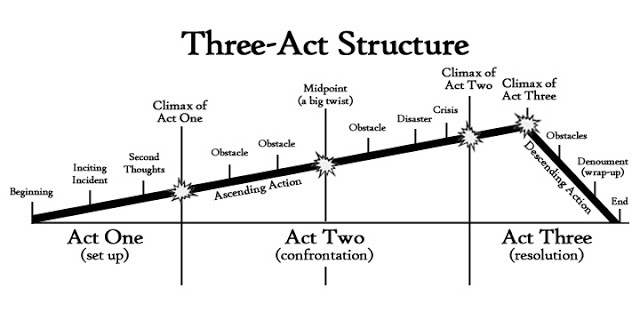
The three-act structure is a popular screenwriting technique that revolves around constantly creating set-ups, conflicts and resolutions. With this structure, a novel is divided into three acts: a beginning, a middle and an end.

There are many versions of the three-act structure. In some, the middle is the same size as the beginning and end put together.

However, when you’re first starting out, it’s much easier to plan each act to be the same length. In this version of the three-act structure, each act is divided into nine chapters for 27 chapters in total. The nine chapters in each act are also split into three blocks of three chapters each.

This version creates a fast-paced novel that invites readers to keep turning your pages. If you’re still unconvinced, for an example Suzanne Collins’ bestselling young adult Hunger Games trilogy follows this structure almost perfectly.

Throughout this article, we’ll take a look at what each section of the three-act structure involves, using examples from The Hunger Games to demonstrate each element. (SPOILER ALERT: If you haven’t read or seen The Hunger Games and don’t want key plot points spoiled, read on at your own risk!)

Act One (set-up)

The first act is used to introduce the reader to the world your characters live in and to set up the coming conflict.

Block One – Introduce Hero in Ordinary World

  • Chapter 1: Introduction (set up)
  • Chapter 2: Inciting incident (conflict)
  • Chapter 3: Immediate reaction (resolution)

In the first chapter, you need to set up your hero in their ordinary world. Introduce us to your characters and the relationships and conflicts between them. In The Hunger Games, the first chapter introduces the dystopian world and the Reaping.

The inciting incident in Chapter Two is the event or decision that sets your hero along the path of your narrative. The inciting incident is really important – without it, your story would not occur. The inciting incident in The Hunger Games is Katniss volunteering herself for the Hunger Games to save her sister; if Katniss didn’t volunteer, the rest of the novel would not have happened.

In the third chapter, the hero reacts to the inciting incident. The immediate reaction in The Hunger Games is when Katniss’ family and friends come to say goodbye to her before she leaves for the Games.

Block Two – Problem Disrupts Hero’s Life

  • Chapter 4: Reaction (set-up)
  • Chapter 5: Action (conflict)
  • Chapter 6: Consequence (resolution)

Chapter Four is where the hero reacts to and reflects on the long-term impacts of the inciting incident. In Chapter Four, Katniss reflects on the impact her death would have on her community, especially her mother and sister. Katniss also starts to discuss strategy with Haymitch, her mentor.

As a result of their reflection, the hero decides to take action and do something to change their situation in Chapter Five. In The Hunger Games, Katniss takes her first step towards winning the Games in the parade of tributes. Her fiery dress and attitude win over the crowd.

Chapter Six details the immediate consequences of the action the hero took in Chapter Five. In The Hunger Games, Katniss discusses the success of the parade with Haymitch. She also reflects on her past and the difficulty of rebellion.

Block Three – Hero’s Life Changes Direction

  • Chapter 7: Pressure (set-up)
  • Chapter 8: Pinch (conflict)
  • Chapter 9: Push (resolution)

The hero’s life has changed as a result of the action they took in Chapter Five, and this creates a lot of pressure and stress in Chapter Seven. The pressure is obvious in Chapter Seven of The Hunger Games. Here, Katniss has her demonstration where she shows the Gamemakers her archery skills by shooting an arrow towards them in frustration.

In Chapter Eight, the first pinch – or plot twist – occurs. A good plot twist is something completely unexpected for the reader. The first pinch in The Hunger Games is Katniss receiving a score of 11, something completely unexpected.

As a result of the pinch, the hero is pushed into a new world in Chapter Nine. The majority of this chapter in The Hunger Games centres around the television interviews with Caesar, the last formality before the tributes are sent into the Games. Here, Peeta declares his love for Katniss.

Act Two (conflict)

The second act is full of conflict. Character development is crucial in the second act; the hero at the end of Act One does not yet have the tools (whether those tools be emotional, physical or literal items the hero must retrieve) to succeed in the third act, so Act Two is all about the journey.

Block Four – Hero Explores New World

  • Chapter 10: New world (set-up)
  • Chapter 11: Fun and games (event/conflict)
  • Chapter 12: Old world contrast (resolution)

Chapter 10 allows you to introduce the reader to the new world. What has changed, and how does the hero feel about it? In Chapter 10, Katniss finally enters the Hunger Games.

In Chapter 11, the hero can take a break and have a little fun. Maybe they have a date with their new lover, or maybe they do something they’ve never done before. Here, Katniss travels through the arena looking for water, and while she is still in an intense environment, she has a bit of a break.

Chapter 12 is time for the hero to compare their current world to how things were at the novel’s beginning. After realising Peeta has teamed up with her enemies, Katniss reflects on their relationship and compares this Peeta to the person she was friends with.

Block Five – Crisis of New World

  • Chapter 13: Build-up (set-up)
  • Chapter 14: Midpoint (conflict)
  • Chapter 15: Reversal (resolution)

The fifth block is all about the midpoint, or the main crisis or conflict of your novel.

Chapter 13 is the build-up to the midpoint and Chapter 14 is the midpoint itself. A good midpoint will dramatically change the hero or impact their life in a negative way. In The Hunger Games, Katniss is pushed towards the Career tributes in Chapter 13, and escapes from them after Peeta saves her in Chapter 14.

Chapter 15 is the immediate reaction or consequence of the midpoint. Here, Katniss makes an alliance with Rue and they formulate a plan to take down the Career tributes.

Block Six – Finding a Solution

  • Chapter 16: Reaction (set-up)
  • Chapter 17: Action (conflict)
  • Chapter 18: Dedication (resolution)

In Chapter 16, the hero reflects on the long-term impacts of the midpoint. In The Hunger Games, Katniss realises that to take down the Careers, they need to stop their food supply.

In Chapter 17, the hero decides to take action to resolve the problem created by the midpoint; however, they realise the enormity of their task when things don’t necessarily go to plan. In Chapter 17, Katniss blows up the Career’s food supply, but before she and Rue can celebrate, Rue is attacked by another tribute.

Despite the set-backs, in Chapter 18 the hero decides that they will succeed no matter what. Rue dies in Chapter 18, and Katniss promises to win for her.

Act Three (resolution)

The final act is all about resolutions. In the third act, the hero needs to find solutions to the conflict created by the midpoint, and you as the author need to make sure you tie up all the loose ends.

Block Seven – Victory Seems Impossible

  • Chapter 19: Trials (set-up)
  • Chapter 20: Pinch (event/conflict)
  • Chapter 21: Darkest moment (resolution)

In Chapter 19, the hero faces significant trials. These trials are extremely difficult for the hero and is something the hero has never experienced before. Here, Katniss races to find Peeta and struggles to help save his injured leg.

Chapter 20 is the second pinch, where the hero experiences something completely unexpected that makes everything even worse. In Chapter 20, Peeta’s injury leads to blood poisoning.

This plot twist leads to the darkest moment in Chapter 21 where the thought of success is incomprehensible. Here, Katniss risks everything to get medicine for Peeta, and the chapter ends with her passing out from her own injuries.

Block Eight – Hero Finds Power

  • Chapter 22: Power within (set-up)
  • Chapter 23: Action (conflict)
  • Chapter 24: Converge (resolution)

Having hit rock-bottom, the hero remembers their desire to succeed in Chapter 18 and finds the power within to continue on. In Chapter 22, Katniss and Peeta both start to recover from their injuries.

After deciding they can do it, the hero takes action in Chapter 23, and this action causes the plotlines to converge and come together in Chapter 24. In Chapter 23, Peeta and Katniss realise how close they are to winning, and in Chapter 24 all of the tributes are pushed towards the lake by the Gamemakers for the final battle.

Block Nine – Hero Fights and Wins

  • Chapter 25: Battle (set-up)
  • Chapter 26: Climax (conflict)
  • Chapter 27: Resolution (resolution)

Block nine is the finale. In Chapter 25, the character has one last battle. This doesn’t have to be a physical battle – it could be a fight between friends or lovers, or a mental battle your hero has with themselves. Here, Peeta and Katniss try to survive the freezing night and kill Cato.

Chapter 26 is the final climax. The decisions the hero makes here will impact the rest of their life; it is the point of no return. In The Hunger Games, Katniss and Peeta pretend to eat the poisonous berries, which leads to President Snow stopping them by declaring them both winners. However, Katniss realises that despite winning the Games, she’s now in even more danger.

Chapter 27 is the resolution or the immediate reaction to the hero’s decision in the last chapter. Here, Katniss and Peeta finally get to go home.

The way you end your novel is up to you. You might choose to explain everything, or leave some things (or a lot of things) up to your reader’s imagination. It could be a happy heroic ending, or it could be a tragedy where everyone dies.

Either way, congratulations! You’ve planned a novel.

***

One last thing to note: When you start to plan your novel using this structure it’s important to remember it’s just a guideline. You don’t have to change your story to suit the structure; you can change the structure to suit your story. If your plot twist would make more sense earlier or later, move it. These aren’t hard rules. Do what is right for your story.  So take a deep breath, set yourself up in your favourite place to write and start planning!

Via: https://writersedit.com/plan-novel-using-three-act-structure/

7 Steps to Tackle Your Screenplay Rewrite

Screenwriting

The most important thing I tell any writer who is embarking on writing their screenplay is to just plow through and get that first draft done.  Here’s the rub though.  Finishing that first draft is only the beginning of the journey for you as a writer.

If there is one thing I know… it’s that the first draft of your script is ALWAYS going to be terrible. Don’t worry. That’s okay. Quality is never your goal with the first draft.  The goal is to scoop those ideas out of your brain, put them on paper and get the structure of your story on the page. When you finally get that glorious awful first draft completed, this is where the real work begins.

1) Put it in a drawer

The last thing you want to do is immediately re-read your goopy brain-droppings after you clickity-clack that final Fade to Black. Your mind needs time to decompress. So find a drawer, put your script in said drawer, and leave it alone until you have a nice solid layer of dust on the cover page which you can blow off like Indiana Jones finding an artifact in some cave in Indonesia.

2) Print that puppy out

It’s been a few weeks and you’re finally able to take a look at that crap you wrote. Don’t use the computer. Print it out. Find your favourite colored felt tip pen and mark that sucker up. You’re bound to find a billion grammar mistakes, missing words, wrong names, etc. But you’ll also figure out scenes that aren’t working and characters who need improvement. New ideas will pop out and make your story work better. You will punch yourself in the face for not thinking of them the first time you wrote this garbage pile, but that’s okay. This is the evolution of the rewrite.

3) Make a New Outline

As you prep to do your first rewrite, open up a notes doc and make an outline (or beat sheet) of everything currently happening in your scrip. This will help you discover everything you need to happen in your next draft. By giving yourself a thorough roadmap for your rewrite, when you dive in, you will know where you need to go to improve all your elements. That said, don’t be afraid to stray from your roadmap. It is good to create new scenes that flow from your fingertips stream of conscious. Some of your best ideas happen in the moment, and are unplanned. If you can surprise yourself, you can surprise your audience.

4) Lather, Rinse and Repeat

After you’ve gotten through that second draft, that now doesn’t completely suck, there’s one thing you need to remind yourself. This still is not good enough to show people. You need to put it back in that drawer. You need to go do something else for a few weeks until you’ve completely forgotten everything you did, and then pull it out and repeat Steps 1-3. How many times you’ll have to repeat these steps, I cannot tell you, but you’ll eventually know when your script is ready to show to someone.

5) Get Notes

Once you finally have a draft that feels pretty good to you, it’s time to show it to a trusted group of readers who know you well enough to tell you how awful your screenplay is without totally destroying your confidence. While you may think your ideas are amazing, if other people don’t find the execution of them equally as amazing… then they might not be to the level you need them to be. Getting people’s’ feedback and applying that feedback to your script is a crucial step.

You must be able to take constructive criticism. You don’t want someone to read your fourth draft script and say “that was great” and not get any notes. Your script always needs work. Most scripts are being worked on while they are shooting the movie. Yours is no different.

Now, that doesn’t mean you have to take EVERY note. A lot of times, I’ll use this rule: if someone gives me a note I don’t agree with, I’ll ignore it for the time being. However, if three people give me that same note, then I know there’s a problem that needs fixing.

6) Have a Reading

Now that you’ve applied all of your notes to the script, it’s time to assemble a group of actors and read your script out loud and have a discussion of the story. Many times, it is an actor who gets a script bought, sold, greenlit, etc. So you need to make sure EVERY character is attractive to the actors who will play the role. Sometimes, you’ll get a tiny note that will make a world of difference when your screenplay finds itself on the desk of a studio reader.

7) The Final Draft

After you’ve squeezed every last drop of creativity from your brain onto the page, and you have done your final grammar pass, and incorporated all of your friends notes, you are ready to give the script to your agent, or producer for review. If you have done your job, their notes will be minimal and getting it into the hands of people who want to buy your screenplay will be the next step to achieve the truly fun and exciting part of being a writer… and that’s doing another rewrite with a director and a star.

In conclusion…

This is the process that works for me.  I hope it works for you.  Good luck!  Now go write that terrible, horrible, no good, very bad first draft of your screenplay.

***

Via: https://screenwritingumagazine.com/2017/12/04/7-steps-tackle-screenplay-rewrite/


Should You Write In The First, Second Or Third Person?

Which-person-do-you-write-in

When writing your content, whether it’s a novel or an article, it can become confusing having to decide between the first, second and third person. Which you decide to use is completely up to you, but there is some method behind the madness. Let’s discuss all three options and see which would be the best for you.

The First Person

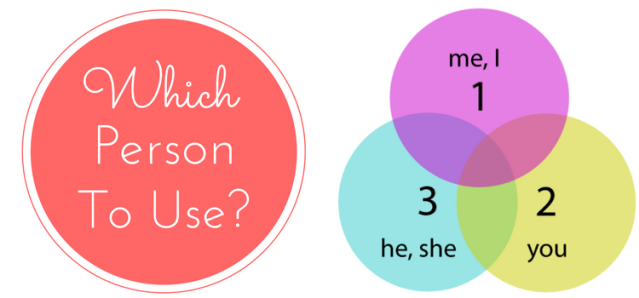
In a nutshell, first person is you and your views (or your character directly speaking and their views), and is expressed using the word ‘I’. What I like about this writing style is that you can easily express yourself and share your experiences the way it happened. It may be a bit more of a challenge when you are not writing about yourself, but still, the action is experienced in the moment as it is happening.

Many people believe that writing in the first person is the easiest way to write and perhaps they are right to a point. But beware that when you write in the first person as you can get very comfortable and sometimes overshare. If you find yourself doing this a text rewriter may come in very handy at this point.

The Second Person

Second person is where the narrator tells the story to another character using the word ‘you’. The story is being told in the voice of the onlooker, which can also be you, the reader. For instance, the text could read, “You went to school that morning. And whilst you were there you played with some play-dough.”

The second person point of view is rarely used in fiction because of its difficulty level. It is hard to develop a set of characters and a story in which the second person is appropriate. Saying that, however, you can find some fantastic stories that have been written this way if you go and look for them.

If you are writing non-fiction, you can use this style of writing when you are sharing information that does not pertain to your own experiences. For instance, this is handy when you are writing a ‘how to’ blog post or an instructional article of any kind.

If you are not familiar with this writing style, find a word rewriter and use any tools you might need until you get it right. It does take some getting used to, but it is a very effective writing style.

The Third Person

The third person point of view belongs to the person (or people) being talked about. The third person pronouns include he, him, his, himself, she, her, hers, herself, it, its, itself, they, them, their, theirs,and themselves.

You would usually associate this writing style with fiction and storytelling. It is also the preferred writing style for academic literature.

Plenty of stories and novels are written in the third person. In this type of story, a disembodied narrator describes what the characters do and what happens to them. You don’t see directly through a character’s eyes as you do in a first person narrative, but often the narrator describes the main character’s thoughts and feelings about what’s going on.

So in essence, you are a little more removed from the character in terms of direct thoughts and feelings, but you can be aware of more and inform the reader of things that your character could not do directly in first person unless they were actually experiencing them. This option gives you more choice and a greater possibility for knowledge during events, and about other characters.

The Best Choice

As you can see, there is a place for all three point of view writing styles, and one is not necessarily better than the other.

At the end of the day, we all have a different way of communicating, and you should find the style which suits you best. Think about what you have written thus far.Is there one particular style that you naturally gravitate towards?

Even though you might want to go for the easiest writing style, there is nothing wrong with stepping out of your comfort zone every now and then. It might take a little longer to write, but it will be worth the effort to get it right.

Conclusion

Writing is all about sending out good stories into the world, and this should be your principal focus.

If you are writing a novel, try writing a chapter in each different point of view and see what works best or your story. Each story you write may have a different point of view that works best for what you are trying to convey, so don’t assume that just because you usually write in one point of view that it will be the best one.

Read your work out loud, and see if it sounds right. If not, try changing the pronouns and see if it works better. Your story (and characters) will normally tell you how they want to communicate. So listen out for their voice and go with that.

If you are writing an article, write in the way that feels most natural to you. Then you can’t go wrong.

Ultimately, it does not matter if you write in first, second or third person, as long as you are writing authentically for yourself or your characters and connecting with your audience. Happy writing!

***

Via: https://www.justpublishingadvice.com/should-you-write-in-the-first-second-or-third-person/ and https://www.grammarly.com/blog/first-second-and-third-person/


10 Ways To Develop A Unique Writing Style

Unique-writing-style-blog2

Creating and refining your own unique style of writing is important, particularly in the modern Internet age, where a high content turnover means readers are constantly in pursuit of something original and clever. However, it’s often difficult – especially when you’re just starting out – to fine-tune the way you write and embody the qualities that make your voice distinct and innovative.

So how exactly do you tease out those qualities? How do you then apply them to the actual process of writing? Here are ten hot tips to get you started today.

1. Use experiences as a springboard

Start with what you know. If you begin your writing process in a world that you’re familiar with, it’ll generally be much easier for you to slip on your characters’ shoes and immerse yourself into the setting of your story. In fact, J. K. Rowling herself based one of her best-known and most complex characters, Professor Snape, on her chemistry teacher.

Be inspired by real people, real emotions and real events. Reflect on your own journey as a human being. Reflect on small moments that seem to have permanently burned themselves into your memory, and let those reflections guide the philosophy that underpins your writing. As author Kashmira Sheth points out:

The emotional growth of your characters is one place where you can use your own experiences much more deeply. If you are writing about the summer between sophomore and junior year, then you can go back to your emotional state of that summer. Was it the summer of heartbreak, angst, rebellion, disappointment, or sorrow? How did you survive and persist? How did your emotions manifest themselves in your interactions with others? What did you learn? How did that one pivotal summer make you grow and change?”

If the content of your writing leaves you with deep and nostalgic feeling of been there, done that, then it’ll more likely exude a profound sense of realism and empathy – one that will resonate and connect with readers more powerfully.

2. Be aware of what makes your observations unique

Everyone sees the world through their own unconventional lens, but not everyone is aware of the existence of those lenses. That’s when it becomes important to take a step back and become aware.

For instance, if you’re observing the way people engage in conversation, take note not only of the dialogue, but also of the silences, of the interruptions and of the speakers’ unconscious habits like pushing up their glasses, adjusting the collar of their T-shirt or tapping their foot against the carpet. Ask yourself why those habits are emerging in the first place. Are they nervous? Are they scared of the other person’s reaction to a particular piece of news? What does this say about their relationship with one another?

As writer Annie Evett argues in her article on observational writing,

Good observational writing utilises all of the senses in describing the event, character or item; transporting your reader easily into the world you are creating or describing.”

That being said, one question you may ask is: how exactly do you utilise these senses?

3. Awaken all senses

When the reader takes a dip into the waters of your writing, they want to feel something. They want to immerse themselves in imagery that extends beyond a mere description of what can be seen. So it’s your job as the writer to ignite as many of their senses as possible.

Let’s say that you’re writing about a bushfire approaching from the distance. You may initially choose to illustrate the way the fire rapidly gains speed, leaping from tree to tree, an angry flame that cannot be tamed. But wouldn’t your setting be much more evocative if you gave the reader the capacity to hear by assaulting their ears with the strange silence that falls upon the forest, with the sudden roaring of fire as it tears through this silence, with the protagonist’s faint coughs as her lungs choke up with smoke?

And wouldn’t your scene be even more vivid if you also engaged the reader with descriptions of the scent of smoke blowing into her cheeks, of the vile taste of charcoal in her mouth, and of the soft fabric of her blouse battering against her skin as it fights a battle it knows it cannot win?

Writer of the Udemy Blog Margo Jurgens provides some further tips and advice on how to best approach writing sensory imagery.

4. Show with a spin

One of the most common pieces of advice given to writers is ‘Show, don’t tell’ – but it’s also important that you enact the ‘show’ part with a twist. Avoid using the same old words to paint a picture. Try adopting a different approach or perspective.

Let’s take the bushfire example from above. Rather than using phrases like ‘The fire roared’ or ‘Smoke billowed up into the sky’, you might perhaps juxtapose the constant ticking of the clock inside the house with the comparatively erratic rhythms of the fire leaping from treetop to treetop.

You might also use a memory or an anecdote as the transition into your description of the fire’s sudden approach: perhaps the protagonist recalls a time she watched a juggler accidentally drop his flaming torches, and contrasts how quickly the torches were extinguished with how impossible it would be to put out this monstrous bushfire.

5. Avoid clichés

It’s sometimes very easy to fall into the trap of clichés – especially in times of doubt and uncertainty, when you find yourself borrowing the storyline of your favourite novel or imitating the writing style of your favourite author or poet. This can ultimately hinder your potential for originality.

How do you rid your writing of clichés? Writer’s Digest‘s Peter Selgin suggests that the best way to avoid cliché

… is to practice sincerity. If we’ve come by sensational material honestly, through our own personal experience or imagination, we may rightly claim it as our own. Otherwise, we’d best steer clear. Our stories should be stories that only we can tell, as only we can tell them.”

Brian A. Klems gives 12 examples of clichés that ‘need to be permanently retired’, while Writer’s Web provides some tips on how you can identify and avoid clichés.

6. Be intimate with details

Intimate details are the key to enhancing the vivid quality of your writing. Be specific in your characterisation and descriptions of setting. The subtlest of movements – your protagonist tugging at the hem of his shirt, your villain tapping two fingers against the table – can help build up the mood of your story or poem, accentuating the emotions experienced by your characters.

Being specific in your details means combing through your writing and paring it down, so that it includes only those words that (in some way or form) contribute to the meaning you’re trying to convey to the reader. Word choice becomes crucial here.

Author Kristen Lamb highlights the importance of diction: ‘She bolted from her chair’ is much better than ‘She stood quickly out of the chair’, because the word ‘bolted’ holds a powerful sense of action and urgency that the phrase ‘stood quickly’ simply does not have.

7. Turn objects into metaphors

If you’re looking for inspiration, an effective exercise to get your creative mind pumping is to turn random objects into quirky metaphors. Select any item in your line of vision – a pencil, a typewriter, a mug – and write about it in the greater context of life. This exercise gives you the opportunity to turn something mundane into something totally and utterly original.

For instance, you may decide to write about the blinds by your desk. Perhaps they represent the idea that we have control over the degrees of light and dark within us; when the world inside is cold and grey, all we have to do to warm ourselves up is pull open the blinds and let bars of light in.

Feeling creative enough yet?

8. Create strong, authentic voices

A classic example of writing with a strong, authentic voice is J. D. Salinger’s The Catcher in the Rye – when you read that novel, you cannot help but hear Holden Caulfield’s voice in your head. With the effective use of voice, the reader becomes so deeply submerged in the story, the characters and the underlying meanings that they forget a writer has fabricated this world.

Author Junot Díaz draws from his own characters as examples on how to strengthen the various aspects of voice. Blogger Lorrie Porter focuses more on how you can incorporate strong voice into dialogue.

9. Know the rules of writing, then break them

Don’t be afraid to experiment and to test the limits of what you think you are capable of writing. Take Kurt Vonnegut’s 8 tips on how to write a good short story, for instance. Once you understand his rules, you can start bending them and eventually start breaking them. As Vonnegut himself writes,

The greatest American short story writer of my generation was Flannery O’Connor. She broke practically every one of my rules but the first. Great writers tend to do that.”

10. Write a little every day

As the old saying goes, practice makes perfect! The more you write, the more you will grow conscious of your own writing style and thus be able to improve upon it. Blogger Leo Babauta presents a range of tips on how you can write daily.

You might end up writing a few sentences, a few paragraphs, even a few pages. Quantity doesn’t matter; frequency does. So set aside some time everyday and get writing! A world of words await you. Time to turn on your mind and let your creative juices run free.

***

Via: https://writersedit.com/fiction-writing/develop-unique-writing-style/

Effective Ways To Make Your Characters More Memorable

Memorable-characters

Characterisation is, without doubt, one of the most important elements to master when writing a novel or short story.

You may have dreamed up a plot of unparalleled genius or a storyline so amazing you have your readers drooling. However, if you don’t have authentic and compelling characters driving the story, no one will ever reach the final page.

If a story is a sailboat, characters are the rudder that steers the whole ship.

Clever’s not enough to hold me – I want characters who are more than devices to be moved about for Effect” – Laura Anne Gilman

Characterisation is defined by what the characters think, say and do. It’s about the writer developing the personality of the people in the story to make the work interesting, compelling, and affecting.

One could go so far to say characterisation is even more important than plot. If your character is fascinating, whatever they do will take on gravitas.

The best characters are the ones that seem to take on a life on their own. For example, when the reader is always drawn back to the book because they can’t help wondering what the character is up to. It’s not as hard as you think to create a character as memorable as Harry Potter or Sherlock Holmes.

Know Your Character

To allow the readers to engage with your characters, they need to become multi-faceted, living, breathing individuals. You have to know them as personally as you know yourself.

The best way to achieve this is by creating a complete character profile that you can always refer to. This way you can trace how a character might react to every situation and how they might feel about the things that happen to them.

Consider these major factors when formulating a character profile:

Develop A Thorough Backstory

For your character to function successfully as a reliable entity, they must possess a past that has shaped who they are when the reader meets them. You don’t have to reveal it all at once, or even reveal it at all. However, it’s important for putting the character’s actions into context. It’s also a very useful way of teasing out information throughout a story by allowing the reader to slowly learn more about the character.

The key influences on a backstory often include:

  • Where the character grew up
  • Family members
  • Past trauma
  • Religion
  • Socio-economic status
  • Job
  • School

The backstory will be a major influence on how the character moves through the story.

For example, if your character has a traumatic past, it will often result in an unresolved personal conflict when they are older. As outlined in his biography, Harry Potter’s experiences as a child directly affected him as an adult.

When he was a baby, Harry and his parents were attacked by Lord Voldemort. His parents were killed but Harry miraculously survived. When he was older, he continually came face to face with his nemesis. Over many years he began to learn more about why this happened and why other strange things were happening to him. This resulted in a growing motivation to pursue this knowledge, leading him into greater conflict, not only with Voldemort but other characters, include Professor Snape, the Malfoy’s and Slytherins.

For this reason, he reached out for allies. Since many of his allies didn’t survive, including Harry’s Godfather Sirius Black, Harry became angrier and more emotionally damaged. However, he was able to use the love his parents showed in protecting him as strength to overcome his obstacles.

Examine Your Character’s Personality

To some degree, the backstory shapes a character’s personality. However, the personality is also less concrete. Having a good grasp of your character’s personality will allow you to remain consistent throughout the novel and understand how events will have different impacts.

You might ask yourself whether your character is an introvert or an extrovert? Will they be funny, intelligent, kind, charismatic or cowardly? What part of their personality will you seek to emphasise in order to build a connection between them and the reader? Do they have hobbies that reveal more about their outlook?

You may also consider what kind of attitudes and opinions your characters have about life that make them intriguing. For example Mark Renton in Trainspotting, by Irvine Welsh, is a black-humoured heroin addict. His taste in anti-establishment music such as Iggy Pop, Lou Reed, and David Bowie, and his accompanying political views, set him apart as a dynamic, off-beat anti-hero.

Envision The Appearance Of Your Characters

If you yourself don’t have a clear sense of what your characters look like, then it’ll be near impossible for the reader to imagine them. You don’t have to list every specific detail. Allow the reader to use their own creativity.

However, it’s also vital to the overall impression of the character to know how they dress. Do they dress mostly according to their job? How do they display themselves in public, casual or fashionable. Is there something they wear that is of significant symbolic importance?

This will link into the character’s personality and provide the reader with greater insight into their mindset. The reader must be able to logically connect the various aspects of the character.

An example of clothing being a major signifier is the appearance of Jack Reacher in Lee Child’s novels. Reacher commonly wears very plain, practical clothes, often bought cheap so as to attract very little attention to himself. He uses clothes to downplay his size and strength. He wants to seem as ordinary as possible, so that when he gets into trouble he can completely surprise his opponents with his fighting ability.

Name Your Characters

Giving your character a unique or crazy name is a bit of a cheat to making them memorable. However, it’s still worth the thought. No one really gets excited by a character named John Smith. A name can also go some way towards shaping the general impression your character gives to the audience. For example, Inigo Montoya sounds flamboyant and heroic straight off the bat.

Consider this list of the fifty greatest literary character names as inspiration for your own characters. Furthermore, this in-depth character profile template will help you craft your characters more easily.

Write Your Character Into The Story

So now you know your characters, it’s time to integrate them into your story. As stated earlier, you can reveal your characters to the readers in three key ways:

Develop Interior Dialogue

Or more simply, thoughts. Literature has an advantage over film, in most cases, because it allows a writer to delve as deep as they like into the character’s head and directly relay their thoughts. Making use of internal dialogue is a quick way of giving the reader more information and understanding about a character.

Only the character and the audience knows what is going on in the character’s head. While you don’t want to over do it (show don’t tell!), it’s useful in circumstances where you want to show the opinions characters have of each other or the events that happen around them.

Inner dialogue is useful to contrast between what the character says out loud and what they are actually thinking.

Sherlock Holmes is famous for keeping a lot more within than he reveals to others. He holds his deductive reasoning in his head, leaving others puzzled as to how he’s joining the dots of the mystery at hand, until he is sure he has solved the problem. This is why he seems like such a genius when he reveals everything at the end of each story.

Create Authentic Dialogue

Dialogue is the most obvious way of displaying your character’s personality. Their delivery and vocabulary will reveal ample information to the reader, even through a simple conversation. How they converse with other characters is vital to their development and how the audience views them. Tone and inflection are everything.

In the dialogue of Arya Stark, it’s easy to identify her passion, petulance, and vulnerability, depending on where she is and who she is speaking to. In this excerpt she displays youthful innocence despite her otherwise feisty nature:

“I bet this is a brothel,” she whispered to Gendry.
“You don’t even know what a brothel is.”
“I do so,” she insisted. “It’s like an inn, with girls.”

– George R. R. Martin, A Storm of Swords

Talking to guards at a gate she displays her volatile temper:

“I’m not a boy,” she spat at them. “I’m Arya Stark of Winterfell, and if you lay a hand on me my lord father will have both your heads on spikes. If you don’t believe me, fetch Jory Cassel or Vayon Poole from the Tower of the Hand.” She put her hands on her hips. “Now are you going to open the gate, or do you need a clout on the ear to help your hearing?”

– George R. R. Martin, A Game of Thrones

Dive Into The Action

Action is a simple and effective way of coercing your character to give away aspects of themselves. Someone slams a door, they’re angry. They runaway, they’re scared or embarrassed. They sigh, they’re disappointed or sad. All of these actions require no speech, yet they still demonstrate to the reader what the character is feeling and thinking.

Action is a great technique to use because it lets the reader play detective. Let them figure out why the character did what they did. This will give the reader satisfaction, when they find out they were right, or surprise, if they were wrong.

In Toni Morrison’s Beloved, we learn that Sethe tried to murder all her children in the past. At first we we struggle to think why she would do this when she seems to love Denver so much. The other events and circumstances allow us to guess at her motivations before they are fully revealed to us. The conclusion provokes the realisation that she was actually trying to spare them a life of misery as slaves.

Don’t Make Them Boring!

Just because your characters seem life-like, it doesn’t mean they’re interesting. Unfortunately, real people can be boring sometimes.

“I don’t know where people got the idea that characters in books are supposed to be likable. Books are not in the business of creating merely likeable characters with whom you can have some simple identification with. Books are in the business of creating great stories that make your brain go ahhbdgbdmerhbergurhbudgebaaarr.” – John Green

You need to give your character a compelling desire or need, a goal that will reel the reader into their story. It might be a story of revenge or mystery, personal redemption or emotional catharsis.

It’s also a good idea to shroud them in some mystery, such that the other characters and the reader can’t quite decipher them. This will keep readers intrigued. For instance, Captain Nemo in Twenty Thousand Leagues Under The Sea by Jules Verne is surrounded by question marks. We know very little of his past or where he got the money to build the Nautilus.

A good character also has to be surprising and unpredictable at times. An effective way to achieve this is to give them some contrasting personality traits. For example, they might be funny but cruel, kind but violent. This just keeps the reader guessing and elevates the tension in the novel.

Danny Kelly in Barracuda by Christos Tsiolkas patiently cares for the handicapped but possesses a violent streak that lands him in jail. Not an evil or dangerous character by any means, yet his violent trait develops from his personal demons regarding his sexuality, and the confusion and stigma that came with it.

Vulnerability is another perfect way to get the reader to interact with your characters and story. If a character is in pain or danger, it’s a human reflex to be drawn to them.

Morn Hyland in Stephen Donaldon’s The Gap Cycle is a character that suffers horribly at the start of the first novel. From that point on we are behind her all the way as she fights through the rest of the harrowing series, finding incredible strength to keep from breaking down completely while trying to care for a son that was born of rape.

It’s important to remember your character doesn’t necessarily have to be likeable, even if they are your main character, as long as the reader becomes attached to their narrative. Alex, the protagonist in A Clockwork Orange by Anthony Burgess commits vile acts, including rape and manslaughter, but we still want to follow him to see if he can be redeemed.

Find Your Characters In The People Around You

When you think of all the different and interesting people in your life, it doesn’t seem so hard to dream up memorable characters. Family members, friends, acquaintances, enemies. All shapes, sizes, ages. You can take parts of all of them to help create authentic characters, while also drawing on your own thoughts and emotions.

In summary, the most important thing to consider can be summed up by Ernest Hemingway’s famous words:

“When writing a novel a writer should create living people; people not characters. A character is a caricature.”

The best way to do this is to make your character profile as detailed as possible, before you start your work. Happy writing!

***

Via : https://writersedit.com/fiction-writing/effective-ways-make-more-memorable-characters/

Punctuation Guide: When to Use a Semicolon

Punctuation1

Today, we have a guess post by the lovely Daisy Hartwell, who contacted me and asked to feature on the blog. She has done a handy guide for using punctuation marks, and this one features the semicolon. I hope you find it useful, and if you want to check out the rest of her guide you can do so via the link at the end of the page. Enjoy!

***

If we list punctuation signs in English, we should mention the semicolon.

When to use a semicolon?

Of course, there are several reasons to place it in your text. But in modern language, it’s more typical to separate a sentence into two parts instead of using a semicolon.

Firstly, there’s a question which bothers many students:

What is the difference between a semicolon and a colon

What is the difference between a semicolon and a colon?

Colon vs semicolon—how do you distinguish between the two?

They have different functions.

We use a colon in sentences to introduce a list or to emphasize one part of a sentence.

A semicolon is responsible for other functions. We need it to separate independent clauses or long parts of a list.

Do you need a semicolon or a colon in the sentence? It depends on the particular case.

If you think that a colon is more appropriate for your sentence—you can read some rules about it as well (just click “Colon” in the right part of the screen).

If not, here are some semicolon standards and examples.

How to use a semicolon instead of a conjunction

How to use a semicolon instead of a conjunction

When we use independent clauses in a sentence, they’re typically connected with each other. In this case, we use a coordinating conjunction (and, but, or) and a comma.

But proper use of English grammar and punctuation changes under different conditions. If you delete the conjunction from the sentence, you should add a semicolon.

Here’s an example of a compound sentence with a semicolon:

All patients must sign up by telephone or in the hospital; patients who use the Internet to make an appointment are not assisted.

Semicolon use before a transition

Semicolon use before a transition

The correct use of a semicolon isn’t difficult to understand in sentences with transitions. Transitions can be specific words and phrases. Authors use them to show the readers they moved from one thought to another idea.

Examples of transition expressions: nevertheless, afterward, of course, in other words, and so on.

A semicolon is used before the transition:

These days, exotic animals are more often turned into pets; for example, Clara from NC keeps a raccoon in her house.

Here’s another example with a semicolon before however:

All her friends tried to stop her from leaving the country until she got over her illness; however, she couldn’t miss her daughter’s wedding.

Lists with commas

Lists with commas

A paragraph without punctuation would be too difficult to read. Even when you use commas, a sentence can still be hard to understand.

That’s why sometimes we need the assistance of other punctuation marks.

In this section, we’ll tell you when to use a semicolon in a list.

According to punctuation rules, the semicolon may be used instead of definite commas. In this case, a semicolon before conjunctions isn’t a punctuation mistake as long as it performs the role of the comma. In the following example, you can see a semicolon before and:

She felt great in the village: making birdhouses, reading old stories, and learning tree names with grandpa; swimming in warm lakes and collecting strange bugs with Ann and Susie; and going to the fair with Aunt Marie.

Elliptical constructions

Elliptical constructions

When to use a comma or period? It is a popular question from writers who try elliptical constructions. The truth is–you can use not only the comma or the period but the semicolon as well!

Separate those parts of the sentence which express a complete idea with the beginning of the sentence:

On the red team 5 players were left; on the blue team, 3; the green team tried to catch up with just 2—it was obvious who was going to win.

Do you capitalize after a semicolon

Do you capitalize after a semicolon?

When we use a colon, sometimes capitalization is necessary. But what about when using a semicolon?

You shouldn’t capitalize after a semicolon unless it’s placed before a proper noun.

Now you can tell when to use a semicolon.

***

If you want to find out about other punctuation marks, you can check out other sections in this punctuation guide via https://custom-writing.org/blog/punctuation/semicolon

How To Write A Smashing First Chapter

ChapterOne

If you are looking for a few tips on how to write a cracking first chapter, you couldn’t do much better than this. Here is an opening chapter masterclass from Author Elizabeth Sims. Enjoy!

**********************************************************************************

When you decide to go to a restaurant for a special dinner, you enjoy the anticipation. You’ve committed to spending sufficient time and money, and now you’ve arrived, and the place looks good and smells good. You smile and order an appetizer. When it comes, you enjoy it as a foretaste of the larger, more complex courses that will follow, but you also savor it for what it is: a delicious dish, complete in itself. If it’s a truly great appetizer, you recognize it as an exquisite blend of flavor, texture and temperature. And you’re happy, because you know you’ll be in good hands for the entire evening.

Isn’t that what it’s like to begin reading a terrific book?

The first chapter is the appetizer – small, yet so tremendously important. And so full of potential.

As an aspiring author, the prospect of writing Chapter One should not intimidate, but excite the hell out of you. Why? Because no other part of your book can provide you with the disproportionate payoff that an excellent first chapter can. Far more than a great query letter, a great Chapter One can attract the attention of an agent. It can keep a harried editor from yawning and hitting “delete.” It can make a bookstore browser keep turning pages during the slow walk to the cash registers. And yes, it can even keep a bleary-eyed owner of one of those electronic thingamajigs touching the screen for more, more, more!

Fiction, like food, is an art and a craft. Here’s how to blend inspiration with technique and serve up an irresistible Chapter One.

#1: RESIST TERROR.
Let’s be honest: Agents and editors like to make you quiver and sweat as you approach Chapter One. All those warnings: “Grab me from the opening sentence! Don’t waste one word! If my attention flags, you’ve failed – you’re down the toilet! In fact, don’t even write Chapter One! Start your book at Chapter Four! Leave out all that David Copperfield crap!” From their perspective it’s an acid test. They know how important Chapter One is, and if you’re weak, they’ll scare you into giving up before you begin. (Hey, it makes their jobs easier: one less query in the queue.)

Here’s the truth: Agents and editors, all of them, are paper tigers. Every last one is a hungry kitten searching for something honest, original and brave to admire. Now is the time to gather your guts, smile and let it rip.

Your inner genius flees from tension, so first of all, relax. Notice that I did not say agents and editors are looking for perfect writing. Nor are they looking for careful writing. Honest, original and brave. That’s what they want, and that’s what you’ll produce if you open up room for mistakes and mediocrity. It’s true! Only by doing that will you be able to tap into your wild and free core. Let out the bad with the good now, and you’ll sort it out later.

Second, remember who you are and why you’re writing this book. What is your book about? What purpose(s) will it serve? Write your answers down and look at them from time to time as you write. (By the way, it’s OK to want to write a book simply to entertain people; the noblest art has sprung from just such a humble desire.)

And third, if you haven’t yet outlined, consider doing so. Even the roughest, most rustic framework will give you a sharper eye for your beginning and, again, will serve to unfetter your mind. Your outline could be a simple list of things-that-are-gonna-happen, or it could be a detailed chronological narrative of all your plot threads and how they relate. I find that knowing where I’m headed frees my mind from everything but the writing at hand. Being prepared makes you calm, and better equipped to tap into your unique voice – which is the most important ingredient in a good Chapter One.

#2: DECIDE ON TENSE AND POINT OF VIEW.
Most readers are totally unconscious of tense and POV; all they care about is the story. Is it worth reading? Fun to read? But you must consider your tense and POV carefully, and Chapter One is go time for these decisions. It used to be simple. You’d choose from:

a) First person: I chased the beer wagon.

b) Third-person limited: Tom chased the beer wagon.

or

c) Omniscient: Tom chased the beer wagon while the villagers watched and wondered, Would all the beer in the world be enough for this oaf?

… and you’d always use past tense.

But today, novels mix points of view and even tenses. In my Rita Farmer novels I shift viewpoints, but limit all POVs to the good guys. By contrast, John Grisham will shift out of the main character’s POV to the bad guy’s for a paragraph or two, then back again. (Some critics have labeled this practice innovative, while others have called it lazy; in the latter case, I’m sure Grisham is crying all the way to the bank.) It’s also worth noting that studies have shown that older readers tend to prefer past tense, while younger ones dig the present. (If that isn’t a statement with larger implications, I don’t know what is.)

Many writing gurus tell you to keep a first novel simple by going with first person, past tense. This approach has worked for thousands of first novels (including mine, 2002’s Holy Hell), but I say go for whatever feels right to you, simple or not. I do, however, recommend that you select present or past tense and stick with it. Similarly, I advise against flashbacks and flash-forwards for first novels. Not that they can’t work, but they seem to be off-putting to agents and editors, who will invariably ask, “Couldn’t this story be told without altering the time-space continuum?”

The point is, you want your readers to feel your writing is smooth; you don’t want them to see the rivets in the hull, so to speak. And the easiest way to do that is to create fewer seams.

If you’re still unsure of your tense or POV choices, try these techniques:

Go to your bookshelf and take a survey of some of your favorite novels. What POVs and tenses are selected, and why do you suppose the authors chose those approaches?

Rehearse. Write a scene using first person, then third-person limited, then omniscient. What feels right?

Don’t forget to consider the needs of your story. If you plan to have simultaneous action in Fresno, Vienna and Pitcairn, and you want to show it all in living color, you almost certainly need more than one POV.

And if you’re still in doubt, don’t freeze up – just pick an approach and start writing. Remember, you can always change it later if you need to.

#3: CHOOSE A NATURAL STARTING POINT.
When you read a good novel, it all seems to unfold so naturally, starting from the first sentence. But when you set out to write your own, you realize your choices are limitless, and this can be paralyzing. Yet your novel must flow from the first scene you select.

Let’s say you’ve got an idea for a historical novel that takes place in 1933. There’s this pair of teenagers who figure out what really happened the night the Lindbergh baby was abducted, but before they can communicate with the police, they themselves are kidnapped. Their captives take them to proto-Nazi Germany, and it turns out there’s some weird relationship between Col. Lindbergh and the chancellor – or is there? Is the guy with the haircut really Lindbergh? The teens desperately wonder: What do they want with us?

Sounds complicated. Where should you start? A recap of the Lindbergh case? The teenagers on a date where one of them stumbles onto a clue in the remote place they go to make out? A newspaper clipping about a German defense contract that should have raised eyebrows but didn’t?

Basically, write your way in.

Think about real life. Any significant episode in your own life did not spring whole from nothing; things happened beforehand that shaped it, and things happened afterward as a result of it. Think about your novel in this same way. The characters have pasts and futures (unless you plan to kill them); places, too, have pasts and futures. Therefore, every storyteller jumps into his story midstream. Knowing this can help you relax about picking a starting point. The Brothers Grimm did not begin by telling about the night Hansel and Gretel were conceived; they got going well into the lives of their little heroes, and they knew we wouldn’t care about anything but what they’re doing right now.

If you’re unsure where to begin, pick a scene you know you’re going to put in – you just don’t know where yet – and start writing it. You might discover your Chapter One right there. And even if you don’t, you’ll have fodder for that scene when the time comes.

Here are a few other strategies that can help you choose a starting point:

  • Write a character sketch or two. You need them anyway, and they’re great warm-ups for Chapter One. Ask yourself: What will this character be doing when we first meet him? Write it. Again, you might find yourself writing Chapter One.
  • Do a Chapter-One-only brainstorm and see what comes out.

The truth is, you probably can write a great story starting from any of several places. If you’ve narrowed it down to two or three beginnings and still can’t decide, flip a coin and get going. In my hypothetical Lindbergh thriller, I’d probably pick the date scene, with a shocking clue revealed. Why? Action!

It’s OK to be extremely loose with your first draft of your first chapter. In fact, I recommend it. The important thing at this point is to begin.

#4: PRESENT A STRONG CHARACTER RIGHT AWAY.
This step might seem obvious, but too many first-time novelists try to lure the reader into a story by holding back the main character. Having a couple of subsidiary characters talking about the protagonist can be a terrific technique for character or plot development at some point, but not at the beginning of your novel.

When designing your Chapter One, establish your characters’ situation(s). What do they know at the beginning? What will they learn going forward? What does their world mean to them?

Who is the strongest character in your story? Watch out; that’s a trick question. Consider Kazuo Ishiguro’s The Remains of the Day. The main character, Stevens, is a weak man, yet his presence is as strong as a hero. How? Ishiguro gave him a voice that is absolutely certain, yet absolutely vacant of self-knowledge. We know Stevens, and because we see his limitations, we know things will be difficult for him. Don’t be afraid to give all the depth you can to your main character early in your story. You’ll discover much more about him later, and can always revise if necessary.

#5: BE SPARING OF SETTING.
Another common error many aspiring novelists make is trying to set an opening scene in too much depth. You’ve got it all pictured in your head: the colors, sounds, flavors and feelings. You want everybody to be in the same place with the story you are. But you’re too close: A cursory – but poignant! – introduction is what’s needed. Readers will trust you to fill in all the necessary information later. They simply want to get a basic feel for the setting, whether it’s a lunar colony or a street in Kansas City.

Pack punch into a few details. Instead of giving the history of the place and how long the character has been there and what the weather’s like, consider something like this:

He lived in a seedy neighborhood in Kansas City. When the night freight passed, the windows rattled in their frames and the dog in the flat below barked like a maniac.

Later (if you want) you’ll tell all about the house, the street, the neighbors and maybe even the dog’s make and model, but for now a couple of sentences like that are all you need.

But, you object, what of great novels that opened with descriptions of place, like John Steinbeck’s The Grapes of Wrath or Edna Ferber’s Giant? Ah, in those books the locale has been crafted with the same care as a character, and effectively used as one. Even so, the environment is presented as the characters relate to it: in the former case, man’s mark on the land (by indiscriminate agriculture), and in the latter, man’s mark on the sky (the jet plumes of modern commerce).

Another way to introduce a setting is to show how a character feels about it. In Dostoyevsky’s Crime and Punishment, Raskolnikov seethes with resentment at the opulence around him in St. Petersburg, and this immediately puts us on the alert about him. The setting serves the character; it does not stand on its own.

#6: USE CAREFULLY CHOSEN DETAIL TO CREATE IMMEDIACY.
Your Chapter One must move along smartly, but in being economical you cannot become vague. Difficult, you say? It’s all in the context.

The genius of books as diverse as Miguel de Cervantes’ Don Quixote and Robin Cook’s Coma lies in the authors’ generosity with good, authentic detail. Cervantes knew that a suit of armor kept in a junk locker for years wouldn’t merely be dusty, it would be corroded to hell – and that would be a problem to overcome. Likewise, Cook, himself a doctor, knew that a patient prepped for surgery would typically be given a calming drug before the main anesthetic – and that some patients, somehow, do not find peace even under the medication, especially if they have reason not to.

If you’re an expert on something, go ahead and show that you know what you’re talking about. One of the reasons my novel Damn Straight, a story involving a professional golfer, won a Lambda Award is that I know golf, and let my years of (painful) experience inform the book. I felt I’d done a good job when reviewer after reviewer wrote, “I absolutely hate golf, but I love how Sims writes about it in this novel. …”

Let’s say your Chapter One begins with your main character getting a root canal. You could show the dentist nattering on and on as dentists tend to do, and that would be realistic, but it could kill your chapter, as in this example:

Dr. Payne’s running commentary included the history of fillings, a story about the first time he ever pulled a tooth, and a funny anecdote about how his college roommate got really drunk every weekend.

Bored yet? Me too. Does that mean there’s too much detail? No. It means there’s too much extraneous detail.

How about this:

Dr. Payne paused in his running commentary on dental history and put down his drill. “Did you know,” he remarked, “that the value of all the gold molars in a city this size, at this afternoon’s spot price of gold, would be something on the order of half a million dollars?” He picked up his drill again. “Open.”

If the detail serves the story, you can hardly have too much.

#7: GIVE IT A MINI PLOT.
It’s no accident that many great novels have first chapters that were excerpted in magazines, where they essentially stood as short stories. I remember being knocked to the floor by the gorgeous completeness of Ian McEwan’s first chapter of On Chesil Beach when it was excerpted in The New Yorker.

Every chapter should have its own plot, none more important than Chapter One. Use what you know about storytelling to:

Make trouble. I side with the writing gurus who advise you to put in a lot of conflict early. Pick your trouble and make it big. If it can’t be big at first, make it ominous.

Focus on action. Years ago I got a rejection that said, “Your characters are terrific and I love the setting, but not enough happens.” A simple and useful critique! Bring action forward in your story; get it going quick. This is why agents and editors tell you to start your story in the middle: They’ve seen too many Chapter Ones bogged down by backstory. Put your backstory in the back, not the front. Readers will stick with you if you give them something juicy right away. I make a point of opening each of my Rita Farmer novels with a violent scene, which is then revealed to be an audition, or a film shoot or a rehearsal. Right away, the reader gets complexity, layers and a surprise shift of frame of reference.

Be decisive. A good way to do that is to make a character take decisive action.

Don’t telegraph too much; let action develop through the chapter. It’s good to end Chapter One with some closure. Because it is Chapter One, your readers will trust that the closure will turn out to be deliciously false.

#8: BE BOLD.
The most important thing to do when writing Chapter One is put your best material out there. Do not humbly introduce your story – present it with a flourish. Don’t hold back! Set your tone and own it. You’re going to write a whole book using great material; have confidence that you can generate terrific ideas for action and emotion whenever you want.

If you do your job creating a fabulous appetizer in Chapter One and follow it up well, your readers will not only stay through the whole meal, they’ll order dessert, coffee and maybe even a nightcap – and they won’t want to leave until you have to throw them out at closing time.

*************************************************************************************
youve-got-a-book-in-you

This guest post is by bestselling author and writing authority Elizabeth SimsShe’s the author of seven popular novels in two series, including The Rita Farmer Mysteries and The Lillian Byrd Crime series. She’s also the author of the excellent resource for writers, You’ve Got a Book in You: A Stress-Free Guide to Writing the Book of Your Dreams, published by Writer’s Digest Books.

*****************************************************************

Via: http://www.writersdigest.com/whats-new/8-ways-to-write-a-5-star-chapter-one