On Writing And Editing Sex Scenes In Fiction

Sex Scenes in Fiction

Sex scenes in fiction are a tricky subject. For a start – depending on your genre – should they be there? How much do you show? Should you write the whole scene or stop at the heavy petting? There are many, many questions. And one of the best articles I’ve read on the subject is by Helen Scheuerer, who gives some helpful tips and advice. Here it is, and I hope you find it useful:

Since getting stuck into the structural edit of my novel, I’ve been doing a lot of reading about sex scenes in fiction. When should they be included? What makes them work? What makes them fail spectacularly? What warrants a ‘Literary Review’s Bad Sex Award‘?

Originally, there was only one sex scene in my novel, but at the request of my publisher, I’ve since added two more in, and recently, I’ve had the somewhat surreal experience of critiquing these scenes with my editor.

Editing in general can often be an intimate discussion regarding the intentions and interpretations of characters versus those of the author, but when it comes to the more explicit scenes in fiction, the process involves even more lengthy debates.

My editor and I read articles on the subject, and researched the best sex scenes in literature (the library scene from Atonement topped most of those lists, in case you were wondering), and realised that in any context, sex is a tricky subject. Perhaps largely because it plays such a major role in people’s lives, and yet it remains arguably a mystery to us, often still taboo, and kept behind closed doors.

Within fiction it’s even more complex. I have friends who hate reading sex scenes in books as it makes them uncomfortable, and then I have friends who enjoy reading the more explicit scenes.

Personally, I’m often confused when there’s zero sex in a book, as it’s such a big part of life, it lays bare motivations, desires and consequences, all of which tell you a lot about a character. Sex can be ugly, uncomfortable and awkward just as much (if not more often) than the head tossing, back arching cliches we so often see in fiction.

It can mean the start (or the end) of something, and set into motion a series of events. It’s a fact of life, just like birth and death, violence and love – none of which we shy away from when we write, so why is it different? Why should sex be metaphorical and ultimately glossed over, when it’s acceptable to create a vivid description of someone being shot in the face?

My editor and I discussed all these issues, before we got down to the nitty gritty sentence-level of the scenes themselves. The scenes I included weren’t particularly explicit in terms of naming body parts and describing actions in detail, but there was definitely more description than the ‘kiss and fade out’ option some authors favour.

So, within the comments section of Microsoft word, my editor and I tried to work out what makes a sex scene ‘literary’, and what factors separate these scenes from erotica, or worse ‘smut’. The use of language in these scenes is definitely tricky; too anatomical and the moment’s ruined, too vague and no one knows what is going where or how the characters feel.

I also learnt as a writer, you also have to be wary of the fact that one person’s turn-on is another person’s deal breaker, which is probably why so many authors choose to keep it vague.

Additionally, I was aware of the fact that I was a female author writing a sex scene. I’ve spoken about the gender bias in the writing industry before, but realised it was incredibly present when it came to interpreting fictional sex scenes. Often, these scenes when written by women are seen as confessions, autobiographical even, which made me feel particularly uncomfortable.

What helped me move past this discomfort was the fact that I was writing from a man’s perspective. This helped me feel like I was keeping a relatively safe distance from the risks above, at least during the writing and editing process (perhaps another post will be due by the time these scenes are finalised in print).

Essentially, what I’ve come to understand is like most things in writing, there’s no ‘right’ answer, a writer just has to be aware of their own intentions, as well as that of their characters, and should work closely with an editor to make sure these two visions match up as best they can.

Lastly, I thought I’d list a few quick tips I’ve learned during this process below. Fingers crossed someone out there finds them useful…

Top 7 Tips For Writing Sex Scenes in Fiction

  1. Don’t include them just for the sake of it, like any scene, they should drive the story forward, or reveal something new about a character.
  2. Space out the explicit details with emotional responses, and revelations of character.
  3. Don’t say ‘member’, ever.
  4. Don’t make it perfect, nothing ever is.
  5. Accept that not every reader will find the same thing attractive.
  6. If you’re not comfortable writing them, don’t – that’s why there’s always a ‘fade out’ option.
  7. Accept that you’re going to have to be comfortable editing these scenes with someone in a professional capacity.

Via: https://writersedit.com/writing-editing-sex-scenes-fiction/

Tips For Writing Superbad Villains

villains_860

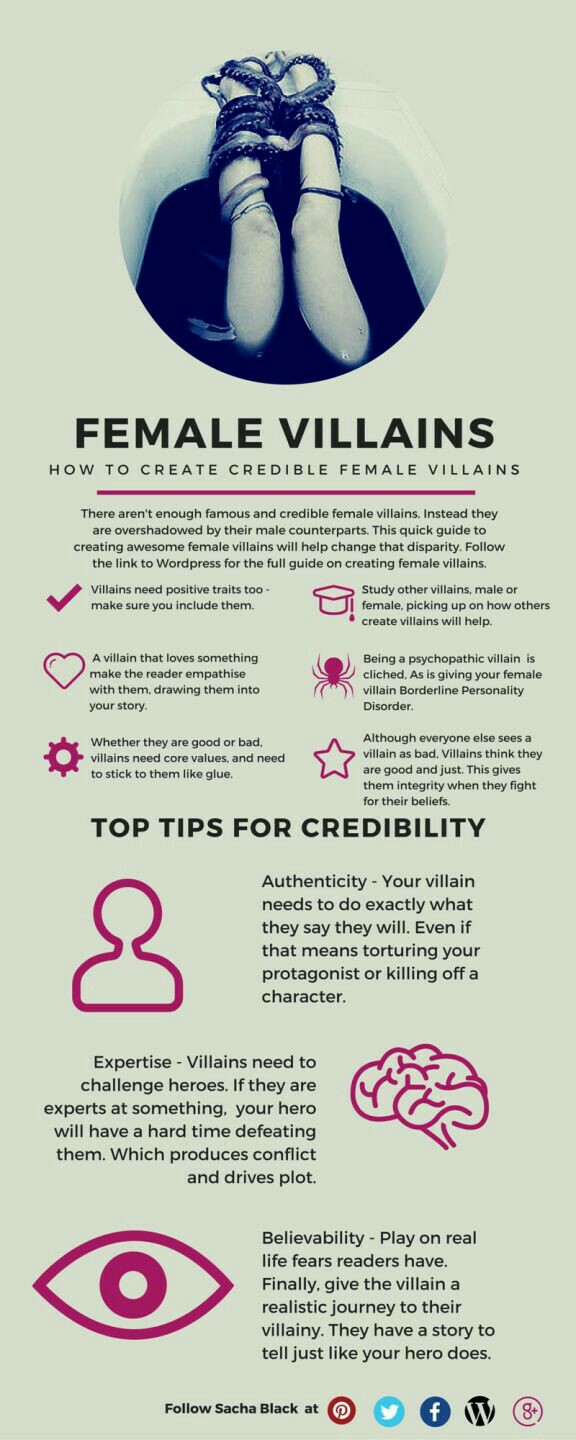
In today’s article, Sacha Black gives some tips on how to write a convincing villain.

Writers have a habit of worshipping their heroes. I know I do. It tends to be the first character we create when we start a new project, and that’s for a reason; our hero saves the day, and usually, that’s who the story is about.

But without Lex Luthor or General Zod causing chaos for Metropolis, there would be no need for Superman to save the day.

Bad guys, villains, gangsters, warlords, vigilantes, and anti-heroes create conflict. Which is why we need to bust the myth that your hero is the most important character in your novel. He isn’t. Your villain is.

But that gives writers a problem because villains are usually seen through the eyes of your hero, which means they don’t get much page time. That makes it harder to give a villain the depth they need to convince your reader they’re credible. Here are 5 quick steps to create kick-ass villains.

1. Understand Their Why

Some people use character interviews or sheets to develop their villain; others wing it as they go. Both ways work. But the one vital piece of information you do need to know is – why your villain is doing what he’s doing.

We all do things for a reason, often because of an amalgamation of experiences in our past. It’s the big events, the things that wound us for instance, losing the love of your life, or not making it to your parent’s deathbed.

Those events shape our brains and the way we see the world and ultimately, they become the source of the decisions we make. All of a sudden, rational thought leaves a villain and doing something immoral or unjust is perfectly valid because that’s what experience has taught them.

The Lion King is a great example of this. The King, Mufasa, has a brother called Scar who grew up in his shadow, always second best. As a result, Scar becomes bitter and jealous. In his mind, he deserves the crown. Therefore, anything he does to get it is fair. His jealousy is the reason why there’s conflict, and that conflict over the crown drives the plot.

2. Motive and Goal

Motives and goals are closely linked:

The goal is what a villain wants e.g. a throne or a squillion dollars.

The motive is the reason why he wants it e.g. he thinks he deserves the throne or wants to be rich.

Motive is the foundation of your story because:

No motive means no conflict, and no conflict means no story.

If your villain doesn’t have a motive, neither does your hero. Put it this way:

You’ve identified your villain’s ‘why,’ the source of their behavior. Add that to a motive – revenge or a warped view of justice, and that gives you the action your villain takes to reach his goal. Which leads to your hero’s reaction saving the day. Simply,

Why + Motive = Villain Action

Therefore, Villain Action = Hero Reaction

3. Make the Conflict Specific

When it comes to conflict, you can’t be broad. Half measures won’t work. That’s like going into a bar on a Friday night and ordering half a shot of tequila. No one does that unless they’re cheap, or a chicken. You’re just short-changing yourself a Saturday morning hangover. While no one wants an ethanol-induced hangover, readers do want a book hangover.

To give a reader what they want, the conflict has to be full of drama to suck a reader in.

The best way to do that is to create conflict that’s specific and targeted so that the hero and villain both invest in fighting each other.

For example, if a wild-eyed science genius is considering releasing a plague, but your friend’s sister-in-law’s cousin said it might only effect ostriches, then no one’s going to get out of bed to save the world. Be specific and link the conflict to your hero/villain’s goals.

Scar wants his brother’s, crown, so everything he does is targeted straight at his brother and his son.

4. Know Your Cliché From Your Trope

There’s a big difference between a cliché and a trope. A cliché is old and tired, it’s been done to death, and when you read or watch a cliché, it makes you cringe. Like a lawyer shouting ‘objection’ in the courtroom or the lover arriving at a marriage ceremony right as the priest says ‘does anyone object?’

For a villain, clichés could be a witch with a cackle and a wart on her nose, or a bad guy dressed head to toe in black, sipping on red wine with an oil painting portrait hanging above a roaring fire. Get the picture? Good.

Clichés are pesky little irritants; they sneak into our stories without us realizing. The important thing is for you to eliminate them regularly.

Tropes, however, are very different. Your novel needs tropes like your body needs oxygen, desperately, and on a permanent basis!

A trope is a pattern. Like a theme or concept that’s found embedded in particular genres. The difference is, a trope can be used time and again.

For example, in fantasy, there might be a magic sword, or ‘the chosen one’ character who is the only one that can save the day. In crime, it could be a maverick detective whose underhand tactics save the day.

The best way to nail down the tropes from the clichés is to read and watch everything you can in your genre. Do it obsessively and jot down the patterns that keep arising.

5. Make Your Villain Unbeatable

Nobody likes a hero who gets it easy. You know the ones – the guys that always land on their feet and defeat the villain with a mere waft of their shapely biceps. It’s boring because it’s unrealistic. Life isn’t like that so your story shouldn’t be either.

Readers want to relate to your hero. That means he needs to work hard for his win. He needs to defeat a huge villain shaped barrier that seems, for 85% of your novel, like it’s totally insurmountable.

How do you make the villain seem undefeatable?

Make your villain an expert at something – if your villain is an expert in amassing huge armies, your hero is going to struggle to gather a rabble of misfits big enough to defeat him.

Inextricably link to your hero’s character arc to your villain-barrier. Think Thor from the Marvel universe movies. Thor was so arrogant and selfish his father cursed his magical hammer (the hammer that can defeat the villain) until he can change and prove himself worthy of the power the hammer wields.

Your Villain Matters

Remember, your villain needs as much love as your hero does. If you accept that, and devote as much time to shaping your villain as you do your hero, your story conflict, pace and tension will be much better for it.

How superbad are your villains?

Via: https://www.thecreativepenn.com/tips-writing-superbad-villains/

Writing Prompts: Perspective

writing-prompt-perspective-shoes

Perspective is an essential part of writing, and as well-known piece of advice is to always “write what you know”. But if we followed this idea we would miss out on a lot of great stories (not just from genres like sci-fi and fantasy, but stories written in other times, settings, or countries).

This writing prompt is about breaking the rules and immersing yourself entirely in another space and time to gain new perspectives, even when you have no solid real life experience.

Think outside your square

Imagine a character that lives in a country or city you’ve never visited, and then choose a time period that is either past or future, but not present. You don’t necessarily have to know historical or geographical details of this time and place, and it’s probably better if you don’t.

Write a few paragraphs or a short story that takes place in this completely unknown world. Don’t worry about being factually correct because this writing prompt is only designed to put yourself in someone else’s shoes, and whose shoes they are doesn’t really matter.

Using your imagination and general knowledge to create something new in a story-world that is alien to you will get you used to seeing from other perspectives which will help you in your own work. Whether you’re writing for the opposite gender or writing something set in the 1800’s, you have to be able to re-create and re-imagine something you’ve never really known.

We can never have complete personal experience of every time and setting, so why restrict ourselves to stories that we ‘know’?

Happy writing!

Via: https://writersedit.com/weekly-writing-prompts-23/


Writing Prompt: Love Without Cliché

writing-prompt-love

It’s hard to escape that most talked-about and often clichéd theme: love. It’s a fundamental part of many stories, whether it’s love between people, love for a thing, or love that was lost.

But how do we approach the topic of love in our writing without sounding sappy or following too closely in the footsteps of the many authors who have written about ‘love’ before us?

This writing prompt is about battling the clichés and writing something original.

Write a scene where two characters show love for each other.

Sounds simple enough, right? Here are the rules:

  • Set your scene somewhere completely unromantic (the dump, a fish market, a funeral – it’s up to you).
  • You cannot use the words, ‘love’, ‘beautiful’, ‘overwhelming’, ‘heart’, or ‘butterflies’.
  • You cannot use a ‘love at first sight’ or ‘let’s make love’ plot (keep it PG-13, people!).
  • Avoid clichés at all costs!

Writing about love (and making it sound sincere rather than silly) is a difficult thing, so cut out the clichés and broaden your imagination.

Happy writing!

Via: https://writersedit.com/weekly-writing-prompts-16/

Video: How To Punctuate Your Dialogue

Punctuate-Dialogue

You’re in the thick of writing some characters’ conversations and it hits you: where do the commas go? Do you need one after an exclamation mark? How’s it supposed to look on the page?

We’ve broken down some dialogue into it’s simplest parts with our step-by-step, visual tutorial covering punctuation, dialogue tags, descriptors, and formatting.

“When you’re writing your work and submitting it to places, you’ll look a lot more professional and it’ll be less work for your editor to go back and fix up those nitty-gritty bits…”

Dialogue is something that you can easily get wrong with just one comma out of place. Check out the video in full by following this link:

Video: Master Dialogue Punctuation

What to Take Away From This Video:

  1. Punctuation should always be inside the quotation marks.
  2. The simple comma is your friend! Use it when tying up speech around dialogue tags (the old favourite, ‘s/he said’).
  3. Each line of dialogue should be on a new line; keep the formatting nice and clean.

A great exercise is to pick two or three books (ones that you love!) and find some examples of dialogue. Each book may be slightly different in their smaller details, but it’s handy to see the basics of punctuation in action.

The best way to learn, of course, is by writing some dialogue yourself. Don’t be afraid to make mistakes, because practice makes perfect!

Writing Prompts | Travel

Travel

Whether you’ve got an existing protagonist, or you’re about to create something new, keep this in mind: Travel changes a person. Today, we’re not just talking about the commute to work, we’re talking big travel. Think about your protagonist and their experiences, where have they been? Have they been anywhere at all? It’s time to explore these possibilities.

You don’t have to make them travel, but it now’s the moment to be asking yourself, and them – why not? And if they have travelled – where? Why? Who with? What was different when they came back? One of the oldest notions about travel is that you feel as though everything has changed when you return, when in fact, it’s you who’s changed.

One of the reasons we fall in love with characters is because they go through different stages of development and growth… Do the choices your character has made about travel, tell us something deeper about them?

Happy writing!

Via: http://writersedit.com/weekly-writing-prompts-8/

Why Taking Writing Breaks Is Important

img_5520

Often when we work continuously on the same piece of writing (especially a long piece) we can lose our objectivity. Sometimes we get so caught up in our writing, we forget that simply powering through can affect the quality of our work. Taking a break allows us to come back to our work with a clear mind and a new perspective. This is important because it also allows us to critique our own writing by bringing a fresh view to our work.

Sometimes when reviewing work after a break we might even change our focus and bring new ideas to our writing. This is very useful when your writing just isn’t working. If you are at the point where you are forcing a story, take this as a sign to take a break from it.  Give yourself time to understand why it isn’t working and allow your creative juices to flow and bring you a new view, a new path to take in your writing, or even the courage to scrap what you were doing and start something completely new.

As writers, we overwork our brains and we don’t realise it. We are constantly thinking, constantly brainstorming, and constantly flooding our heads with superfluous information from blogs to books” – Paul Jun (Problogger)

Remember why you write

There are many reasons why writers write. Some of these are:

  • We enjoy it
  • We have something we want to say
  • Writing gives our imagination freedom to run wild
  • To inspire others
  • It’s our creative outlet

Whatever the reason, we shouldn’t lose sight of why we are writing something and we certainly shouldn’t lose the enjoyment. If you find that this is happening to you then take a break. The last thing you want to do is lose sight of the reason why you are writing. Especially if it’s important to you. Sometimes taking a break to remind yourself of these reasons can be very useful. Take the time to give your mind some breathing space, relax and enjoy life.

Taking a writing break doesn’t mean you can’t think about writing or think about new ideas. As writers, simply seeing or hearing something can spark our creativity and cause our imaginations to run wild. This doesn’t need to stop. Taking a writing break can simply be a break from your current writing project to allow your mind to have a rest and let you re-energise. In the meantime, if you get an idea for another piece of writing, or even for your current project, jot down the idea so you don’t forget it and come back to it later. This will also allow you to assess your new idea objectively.

Time Out and Observation

There are some things you can do whilst taking a break that can help your writing and help you to view what you have written objectively. When you are out, whether it be in a shopping centre, in a park, or when you’re simply around other people, listen to the way people talk to each other. This is one way to check whether the conversations between your characters sound realistic or forced. When you listen to the way people talk naturally, you may realise that some of the conversations between your characters sound robotic or too formal. This is a good way to remind yourself how a conversation between people flows naturally.

“We writers tend to live in our heads and its necessary for us to step outside and enjoy the sunshine more than every once in a while. Shaking up your routine can sometimes, inadvertently, lead to you generating some of your best material” – Mitchell Martin Jnr. (Paper Hangover).

Simply observing people can help you with your character development. Observation can often spark the creation of a new character, add realistic descriptions to your characters and their actions, or even give you a new story idea. For example, you may see a couple who are arguing, even if you can’t hear what they are saying, you might want to use your creativity and make up something that they might be arguing about, something that can be applied to your characters.

Observe (discreetly) the body language of the couple as this can help when you describe interactions with your characters. You want your readers to be able to visualise what is happening and the more realistic it sounds, the easier it will be for your readers. Or perhaps you notice an interesting looking person, someone who is oblivious to what is going on around him or her, perhaps he or she doesn’t seem to notice other people because they don’t seem to care what other people think. Do you have a character like this in your story? If so, some simple observation can give you wealth of inspiration.

Keep reading

Enjoy other people’s writing. Choose a book that you like and read (or re-read) it. Take the time to think about why you enjoy this book so much. Think about things such as:

  • How does the author capture your attention?
  • What methods does the author use to keep your attention?
  • Do you care about the characters in the story? Why or why not?
  • How does the author move the story along?

You can learn a lot by reading books and understanding techniques used by other authors. This can add great value to your own work when you are stuck on how to progress your story or when you need a reminder on how to keep the reader interested.

How long should the break be?

Only you can decide how long of a break you should take. Don’t feel guilty if you end up taking a long break. Take all the time you feel you need. Your writing will be there when you are ready to come back to it and it will benefit from the break. So, if you feel that your writing is getting stale or if you feel that you simply are not making progress, then do yourself a favour and have a break from your writing. Allow yourself time to refresh, get reacquainted with your creativity and revamp your writing.

Via: http://writersedit.com/taking-writing-breaks-important/

Writing Prompts | Inspiration for Writers

Inspiration

Writing prompts are a great way to get your creative juices going, particularly if you find yourself in a bit of a writing slump. Don’t worry, every writer’s been there. Whether you’re lacking motivation, ideas or time, writing prompts can provide that little push you need to scribble something down, and keep you in your writing routine.

The Senses

This week, we’re thinking about the senses. Writers often get so caught up in getting their story and their characters on paper (or screen), that they forget to keep their writing 3D by using all five of the senses: sight, smell, sound, touch and taste. If you’re working on a story currently, take a paragraph and explore something with one of the senses that you haven’t used before. Add another sense. By doing this, you’re creating a more well-rounded world for your reader to experience and empathise with, the more senses you use well, the more the reader will become immersed in your story.

Pick a Memory

If you’re looking at a blank sheet of paper, pick a recent memory. Write a paragraph or two, exploring this memory with two or three of the senses. Does the story become longer? More in depth? Could you continue to write this way?

Happy writing!

Via: http://writersedit.com/weekly-writing-prompts-7/