How to: Write an Amazing Short Story

short-stories-1

So, now we’ve come to the end of our Writer’s Blog Short Story Week, you may be thinking of composing a short story of your own. But how exactly do you go about doing so? To help you out, here is a basic ‘How To’ guide for anyone considering turning their talents to the wonderful genre of the short story.

1. Know what a short story is

Before diving into any genre, it is important to understand the basics of that genre. Most definitions of a short story focus on the following key points:

  1. A short story is a prose narrative
  2. Is shorter than a novel
  3. Deals with limited characters
  4. Aims to create a single effect

Other definitions, however, are more concerned with word count, stating that a short story may range anywhere between 1,000 – 30,000 words. Anything over 30,000 words, however, tends to be considered ‘too long’, and crosses into the classification of a novella.

But how important are word counts? Well, if you are looking to have your work published, the word count can be extremely important. For instance, most literary magazines prefer their short story entries to be kept brief, and even stipulate a limit for all their submissions. You should always check the submission guidelines of any magazine you wish to send your work to. These guidelines can generally be found on the magazine’s website.

It is also crucial that you never underestimate the importance of reading. Read the form you hope to write in. To see a list of Classic short stories you could check out yesterday’s post.

2. Develop an Idea

Once you know a bit about the genre, and what is expected from a short story, you can begin creating one of your own. As with any fiction writing, this all begins with an idea. But where does a writer find ideas? When faced with this, very question, Neil Gaiman stated:

“You get ideas from daydreaming… You get ideas from asking yourself simple questions. The most important of the questions is just, What if…?”

With this answer, Gaiman highlights the importance of the writer’s imagination in the process of developing a story. But what if your imagination needs a little prompting? Although daydreaming can be an excellent tool in crafting a story, sometimes our imaginations need a little external stimulus to help light the spark. So what sort of external stimulus can be helpful in sparking a good short story idea?

Hint: Eavesdropping

Polite society will tell us it is wrong to listen in on other people’s conversations, but a sly bit of eavesdropping every now and then can be quite invaluable for a writer.

The people in the world around us – whether they be on a train to the city, on the phone in the supermarket, or enjoying a family barbeque in the park – provide an exceptional case study of human character and behaviour. By acting as an observer of daily life, and fusing together what we see and hear with our own imaginations, we can come up with all sorts of story ideas we may otherwise have never considered.

An example of this practice can be seen in ‘Rest Stop’; a short story by Stephen King, published in his collection, ‘Just After Sunset’. This story follows the experience of a writer who stops at a service station to use the bathrooms, only to find himself witness to a case of domestic violence. The writer then faces the tough decision of whether to play hero and intervene, or whether to save himself from a possible beating of his own, hop back in his car, and drive away.

In the notes provided by Stephen King in the back of the book, he admits to this idea sparking from an experience of his own, in which he stopped at a rest stop and overheard a couple engaged in a very heated argument. King writes:

“They both sounded tight and on the verge of getting physical. I wondered what in the world I’d do if that happened…”

In other words, King started with an overheard conversation (or, in this case, argument), then used his imagination to ask himself ‘What if…?’ – ‘What if the argument developed into a physical fight? What would a writer, much like myself, do in this situation?’. ‘Rest Stop’ is therefore an excellent example of how the odd bit of eavesdropping can help fuel our imaginations, and allow us to create an engaging short story.

Hint: Use a memory/experience of your own

‘Rest Stop’ is also a good example of how we can use our own experiences/memories as a starting point for a short story. Possibly the greatest advantage of this technique is the degree of tangibility it lends to our work.

For example, in ‘Rest Stop’, King is able to create a detailed description of the setting by providing a strong vision of the missing children posters, tacked up all over the walls. This attention to finer detail, pulled from King’s own memory, allows the reader to feel as though they are seeing the service station for themselves. It is more realistic, more tangible, more believable.

Of course, any fictional setting/event can be made to feel this way with the inclusion of finer detail, but starting with a memory is great practice. Once you can describe how something looked, felt, smelt, sounded or tasted in your own experience, the better you will be able to describe the fictional experiences of your characters. Try searching your mind for a very clear memory of your own. What did you see? What did you feel? What did you smell? Now use this memory to construct a short story by throwing in the ‘What if?’ question. For example, ‘What if this character had a similar experience?’

Hint: Read the daily papers

They say fact is stranger than fiction, and in no place is this more evident than in the daily news. Like eavesdropping, newspapers and news reports can also provide writers with an interesting case study of real life. Try collecting some news clippings of extraordinary stories, and imagine a character of your own witnessing these events. How does it affect them? How are they involved? Does their experience challenge what was reported in the clipping? Perhaps experiment with different points of view – try writing the story from the varying perspectives of those involved.

Hint: Make a playlist

Another excellent prompt for the imagination is music. For example, try listening to a random song on your ipod. What mood does the song create? What images come to mind? What story do the lyrics tell? Now try writing a story around one or more of these elements.

Hint: General writing prompts

If none of these techniques seem appealing to you, the Internet is full of writing prompts that may ignite your creativity. For example, a list of writing prompts may be found at Writer’s Digest, and Creative Writing Now.

3. Experiment

Sometimes just playing around with ideas can actually lead to some of our best work. Before writing your story, try composing a few ‘test’ paragraphs. Use these paragraphs to trial a number of different voices, styles and points of view (POV). Try writing in first person, then try writing in third person, or possibly even second person (although be wary that second person narratives are rare, and difficult to do well). Experiment with different tenses. Change things around and try to find the style, voice, POV, and so on, best suited for the story you wish to create. For more on finding the right tense/POV/etc for your story, try here.

Another great way to experiment is to try free-writing. Free-writing, much like stream of consciousness, is high speed, continuous writing, free from planning or self-editing/censorship. This type of writing can unlock phrases and ideas, hidden away in our subconscious, that may otherwise prove elusive due to our tendency to over-think.

4. Plan

Despite the previous point about overthinking, there is also something to be said about the benefits of planning. Once you have a solid idea for your work, it is a good idea to plan your story. Although some writers work better with plans than others, mapping out and structuring your ideas can be a highly beneficial process. American novelist, John Gardner once wrote:

Writing a novel is like heading out over the open sea in a small boat. If you have a plan and a course laid out, that’s helpful.”

Although short stories may not seem as epic an expedition as a novel, the overall structure of the genres are not so different. Like the novel, a short story is a form of prose narrative, expected to contain a beginning, middle and end. Thus, just as it is helpful to plan a novel, it is also helpful to plan a short story.

Essentially, what a plan does is provide us with a ‘print preview’ of our work. It allows us to see clearly any kinks or problems we may need to smooth over before we commit our story to its final form. (For more on the benefits of planning, read this Writer’s Edit’s article on How To Plan Your Book.) You can plan in whatever way is most helpful to you – whether this be mind-mapping, jotting down your key plot points, writing character profiles, or mapping out the order of events. You may also want to try planning your story using Freytag’s Five Stage Story Structure as a guide.

5. Know the Specifics

If you are composing your short story with the hope of publishing, it is important to take care of the finer details. For instance, who are you writing for? Some writers set out to write a short story with a particular magazine or publication already in mind. However, it is often best not to write this way, unless you have already been commissioned to do so. Writing with a sole publication in mind could not only restrict/limit your story, but could also be potentially devastating if the publication in question decides not to publish. Instead, it is often far better to write the story that feels right for you, then search for magazines that suit the tone/feel of your work, rather than the other way around. In other words, be true to yourself, write what you’re passionate about, and eventually, you and your story will find the right home.

Nevertheless, it is important to demonstrate to any magazine you submit to that you are familiar with their publication, and their style. Before you submit anywhere, ensure you subscribe to the publication, or at least thoroughly read a number of past editions. Make sure that your story suits the publication, and be ready to convince the editors exactly why your story would be suited to their magazine.

But knowing who you’re writing for is about more than knowing the magazines you approach. It is also about knowing your audience. What genre does your story fall under? What themes/issues does it deal with? Once you know who your story will appeal to, you will be better equipped to find that ‘home’ your story is looking for. For example, if your protagonist is a teenager, and your story explores issues of coming of age/crossing the threshold into adulthood, chances are your story falls under ‘young adult fiction’. You should therefore direct your story to a magazine with a largely young adult readership. If, however, your young protagonist happens to be a skilled wizard/dragon-rider, fighting a war against evil goblins, your story’s ultimate genre is likely fantasy, and you may be better off researching which publications appeal most to fantasy readers.

Identifying your target audience, and finding ways to direct your work towards them will provide your story with the ideal environment and conditions to flourish, so always try to keep them in mind.

6. Write it!

Once you have your idea, you’ve played around with different ways of writing, and you have a clear plan for your plot/structure, you can begin to write. Often getting started is the hardest step, so try not to put this off for too long. If you need help, refer to your plan or use some of your experiments as a starting point. Remember, you can always redraft and/or edit later if you are not happy with anything you put down. The most important thing is to get started, and the rest will follow.

7. Don’t Rush

One of the biggest mistakes writers can make is to become so focussed on the end game of getting published, that they don’t take the time to perfect what they’re writing. Often the result of this is an obvious sloppiness to the work, possible plot-holes, contradictions, inconsistences, and an overall rushed feeling that doesn’t do justice to the story being told. So take your time. Don’t rush. If you want to get your story out there, create yourself a writing habit.

Set aside time each day that is purely for writing. To maximise your productivity, limit your distractions during this time. Shut off Facebook, find a room with no television (or a quiet spot outdoors), switch your phone to silent, and just get as much writing done as you possibly can. By making this a regular habit, you can afford your writing the time and focus it deserves.

8. Edit

Once you have a completely finished draft on your hands, you can begin to edit. Editing is an extremely crucial process that allows us to mould our work into its best, possible shape. It is through editing that we ensure our writing is as effective as possible. For any writer, the first step to editing is to edit your own work, however, when editing your work, it is also important to consider the feedback of others. Try taking your story along to a writing group. Writing groups are a great place to seek constructive feedback from other writers. This feedback, along with the workshop nature of these groups, can prove absolutely invaluable when revising your work. During the editing process, it is also highly beneficial to consult the advice of a beta reader. A beta reader can serve as a proof-reader, check the story for effectiveness, plot-holes, consistency, believability, and so on. If you do not already know an ideal beta reader, writing groups are a great place to meet them, so get out there!

Once you have edited, re-edited, and edited some more, you should finally find your story is in a form you are happy to call ‘finished’. Now you’re ready to try submitting your work to the magazines/publications you have properly researched as suitable for your story. This can be a daunting task, and you may well face a number of knock-backs, but if you persevere, you will eventually find that you have a published copy of your short story, right there in front of you, and for all to see.

Happy writing!

Via: http://writersedit.com/write-amazing-short-story/

Short Stories: Why You Should Write Them

short-story-2

“Were I called upon, however, to designate that class of composition which… should best fulfil the demands and serve the purposes of ambitious genius, should offer it the most advantageous field of exertion, and afford it the fairest opportunity of display, I should speak at once of the brief prose tale.” – Edgar Allan Poe.

The lovely people at Writer’s Edit recently had a ‘Short Story Week’ – and so, here on Writer’s Blog, we shall also celebrate and examine the literary genre of the short, prose narrative.

Why the short story?

Just what is the significance of the short story? Why is this literary form important? And why should emerging novelists be writing short stories? Perhaps these questions are best answered by returning to the opening quote.

At the beginning of this article we quote Edgar Allan Poe – often deemed the ‘Father of the Short Story’. At the time Poe was writing in 1847, the short story was just emerging as a recognised literary genre.  Clearly, Poe thought very highly of this new genre. After all, throughout the mid-19th century, he crafted some 69 short stories of his own. And indeed, the 19th century saw a boom of literary greats turn their talents to this format. Think Charles Dickens, Robert Louis Stevenson, and Sir Arthur Conan Doyle, just to name a few.

What place does the short story hold in literature today?

Although most modern writers strive to find ultimate success via the novel, it could be argued that the short story is still the best medium to ‘serve the purpose of ambitious genius’ and ‘afford it the fairest opportunity of display’.

For instance, short stories can often act as an important stepping-stone in the career of a novelist. For a first-time novelist, it can be difficult to establish credibility, both with readers, and with publishers, due to a lack of previous, published work. By publishing short stories in literary magazines, a first-time novelist can build up their profile, establish a readership, and gain credibility as a writer.

What is it about the short story that serves the ambitious writer so well?

Once again, the answer to this can be found in the words of Poe.

As the novel cannot be read at one sitting, it cannot avail itself of the immense benefit of totality. Worldly interests, intervening during the pauses of perusal, modify, counteract and annul the impressions intended… In the brief tale, however, the author is enabled to carry out his full design without interruption. During the hour of perusal, the soul of the reader is at the writer’s control.”

Here, Poe indicates that the short story’s greatest advantage is its ability to be read ‘in one sitting’ – claiming that this allows the author to create his/her desired effect on the reader without being interrupted from the distractions of everyday life.

Short stories in the NOW…

Over 150 years later, Poe’s point is more relevant than ever. In a world of smart phones, social media, and high-speed Internet, it seems society’s attention span is ever-shrinking. If a writer wants to make an impression on a reader, they must do so quickly. They must be able to grab and hold the reader’s attention before the lure of the likes of Twitter chirps in their ear, and calls them away.

However, it is not only the reader’s attention we writers must fight for, but also that of literary agents, editors, and publishers as well.

Before committing their time and energy to developing us as writers, these literary professionals often wish to see examples of what we can do, however, they are also extremely busy, and often pressed for time. They will not, therefore, wish to sift through an entire novel manuscript. Instead, they will more likely be interested in shorter examples of our prose. While excerpts of longer works may still be helpful, a short story will have the advantage of ‘totality’. A literary agent/editor/publisher will be able to read a short story and develop a proper understanding of our abilities to create a complete, and unified narrative.

So, now you know the benefits of a short story, why not try writing one of your own? And keep an eye on Writer’s Blog, as we delve further into our celebration of Short Story Week – tomorrow we look at the 10 Best Classic Short Stories.

This article is part one of three in an examination and celebration of the short story form. Stay tuned for parts two and three!

Via: http://writersedit.com/write-short-stories/

The Golden Rules of Successful Writing (Warning: Contains Sarcasm)

Golden-Rules

For those of you who are either contemplating becoming an author or are writers who want to get  to bestseller status super fast, I thought I would share with you what I believe to be the ten prime factors that are necessary for book writing and publishing success.

Some of these ten vital points are highly technical, while others require hours and hours of practice and perfection, but I am sure you will see the benefits very quickly once you start following my advice. Ready?

The Golden Rules for Successful Book Writing:

1. Add Blank Pages

Always include a lot of blank pages at the back of the book because this makes your book look thicker, so it looks like much better value to book buyers. With Ebooks, this trick works nicely too, by making the percentage read line a lot longer, so readers will be duped into thinking that they have a lot more pages to read than they actually have left. With some books, reaching the end sooner than anticipated might even be a relief for the reader. 

2. Make Clear Mistakes

Be consistent with your typos and spelling mistakes. According to Cambridge University, the reader’s brain will adjust quickly enough. For example:

Cdnuolt blveiee taht I cluod aulaclty uesdnatnrd waht I was rdanieg. The phaonmneal pweor of the hmuan mnid. Aoccdrnig to rscheearch at Cmabrigde Uinervtisy, it deosn’t mttaer in waht oredr the ltteers in a wrod are, the olny iprmoatnt tihng is taht the frist and lsat ltteer be in the rghit pclae.

3. Exploit your Mother

Always dedicate your book to your mother. It dramatically increases the aawwww factor, and also gives you an opportunity to include yet another blank page after it.

4. Change Your Name

If you have a long name, change it. Bestselling authors must restrict their names to six letters or less so that it can be seen in enormously tall, bold letters on the front cover. Long names reduce the font height by an exponential factor for each letter after the sixth. If your name is ten letters or more, expect readers to need a magnifying glass to find it on the cover. Meaningless initials are also, of course, mandatory.

5. Age Quickly

If you are under fifty, do not put a photo of yourself on the back cover. Writers must look mature, experienced, sage and well, old. If you really want your photo on the back cover, do a bit of magic with Photoshop to add some wrinkles, glasses and grey hair.

6. Ditch the Narrative

Use a lot of dialogue in your book because it takes up a lot more page space, and helps with point one in making your book thicker. Narrative tends to be in tidy, solid paragraphs, so stay clear on neat, economical space saving paragraphs as much as possible. Use brief, very short dialogue lines of only a few words, and you will have written a tome in no time at all. For instance:

“It’s easy,” he said.

“I agree,” she said.

7. I Love This Book

Get your very best friend, mother or spouse to write the book review blurb for the back of your book because they love you and will only say very nice things about you and your book. They probably never got around to actually reading your masterpiece, but who cares.

8. And, But, So

Use very short, simple words. Words comprising of over six letters can be confusing for some readers. Interminably elongated words foreshorten your probable market prospective to exclusively those readers with an elevated intelligence quotient. Have I made my point clear.

9. Punctuation

Always start a sentence with a Capital letter, and try to remember the full stop (period) at the end. It helps readers navigate the text a little better. Avoid using semi-colons though; as no one really knows how to use them. If in doubt about your punctuation — use an em dash — as it always works.

10. The Story, One Hopes

Make sure you have some sort of story to tell and that you don’t just copy and paste stuff that isn’t yours. Three hundred pages of Lorem ipsum dolor sit amet, sapien platea morbi dolor lacus nunc, nunc ullamcorper. Felis aliquet egestas vitae, nibh ante quis quis dolor sed mauris. Erat lectus sem ut lobortis, adipiscing ligula eleifend, sodales fringilla mattis dui nullam has proven not to sell very well, even though, admittedly, it does speed up the process of writing a hell of a lot.

11. Bonus Rule: The End

Readers seem to like having a neat ending to a story, so make sure you tidy up all the loose ends that you created in your story and don’t just leave…

Via: https://www.justpublishingadvice.com/the-ten-golden-rules-of-successful-book-writing/

How To: Develop Good Writing Habits

Small-e1424109702993

I have this idea, every once in a while, that I need to improve my habits. I need to drink more water, get more fresh air, walk the dog. I don’t even have a dog.

So you can imagine what happens when I read a blog or a book or a helpful message telling me I need to get up earlier to write first thing in the morning.

This is, they assure me, the path to all that is right and good. If you just get up earlier, you can gain a whole hour in your day. I hear, and I start nodding along.

Yes! Great idea, an hour earlier. I will just get up and start writing. Never mind that my brain has not yet switched on at that hour. Never mind that I cannot find three words to string together.

The quiet, the lack of interruption, the feeling that I am absorbing the secrets of the sleeping universe will make it all worthwhile. A bucket of coffee will help.

But while “more writing” gets a big thumbs-up from me, “less sleep” does not. Less sleep is on my list of Things That Lead to Certain Doom.

My best intentions – having shiny good habits, being an early bird, getting all the worms, etc – turn into burning the candle at both ends, and that much fire will turn your life into a disaster zone real quick.

That is not the habit for me.

It always takes me a few days to remember this.

I don’t have to write at the time someone else tells me I should. I can write at my own pace, at the times and places that work best for me.

I don’t have to do what someone else does. I don’t have to write as fast as someone else does. I don’t have to write as much as someone else does. I don’t have to write as often as someone else does.

A writing habit is a gift, but it can become a burden if you’re doing it in a way that doesn’t fit you.

You don’t need to follow someone else’s plan, and you don’t need to go big when you first jump in. You can start small and make it sustainable. You can learn about yourself as you go, and you can make new plans with what you learn.

Know Your Why

The reason you write might not be the same as mine, or as anyone else’s.

Are you writing to preserve memories? To process a trauma? To connect with others? To build a creative habit?

Your why can help you decide what your writing practice should look like, and will keep you motivated as you continue.

Start With Tiny

Once you know why you’re doing this, set a goal so small that you can hardly help but meet it. Starting small makes it easier to continue, and it makes you feel successful.

So: type one new sentence. Or open your journal to a clean sheet, and title the page. Or read the last paragraph you wrote, and add the next sentence. Goal complete. (But feel free to keep going.)

If you want to get up earlier, try ten minutes instead of an hour. If you want to start writing every day, try 100 words before you commit to 500.

Small matters. Small gets you started, and small adds up!

Reclaim Your Minutes

Instead of setting up a whole new daily routine, can you find a few minutes in your day that won’t be missed? Your (non-driving) commute, lunch hour, naptime? While waiting in the car?

Is there a time to think and plan – while you wash dishes, fold laundry, drive, shower?

Repurposing the minutes you have will get you going, and help you figure out what you need to continue.

Adjust As You Go

Maybe you’ll learn that early morning is not your best writing time. (Ahem.) Maybe you’ll discover that you love journaling on a park bench while your kids swing. Maybe you’ll find that you need quiet alone time to get the words flowing.

It’s okay to make adjustments. It’s okay to try something different. It’s okay if the thing you try doesn’t work out. You can make changes, you can try again.

Your writing habit is a gift to you. It doesn’t need to measure up to someone else’s ideal.

I don’t want to get up before the sun. You don’t have to stay up until after midnight. (Although I might.) You can do what works for you.

Start small. Make adjustments. And let this gift be your own.

Via: http://thegiftofwriting.com/2015/02/develop-writing-practice/

Writing Prompts: Write a Movie Scene

movie-theatre

When I’m on a roll, writing is like watching a movie in my mind’s eye and all I have to do is jot down the details. It doesn’t happen often, but when it does I have to try and make it last as long as I can. It’s easy because it’s all right there in front of me: the setting, characters, dialogue, imagery.

This writing prompt takes this amazing writing sensation literally. Instead of writing from your imagination you’ll be writing from something that’s already been created. This exercise plays with the idea of interpretation and representation, getting you to approach writing in a new way.

Write from a movie

Think of one of your favourite movies and pick a scene that you love. It can be a moment that’s very quiet but loaded with emotion, something that’s action packed – anything that takes your fancy. You don’t have to watch the scene again, but you can if you want to.Now write the scene as if it were a piece of prose. Don’t worry about the fact that the scene and characters you’re writing aren’t ‘yours’ – this is just exploration and fun for yourself, not for overt plagiarism or publication. Here are some things to take into account:

  • Creative descriptions of the visual surroundings and characters.
  • Translating dialogue from the aural to the written word.
  • Characters internal thoughts (this is where you can get imaginative).

When you’re done turning your movie scene into a prose piece, try turning it into a poem. Take the narrative and the descriptions and cut them down to their barest forms (yes, this means killing your darlings) and play with line breaks and structure. Even if you’re ‘not a poet’, have a go anyway; broadening your writing horizons is great for keeping your creativity fresh.

This writing prompt is a bit of fun to get you thinking about texts in new ways, considering how to manipulate them into different forms and seeing how you can accurately write what you see (whether you’re seeing it in real life, in a play or film, or in your mind).

Happy writing!

How To Outline Your Novel | Useful Resources

writing10

This week, as an extended Bank Holiday Bonus, we have been looking at how to outline your novel. To close off the week I have prepared a list of the links provided over the week, which will serve as a very nice further reading and useful resources list. I hope you find it useful:

***

Plotting: Constructing Your Story

http://www.scribendi.com/advice/theplotskeleton.en.html

http://terribleminds.com/ramble/2011/09/14/25-ways-to-plot-plan-and-prep-your-story/

http://contemporarylit.about.com/od/literaryterms/g/Narrative-Arc-What-Is-Narrative-Arc-In-Literature.htm

Characters

http://www.narniaweb.com/resources-links/character-ages/

http://www.veronicasicoe.com/blog/2013/04/the-3-types-of-character-arc-change-growth-and-fall/

http://www.writersdigest.com/editor-blogs/there-are-no-rules/11-secrets-to-writing-effective-character-description

Setting

https://writersblog.co/2017/04/19/literary-devices-setting/

http://www.scribophile.com/blog/importance-of-setting-in-a-novel/

http://www.wordstrumpet.com/2012/03/tips-on-writing-prepping-for-the-novel-part-five-setting.html

Theme

http://www.livewritethrive.com/2013/10/09/getting-to-your-core-idea/

https://writersblog.co/2017/04/18/literary-devices-how-to-master-theme/

http://blog.nathanbransford.com/2010/05/how-to-write-one-sentence-pitch.html

http://www.writersedit.com/literary-devices-motif/

Structure

http://classroom.synonym.com/literary-term-nonlinear-narrative-1816.html

http://education.seattlepi.com/circular-narrative-style-5885.html

https://nailyournovel.wordpress.com/2011/09/25/plot-is-linear-story-doesn%e2%80%99t-have-to-be/

http://theeditorsblog.net/2013/04/07/marking-time-with-the-viewpoint-character/

http://www.musik-therapie.at/PederHill/Structure&Plot.htm

http://blog.janicehardy.com/2013/02/three-ways-to-add-tension-during.html

http://www.thewritersjourney.com/hero’s_journey.htm

http://www.dailywritingtips.com/how-to-structure-a-story-the-eight-point-arc/

http://www.huffingtonpost.com/how to make 3 act structure work for you

http://blog.janicehardy.com/2013/10/how-to-plot-with-three-act-structure.html

Act I: The Beginning

http://thescriptlab.com/screenwriting/structure/three-acts/55-act-one-the-beginning

http://rebeccaberto.com/2012/01/15/the-best-advice-ive-learned-on-story-structure-part-2-plot-point-1/

http://digitalwritersfestival.com/2015/event/first-chapter/

http://www.writersedit.com/literary-devices-mood/

http://www.ptmichelle.com/2011/10/21/writing-tips-mini-story-arcs-within-your-storys-arc/

Act II: Midpoint

http://timetowrite.blogs.com/weblog/2015/06/the-three-cs-of-plot-and-how-they-help-you-write-the-middle-of-your-story.html

https://www.profwritingacademy.com/writers-focus-on-the-midpoint-to-nail-your-story/

http://lydiasharp.blogspot.com.au/2012/03/writing-toward-your-midpoint.html

http://livewritebreathe.com/the-black-moment/

http://rebeccaberto.com/2012/01/27/the-best-advice-ive-learned-on-story-structure-part-3-midpoint-second-third-plot-points/

Act III: Climax and Resolution

http://www.writersdigest.com/whats-new/4-ways-to-improve-plotclimax-in-your-writing

http://www.natashalester.com.au/2013/05/15/the-new-love-of-my-life-why-planning-a-book-with-scrivener-makes-writing-easy/

Other Writing Resources

Writing Prompts

http://www.writersedit.com/category/resources-for-writers/writing-prompts-resources-for-writers/

Writing Software

https://www.literatureandlatte.com/scrivener.php

http://www.scribblecode.com/

***

I hope you have found this series of posts useful. Best of luck with your writing! 

You can find the previous parts here: 

Via: http://writersedit.com/how-to-outline-your-novel-11-easy-steps/

How To Outline Your Novel | Part Five

Writing-3.jpg

This week, as an extended Bank Holiday Bonus, we will be looking at how to outline your novel:

Taking the time to outline your novel can save you grief in the long run. An outline helps keep your story on-track and progressing past the initial thrill of beginning your work. Maybe you can’t wait to start writing, or maybe you’ve already started but are running into problems. This guide will explain all the techniques you’ll need to craft an effective outline for your novel.

***

Essential Components Of Your Story’s Middle

The middle is the longest part of your novel and the most likely to sag. Pacing is the key here, since writers often find it had to keep the middle plot moving. Also take care not to race from one plot point to the next. Splitting the middle into equal sections and outlining each of them will help you control the story’s pace.

Although one of the main purposes of the middle is to build up to the climax, it doesn’t mean nothing can happen before this point. Set your protagonist or other characters obstacles, which ideally also lead directly to the final climax. In this outlining stage it may be useful to work on your ending before the middle. Then you have a clear idea of where the middle needs to go.

Minor characters’ and subplots’ arcs may finish, as well as some major characters’ arcs. This doesn’t mean they disappear from the story, it just allows the questions left hanging to focus on the protagonist and antagonist in the ending.

Midpoint

The midpoint is, as it sounds, in the middle of your novel. It’s a very important stage to shake things up so your story doesn’t get too repetitive. The midpoint involves a Shift in the protagonist’s worldview or goal. Whatever propelled them forward in Plot Point 1 has changed or isn’t enough to keep them going.

“Hamlet is another really good example, because the first half of Hamlet is Hamlet’s journey to prove Claudius’ guilt. Exactly halfway through he proves it, then the second half of the story is ‘What do I do with it?’. And, actually, that’s the shape you find in all archetypal narratives.” – John Yorke

The Shift shouldn’t just come out of nowhere. It should be connected to your overall story premise or core message. At the midpoint, the tension should be raised again. This tension can either be sudden and external, leading to the Shift, or be a result of the Shift by making the situation more personal to the protagonist.

The Black Moment and Plot Point 2

At the end of Act 2, the protagonist should come across the Black Moment. Regardless of all the work they’ve done over this Act, they reach a point where their goal seems impossible. Maybe they discover that their new super skill has a fatal weakness, or perhaps the antagonist unlocks the secret to immortality.

Shortly afterwards is Plot Point 2 where something changes to propel the protagonist onto the final confrontation. Perhaps their skill has reached another level, they’ve realised that even with such a slim chance the stakes are too high, or one of the antagonist’s henchmen switches sides.

This Black Moment and Plot Point 2 are integral to the pace of the plot. With their sense of purpose reignited, the next step is the climax.

***

Essential Components of Your Story’s End

Writers want to leave a lasting impression on your reader through the ending. It’s good to go back and reflect on your core message while doing the conclusion. Characters are particularly important to draw your reader’s interest and emotions. Keep your characters active until the final moment.

“The hero must be the catalyst. A passerby in the street can do something ‘enlightening’ but that’s all that moment must be. The protagonist will be the one to use that clue to enable meaning in the development of the story.” – Rebecca Berto

Climax

The climax is the final confrontation between the protagonist and antagonist where the stakes are higher than they’ve ever been before, and the inner and outer conflicts come to a head. It isn’t a simple stand-alone point in your plot. The climax needs to be supported in its lead-up and its resolution.

Sometimes the climax has its own mini Black Moment. The protagonist’s initial plan is failing and they are forced to come up with a new plan under pressure, usually something more risky than they would typically consider.

Final Chapter

Act 3 ends showing the result of the protagonist’s decision at the climax. It’s good to have a scene or two afterwards to give your reader a “breather” from all the tension. Along with this, any loose ends or unanswered questions should be resolved. Novel endings are important, so you want to be sure it’s planned carefully.

***

Reassess and Reorder Your Scenes

With the details of the chapter breakdown, you novel is really starting to take shape. As a final task, consider checking for scenes which require reordering and tweaking. This may involve moving scenes chronologically so plot point B becomes plot point A, or plot point B stays as it is, but plot point A appears after as a flashback.

Perhaps the timing of a revelation isn’t ideal. When outlining you want to get your ideas down as and when they come to you. But now is the time to go back and check if, for the sake of mystery, a scene is better at that point in the plot or at another point. Make sure that the tension is kept and the big reveal appears at the best possible moment.

“Writing in scenes is great because anyone who’s ever published a book knows how often scenes get moved around in the redrafting and editing phase of a book.” – Natasha Lester

Reordering scenes is often done after you’ve finished writing, but it doesn’t hurt to do a mini-version of that edit now. To help identify the best order of scenes, check your plot’s tension by drawing a graph and consult your core message. If you’re uncertain, leave the scene where it is. You can always move things around later.

Outlining your novel is important to keep your writing on-track. While you should keep it handy as you write, you’re not limited by it. Feel free to change things around as you write. Be sure to keep control of tension and keep focused on your core. Now you’re all-set to get writing!

***

If you are enjoying this post and finding it useful, then don’t forget to check back tomorrow for the final instalment…

You can find the previous parts here: 

Via: http://writersedit.com/how-to-outline-your-novel-11-easy-steps/

How To Outline Your Novel | Part Four

Writing-1-650p

This week, as an extended Bank Holiday Bonus, we will be looking at how to outline your novel:

Taking the time to outline your novel can save you grief in the long run. An outline helps keep your story on-track and progressing past the initial thrill of beginning your work. Maybe you can’t wait to start writing, or maybe you’ve already started but are running into problems. This guide will explain all the techniques you’ll need to craft an effective outline for your novel.

***

Segment Your Outline Into Chapters

The timeline has given you a basic outline, but it needs to be more concrete and detailed. The story can be broken down into sections of four or five parts, or individual chapters or scenes.

This helps flesh out your novel and define roughly how many words or pages to allow for a certain plot point, subplot or character introduction. Otherwise your beginning might accidentally end up longer than the middle!

It’s useful to plan a few goals to achieve in each chapter or segment. These goals may be:

  • Character-orientated: “reveal Character B’s low self-confidence”, “introduce character C and their personality”, “show that characters C and D have known each other for years”
  • Plot-orientated: “find murder weapon”, “discover object hidden in ancient ruins”
  • Setting-orientated: “make the marshes seem scary”, “reveal the clock tower’s history”

The goals may seem obvious, but having them clearly defined and written down can help focus you when writing that section.

“Working with story structure is not about ‘getting it right’. It is about making your story as clear and specific as it can be. Focusing on your characters’ desire or goal will lead you directly to the dilemma at the heart of your story.” – Alan Watt

One of the most common structures is the Three-Act Structure. While it’s not the only way a novel can be arranged, there are important aspects to include in the Beginning, Middle and End section.

***

Essential Components of Your Story’s Beginning

The first few chapters or so have a vital role to play, regardless of when in your story’s timeline the novel starts. The purpose of the beginning includes introducing and establishing character, setting and plot.

Character

From the beginning, the protagonist and antagonist must be introduced and clearly identifiable, even if the details of the latter are hazy. The protagonist needs to own what is, essentially, their story. You want to introduce a proactive protagonist and make the reader care about them.

It’s best to introduce all major characters. If your protagonist has to travel for a while before meeting a certain major character, introduce them with a short scene from their perspective, or through rumours that the protagonist hears.

Setting

Before getting into the juicy Act 2, your reader needs to be grounded in your world. Show your reader where and when your story is set, including indications of the socioeconomic status of the location and characters.

You also need to establish the rules of your fictional world, even if that just means establishing that they are the same rules as on Earth-as-we-know-it. This doesn’t mean all of your settings secrets should be revealed at the start. Keep setting details rich but controlled.

Plot

In the early chapters, give your reader an indication of what life is like for the protagonist before the catalyst that propels them onwards. Typically, life is either peaceful or lacking something.

“Life before” doesn’t mean back story. This should be revealed more slowly, if at all. The protagonist may meet their first obstacle, which in itself can help reveal the protagonist’s “life before”.

Act 1 ends when the protagonist decides (willingly or not) to pursue the main goal of the story, known as Plot Point 1. It’s possible at this stage that the protagonist and reader don’t know the full, final goal, such as Frodo agreeing to take the ring to Rivendale, but ends up going all the way to Mordor. Either way, the journey of the main plot needs to be clearly introduced. You may also choose to introduce, imply or foreshadow one or two subplots.

First Chapter

Unless you have a prologue, the first chapter is a reader’s introduction to everything. A novel can start anywhere – even at the end of the story! Because of this, it’s often best to finish your outline before choosing when to start.

There are a range of key aspects to weave together for your opening. At this year’s Digital Writer’s Festival, Euan Mitchell had this advice for first chapters:

“For me, I’d come… with the protagonist straight up. There’s three trialled and tested techniques that authors use. There’s: show them in a situation of suffering or pain, show them with a sense of humour, or show them as a part of a family. There are others, but those are the three main ones.”

Key aspects to include:

  • Introduce protagonist (including a couple of defining physical features)
  • Show protagonist goal / an obstacle / both
  • Establish setting (but don’t overdo details)
  • Define the genre, voice, mood and tone
  • Incorporate core message / main themes
  • Don’t overload with new characters
  • Don’t fill with back story

Advised aspects to include:

  • Introduce main antagonist or idea of antagonist
  • Treat as a mini story arc
  • Have the protagonist make an important decision
  • Start the main plot’s action / journey

To pick out more great ideas for the first chapter, grab a dozen books and read their first chapters. Check what is revealed, what is focused on and what is absent. Then do a more focused study with half a dozen or so books with a similar style or genre to your story.

***

If you are enjoying this post and finding it useful, then don’t forget to check back tomorrow for the next instalment…

You can find the previous parts here: 

Via: http://writersedit.com/how-to-outline-your-novel-11-easy-steps/

How To Outline Your Novel | Part Three

Writing-4

This week, as an extended Bank Holiday Bonus, we will be looking at how to outline your novel:

Taking the time to outline your novel can save you grief in the long run. An outline helps keep your story on-track and progressing past the initial thrill of beginning your work. Maybe you can’t wait to start writing, or maybe you’ve already started but are running into problems. This guide will explain all the techniques you’ll need to craft an effective outline for your novel.

***

Assess Your Plot-in-Progress

While your outline is still in its rough, overview state, it’s good to check that the plot is working. To make sure the plot flows, check for gaps both chronologically and dramatically.

A chronological gap occurs when an underdeveloped story jumps over a period of time. It can be disconcerting for the reader if your character is sweating it out in the middle of summer, and then, in what seems a few days, is at home trying to get closer to the fireplace.

Reassess your plot and check for unaccounted days, months, weeks or years. The significance of missing time is relative. If your story spans a period of a year or more, a few days or weeks won’t matter so much.

To fill the gap, you could think of an event to develop a character or a mini obstacle for your protagonist to overcome. Of course, you always have the option to tell your reader that a few uneventful weeks or a busy month passed with no plot progression. Doing this too often can be distracting, but at the same time you don’t want pages of nothing happening.

“References to time and day (or month or season or year) are necessary to keep readers linked with story events and hold them deep inside the fiction” – Beth Hill

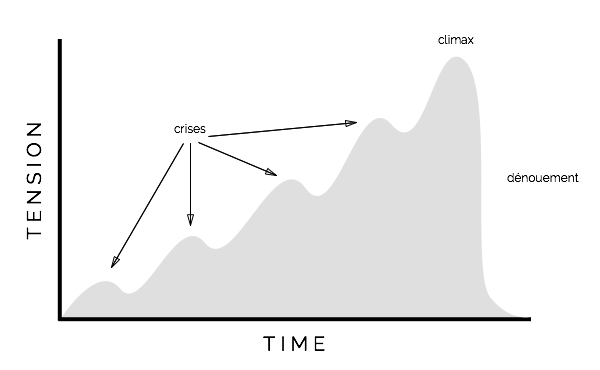
A dramatic gap occurs when the tension of your novel declines when it shouldn’t. The best way to identify these gaps is to draw the story arc as a graph line. Use different colours for subplots to check that the main plot isn’t being overshadowed.

You may encounter lulls in tension shortly after an obstacle is defeated. This is where dramatic lulls are okay as long as they don’t last too long. Overall, the main plot should be increasing in tension as it heads towards the climax.

Tension-and-Time-in-a-Story

If you’ve decided to use 1st person perspective, or are considering it, draw the arc from both a generalised view and then from the 1st person narrator’s perspective. From here you can see whether the delay or lack of knowledge from the narrator’s perspective creates a better dramatic arc. To fill dramatic gaps, build more plot points in strategic places and work on increasing tension.

If it seems that your story isn’t working, trust your instincts. Readers can tell when something is a bit off and, as a writer, you’re a reader too. Be honest if something isn’t working – it’s easier to fix now than later.

If you can’t identify the root of the problem, take a break or ask some trusted writing buddies to look over it. Also research the genre’s conventions. If you’re writing genre fiction, look into a tried and tested outline such as the hero’s journey or the eight-point arc.

***

Identify the Core Message (Theme)

Novels have a core message, whether it’s clear or not. You could successfully write your novel none the wiser of its deeper meanings. Yet, by knowing the core, you can write a stronger novel.

Identifying your core helps when you need to decide between two possibilities, and keeps the novel feeling as one whole piece of work.

“Novelists, just like filmmakers, need to truly understand the story they are trying to tell and what impact or take-home feeling or message they want to leave with their readers” – C. S. Lakin

Your core message and themes emerge naturally with your story and can be a phrase, a word or a question. You’ll instinctively know when you’ve hit on your novel’s core or when you’re getting close to it. Here are a few ways to help identify your core message if you don’t already know it:

  • Identify 1 – 4 central or important themes
  • Look at your protagonist’s goal / desire or main obstacle
  • Sum up your story in one sentence (i.e. “pitch”) keeping note of the above two points
  • Make a list of published novels you think are similar. Can you identify their core messages?
  • Share your story premise with others

Once you’ve identified your core, it’s helpful to go back and tweak plot points or characters to align with this. Be careful to not undermine your story by making the core too obvious or preachy.

Consider if there is a motif or style that is appropriate for your core. There’s a chance that you may not like the core message you identify. At this point you have the option to run with what the story says, or rework the aspects of your story that portray the undesired core message.

***

If you are enjoying this post and finding it useful, then don’t forget to check back tomorrow for the next instalment…

You can find the previous parts here: 

Via: http://writersedit.com/how-to-outline-your-novel-11-easy-steps/

How To Outline Your Novel | Part Two

writing

This week, as an extended Bank Holiday Bonus, we will be looking at how to outline your novel:

Taking the time to outline your novel can save you grief in the long run. An outline helps keep your story on-track and progressing past the initial thrill of beginning your work. Maybe you can’t wait to start writing, or maybe you’ve already started but are running into problems. This guide will explain all the techniques you’ll need to craft an effective outline for your novel.

***

Establish Your Settings

Setting is vital to every story. It helps a reader fall into your fiction world, even if your story is set in Earth-as-we-know-it. It can also be critical to the plot: imagine if Grandma’s house wasn’t deep in the woods. Little Red Riding Hood may never have met the Wolf.

The setting also tells the reader about your characters. If Little Red lived in a castle, she may have been more aware of dangerous people, and the Wolf’s motives may have been more than hunger.

Setting can become vague in writing when the writer doesn’t know their setting well. The same way you have character profiles, settings need profiles too. The process of planning your setting is slightly different if your story is set in a real place, though it follows the same general steps.

Before you get to know your setting, you need to choose your setting. If you’re stumped for ideas, the best place to look is in your plot. Setting is tightly linked to plot, primarily affecting what is possible. Does a character need to be or feel trapped? Go for a fort, boarding school, or a safe house in the middle of nowhere.

Usually your story will take place in more than one setting, so go through your plot and make note of the best setting for each scene.

When you start working on details of your setting, you may already have an idea in your mind – Victorian mansion, sea cliffs, military base, Sydney Opera House. Even if you feel familiar with the setting, go around with a camera or search images online.

Make note of what aspects you notice first: is the colour gaudy, do the edges look harsh, are there hundreds of trees? To mix elements of more than one setting, you can put the images in a document and make notes such as “this roof, but that balcony and a bluer colour”. Create a collage or bring out the sketchbook.

“Tear images out of home magazines or catalogs and put them on your vision board. You can also draw floorplans, which can help when you’re trying to navigate your character” – Charlotte Dixon

As mentioned by Charlotte Dixon, maps and floor plans are also a handy tool. If a character spends a lot of time in a building, you need to know the layout so they don’t come from the kitchen into the dining room one time and from the ballroom another.

Likewise, if they travel a lot or go outside to a certain place frequently, maps will help keep you orientated. Draw the street of your character’s favourite coffee shop; what will they see as they sip on their routine morning hot beverage?

Maps and floorplans can be drawn by hand on plain, lined or grid paper, or done in excel by changing the cell sizes to square. Grid is particularly useful for smaller buildings. It may not matter if your castle is 100 or 110 metres long, but there’s a big difference if a house is 10 or 20 metres.

For smaller buildings, also make sure that it is reasonable to fit all the furniture you describe in a single room. If you want to go the extra mile, there are also free 3D modelling programs such as Sketch Up, but generally simple 2D maps are enough.

You may also want to create a setting arc if it undergoes a serious change in the story. This would likely be either physical damage or a change in emotion or meaning. For the former, make notes of what is damaged, how it is damaged and the differences (such as being able to see through a hole in a wall).

Conversely, perhaps a damaged place was fixed or renovated. If the emotions connected to a place change, pick out the details. A sagging roof that once may have seemed a sign of degradation could simply add character.

***

Choose the Shape and Style of Narration

There are three narration shapes your plot can take: linear, non-linear and circular.

Linear narration is when the novel progresses in the typical chronological order. For example, Little Red leaves her house, meets the Wolf in the forest and then again in Grandma’s house.

Non-linear narration shakes things up a bit. In the case of Little Red Riding Hood, for example, Little Red meets the Wolf at Grandma’s, recalls meeting him earlier, is saved by the woodsman, recalls her mum telling her to be careful, and so on, backwards and forwards. Two well-known non-linear novels to have a look at are Catch-22 by Joseph Heller and The Time Traveler’s Wife by Audrey Niffenegger.

Circular narration starts and ends with the characters in the same place. This “place” can refer to a number of things such as a geographical location, an emotional or mental state, or a hierarchical position.

Whatever “place” means for the beginning and end, it should also be important in the middle. The novel The Chrysalids by John Wyndham starts with telepathic mutants being shunned by normal society. They attempt to create a safe place for themselves. However, when they find a whole town of telepaths, they’re looked down on again because of the weakness of their mutation.

If your novel is to be in a nonlinear or circular shape, it’s best to first craft your outline in a linear form. This makes it easier for you as the author to keep track of the story and helps prevent the plot from becoming confused and lost within itself.

“If you’re timebending or rewinding or flashbacking or Groundhog-daying or getting surreal or showing a series of vignettes that add up to a whole or chopping around like the film Memento, you the writer need to know what the simple order is” – Roz Morris

***

If you are enjoying this post and finding it useful, then don’t forget to check back tomorrow for the next instalment…

You can find the previous part here: 

Via: http://writersedit.com/how-to-outline-your-novel-11-easy-steps/