
30 Ways To Start A Novel 

30-ways-to-start-a-novel.gif

There are many ways to start a novel, but sometimes how to begin just eludes you. Well, here are 30 possible ways to start a novel (or a scene, for that matter) to give you some inspiration:

1.The arrival of a letter, email, or package. (The Thirteenth Tale, Diane Setterfield.)
This could be momentous. However, it could simply tell the reader about the character’s everyday life, such as a distasteful private message on a dating site.

2. A main character in a frustrating situation.
This can also give the reader a feel for her everyday life, while making them empathise with her right away. Maybe her car has broken down, or her cat is puking.

3. A main character in an awkward or embarrassing situation.
Maybe her cat is puking on the lap of a visitor she was trying to impress.

4. The discovery of a dead body. (Thief of Shadows, Elizabeth Hoyt. Also about a million mysteries.)

5. The death of somebody in the family or the community. (All The Pretty Horses, Cormac McCarthy; The Known World, Edward P. Jones.)
This is a popular one, and understandably so, because an ending is a new beginning.

6. The beginning or the middle of a disaster. (All the Light We Cannot See, Anthony Doerr, kind of.)
It could be a bombing, a plane crash, or a tornado.

7. The aftermath of a disaster. (Their Eyes Were Watching God, Zora Neale Hurston.)

8. A kiss.

9. A performance, or the conclusion of one. (Bel Canto, Ann Patchett. This also has a kiss in it!)

10. A main character in the hospital. (Kindred, Octavia Butler.)

11. A main character declaring that he is in big trouble. (The Martian, Andy Weir.) The first line of The Martian is, “I’m pretty much fucked.” But your character’s situation could be somewhat less dire: “I had no chance of doing well that morning.”

12. A main character who’s clearly in big trouble. (What Is the What, Dave Eggers.)
She might be getting mugged or running from Nazi soldiers. Readers will start caring about her immediately.

13. The arrival of a plane, ship, or train. (The Count of Monte Cristo, Alexander Dumas.)
The character might be on board, or he might be watching it come in.

14. A scene at a party, a bar, or a nightclub. (War and Peace, Leo Tolstoy; The Name of the Wind, Patrick Rothfuss.)

15. A fight. (The Warrior, Zoë Archer.)
The character may be part of the fight, or just witnessing it.

16. A character moving in to a new place.
It could be a neighborhood, a dorm room, or a new country.

17. A broad statement about one’s life. (One For the Money, Janet Evanovich.)
One For the Money begins, “There are some men who enter a woman’s life and screw it up forever. Joseph Morelli did this to me — not forever, but periodically.” That’s a great hook.

18. A dramatic moment in the middle or end of the story. (The Secret History, Donna Tartt.)
You can begin here and then backtrack to explain how they got there. For instance, the prologue of The Secret History begins, “The snow in the mountains was melting and Bunny had been dead for several weeks before we came to understand the gravity of our situation.”

19. A trial in a courtroom. (Snow Falling on Cedars, David Guterson; also an example of #18.)
A milder version of this could be your character faces a judge or jury in the form of a parent, a manager, or a peer.

20. A job interview.
I really like this idea because you could get a lot of information across about your character naturally. She might be giving appropriate answers while her internal monologue tells you the rest of the story. Also, an applicant at a job interview is in a vulnerable position, which I think would create empathy for your heroine right away.

21. A main character meets someone new. (Wuthering Heights, Emily Brontë)
A stray cat? A future lover? Someone important, probably.

22. A street scene. (Perdido Street Station, China Miéville.)
Your character could be getting an errand done or going to visit somebody. For a novel that takes place in an historical, futuristic, or fantasy setting, this can be a good way to establish a sense of place as well as establish your character’s normal life and priorities.

23. A main character in a triumphant situation.
Set her up before you knock her down. She could be giving a speech, winning a race, or accepting an award. It could also be a smaller personal triumph, such as successfully fixing a car or turning in her term paper on time.

24. A character or characters getting dressed, shaving, putting makeup on, or doing their hair. (The Makioka Sisters, Junichiro Tanizaki.)

25. A big, happy occasion such as a wedding or a graduation.
Of course, it might or might not be happy for your main character, who may be a participant or someone in the audience.

26. One character teaching another how to do something.
This is another way to establish your main character’s personality and his everyday life. If he’s a father, he could be teaching his son to hunt or to cook rice properly. If he’s an insurance salesperson, he could be giving the new guy some tips.

27. A visitor showing up at the door. (The Big Sleep, Raymond Chandler.)
The main character might be the visitor or the person answering the door.

28. A main character coming across a significant object.
It could be a photograph of a lover she intended to forget, or strange relic that turns out to be magical.

29. A character committing a crime.
He might be the main character, or he might be the antagonist.

30. A character or characters completing a task. (Our Mutual Friend, Charles Dickens.)
This could be an unusual or startling task, or a more ordinary one with emotional significance.

By now, your creative juices should be spilling over. So hop to it! 🙂
Via: http://bryndonovan.com/

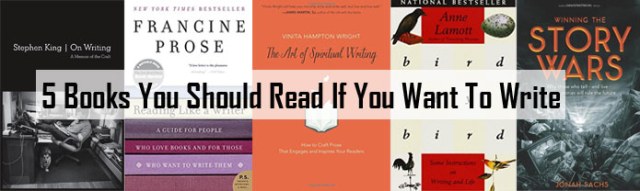
5 Books You Should Read If You Want To Write

5-books-you-should-read-to-write

You have no doubt heard it said over and over again, in order to write, you need to read. Probably the most famous person who says this is Stephen King. And to be fair, if Stephen says it’s true, who am I to argue. The following are 5 top books you should read if you want to write. There are of course many, many others, but these are a good place to start:

1. ON WRITING BY STEPHEN KING

This is a fantastic book on writing. I love Stephen King, and in this book he describes his personal writing process as well as making suggestions for other writers. King is careful to focus mainly on his own journey and not offer blanket statements about writing which may not work for everyone. I really enjoyed the anecdotes and no-nonsense approach to what it takes to be a writer.

2. READING LIKE A WRITER BY FRANCINE PROSE

The premise of this book is firmly founded on the mantra: in order to write, you need to read. Read anything and everything you can get your hands on. Reading the writing of a wide variety of authors allows you to be exposed to different voices, different perspectives, and different ideas. When I was younger, I read nonstop and I’m grateful for the time I put in to each and every one of those books because they taught me how to tell stories.

Prose breaks down her book, Reading Like A Writer, into chapters devoted to different literary devices such as paragraphs, narration, character, dialogue, etc. and offers different excerpts in order for you to read closely and pay attention to what the author is trying to do in his or her work. It’s more of a guidebook than a narration on personal experience, but equally important in order to learn how to focus on all of the different aspects of writing.

3. THE ART OF SPIRITUAL WRITING BY VINITA HAMPTON WRIGHT

I like this book because it is a) short (161 pages) and b) speaks of the importance of authenticity in writing. It is important to share experience and talk about things that are uncomfortable because it’s a way of connecting with others.

Hampton Wright takes her decades of experience as both an editor and an author and lays out a writing manual that describes the best way to write from the heart and inspire other people. It contains both technical writing information as well as advice about what she terms “spiritual writing”.

4. BIRD BY BIRD BY ANNE LAMOTT

This is another great book that contains both suggestions and experiences similar to that of King in On Writing. What I like about it is that it’s even more no-nonsense than King’s book and also goes out of the way to dispel a lot of myths that people have concerning the writing and publishing process.

Be warned, this book does not sugar coats things, which is important in managing expectations. Many people operate under misconceptions that could ultimately harm them if they are seriously trying to make a living as a writer. Lamott is funny, but real, and it’s a quick and entertaining read.

5. WINNING THE STORY WARS BY JONAH SACHS

This book not only appeals to writers, but also marketers and business owners. Sachs writes under the conception that those who tell the best stories will “rule the future”. What he means by that is that in a sea of advertisements, personal stories, social media, and other brand messages, it’s hard for a person or company to get their story out. Writing in a way that breaks through that wall will help your message and your brand gain traction.

Sachs relies on examples from mythology, psychology, the history of advertising, and even biology to push for a revolution of story telling. He offers advice on how to get your story out above the crowd and make others take notice. Along with academia and personal anecdotes, it’s a great book to inspire you to do more with your writing. It’s also a great read for bloggers who are aiming at strengthening their own personal brand and breaking through the noise of millions of other existing blogs.

***

Happy reading! 🙂

Tips for Writing Round Characters

Writing-4

I’ve never had a character come to me fully formed and ready to go. They come to me like ghosts and I have to make them real by getting to know them over time. Creating (good) characters is hard work, but when you take the time and effort to make them ’round’ it’s always worth it.

So what is a ’round’ character? E.M Forster wrote in Aspects of the Novel, that:

“The test of a round character is whether it is capable of surprising in a convincing way. If it never surprises, it is flat… It has an incalculability of life about it – life within the pages of a book.”

Someone once told me that if you can imagine the character existing outside of the novel, if they have lives that reach beyond their role in the book’s plot, they’re round. It’s all about putting life back in those ghostly figures that first appear.

But it’s not always so easy to create a round character. One approach is to let the characters reveal themselves to you, to really sit down and get to know them.

Ask questions.

Write out a set of questions for your character and conduct a kind of interview. This gets your brain thinking about all sorts of random details that you can use for background info to help round out your character. If you’re not sure what to ask, check out this list of possible questions.

HINT: This works even better if you don’t know the questions beforehand. Have a friend do the asking – it’ll keep you on your toes!

Have a chat.

Imagine physically meeting your character for the first time (maybe in a cafe, or at the library – it depends on the character). How does the conversation begin? How do they respond to you? This is great for picking up body language and visualisations about the character.

HINT: It’s not recommended to tell people who aren’t writers that you’ve been ‘talking with your characters’. They just don’t get it. Believe me.

Fill out a job application.

This idea comes from an article on The Write Practice. It’s a great way to work out the facts about a character. Don’t forget the important yet sometimes over looked details like age, date of birth, and previous work history.

HINT: As the article says, don’t hesitate to add more parts to the job application and really scrutinise your character.

Write a letter.

Not many people write letters anymore, so this is a great way to learn more about your character’s motivations, their past, their friends, and so on. It’s a good exercise for creating tone and voice as well as vocabulary.

HINT: Don’t post it!

***

Happy writing 🙂

Via: http://writersedit.com/resources-for-writers/4-tips-writing-round-characters/

13 Struggles Only Unpublished Fiction Writers Understand

unpublished writers srtuggles

First things first. This isn’t an article for all y’all fiction writers who have actually been published. I’m sure you have your problems, but this post is not for you, you beautiful, successful monsters. This post is for the semi-clueless writers whose hearts are still full of hope, with their Word docs full of nonsense plot outlines and six different versions of the same abandoned manuscript. This is for anyone and everyone who is writing a book right now and has no idea what the hell they’re doing, because that’s where I’m at too. If you’re riding on this struggle-bus with me, you know all of these struggles way too well:

1. You never have time to write

Apparently you have to work to pay rent? And see people to maintain friendships? Also, laundry gets dirty, plates don’t wash themselves, and the fridge is not filled by fairies? What! Does not compute???

2. Just kidding — you do have time, and you waste it like nobody’s business

*scrolls into the Twitter abyss*

*calls mum for a catch up*

*finds the lost portal to Narnia*

Oh man, no time to write! Better luck tomorrow.

3. The conditions have to be ‘just so’ when you’re writing

When there’s no pressure, you can write upside down strapped to a rocket. When you’re writing The Novel That Will Make You As Famous As J.K. Rowling, So Help You God, then you need to have a candle burning, a half glass of red wine at your side, and a chimpanzee playing the violin before you’ll even think about opening your laptop.

4. You’re constantly daydreaming about your characters

I’ve apologised to at least ten different stationary objects that I’ve walked into this month alone.

5. You keep getting 40,000 words into something and then immediately want to burn it down

BURN IT ALL DOWN. (Or rename it “ZZZZZ” so it hits the bottom of your Docs folder and you never have to see its ugly mug again.)

6. Whenever someone asks you what kind of story you’re working on, you make this face…

bustle pic 1 face.gif

Which basically says “It’s just this little dumb stupid terrible awful horrible story I’m working on, sort of, kind of, maybe.”

7. And whenever someone asks to read what you’re working on, you make THIS face…

bustle pic 2 face.gif

Whilst thinking “OVER MY DEAD BODY. (Nobody has to read this for it to get published, right? Right??)”.

8. And yet, you’re genuinely concerned about casting the movie for this book you haven’t even finished

Is [insert favourite actor/actress here] available and will they remain available for the next 10-15 years while I’m getting my sh*t together?

9. Friends you didn’t even know were writing a book end up getting published before you do

Congrats, by the way. Can’t wait to read it and love it and eat an entire pack of Oreos consoling myself, you talented pain in the ass.

10. Every 3 weeks or so you are thoroughly convinced that your ideas suck, everything is crap and what the hell were you even thinking?!

Writers are totally emotionally stable, though!! Honestly, we’re fine!! Everything’s great!!!!!!!!! (Help.)

11. Writer’s block is some real sauce

You can stare at that blank page for hours, and end up typing every random word you can think of in the futile quest for inspiration. You start a sentence, and delete it. Get up and make a drink. Type another sentence. Delete it. At the end of the day you have a blank page and a headache from banging your head on the wall. And it’s not like you can talk to anybody about it, because then you’d have to actually admit that you were writing something in the first place.

12. Nobody but you actually cares

Like, you’re a nobody. You have no deadlines, no expectations, and no cheerleaders to provide that much needed praise and admiration for the stinking pile of dog-poop you’re writing. So you are forced to plod on, without reward. Most likely most days you feel dead inside. TELL ME I’M PRETTY, INTERNET.

13. You actually have no freaking idea what to do when you’re done with this giant thing you made

bustle pic 3 face

Click your heels three times, blow some glitter on your manuscript and hope for the best! According to the internet, the “real work” in getting published hasn’t even begun yet.

***

Via: https://www.bustle.com/articles/101031-13-struggles-only-unpublished-fiction-writers-understand


Simple Ways To Boost Your Confidence As A Writer

city-woman-view-blue-sky

Being a writer by profession is an incredibly public thing to do. Our work will inevitably be distributed and read by extended audiences that we may never meet.

With the opportunity of self-publishing thriving, more and more writers have emerged and there is now a saturation of content. More than just asking ourselves how to produce great quality work, we now have to face the question of how to stand out among the crowd as well. 

To do this, one of the most significant attributes to have is confidence.

Confidence helps us stay focused about our writing paths regardless of the amount of competition that is in the industry. Confidence also keeps us motivated to write and write some more regardless of whether our work is labelled successes or failures.

Here are a few simple ways to help writers boost that confidence.

1. Understand the learning process

Though it sounds cliche, it makes the saying no less true: writing is a learning process.

The more we write, the more we will learn about language itself and about the topics we are writing about. For example, if you’re writing about a character in your novel, re-writing the dialogues and revising the plot lines helps you to think more critically about that character and their situation.

Writing and re-writing forces you to make connections between ideas and self-expression. Consequently, the output of repetitive writing practice allows you to create more established thought processes for your next piece of work. In this way too, your confidence will be boosted.

2. Read to learn

The equation of becoming a better writer is simple. We must read and we must write. But to do this well, it is important to maintain a teachable perspective.

As easy as it is for others to read your writing, so will you of others. With no shortage of readily available reading material for us online, it’s become even easier to learn about writing on a more dynamic scale.

People are made up of different stories and their own unique experiences. Consider it a privilege to have incredible amounts of reading material at the tip of your fingers.

Reading with a teachable perspective, though, makes a distinction between reading for enjoyment and reading to learn. Try not to spend too much time comparing, it will only disappoint you as you realise that there will always be someone out there who writes better or has found greater success.

When you read to learn, however, you give yourself potential to discover new ideas, more patterns of writing, new vocabulary and so on. This will help your confidence.

3. Celebrate the little victories

Rarely do writers find success overnight. The potential for an incredibly long process of trying, before your work gets recognised or published, can be confidence crushing.

One way to avoid this is to celebrate the little victories, because success is essentially made of milestones.

Milestones, like getting your articles published online, building your market of influence, extending your network of contacts and gaining inspiration for new ideas, are all included. Even through these victories, you’ll be able to learn more about the writing industry, how to build your writing career and even who to go to when you need help.

These little victories will boost your confidence as you know that you’re gaining achievements that’ll help you in the future.

4. Give yourself a break

Everyone makes mistakes. However, when we understand the learning process of becoming a better writer, we begin to appreciate the mistakes we make.

It’s through our mistakes that we discover what we can improve on in our work. Responding with determination and an active spirit for learning, rather than self-degradation, is a much healthier way of dealing with mistakes and failures.

For Margaret Atwood, author of The Handmaid’s Tale and more recently, The Heart Goes Last, she says in an interview with The Guardian:

“Failure is just another name for much of real life: much of what we set out to accomplish ends in failure, at least in our own eyes. Who set the bar so high that most of our attempts to sail gracefully over it on the viewless wings of Poesy end in an undignified scramble or a nasty fall into the mud? Who told us we had to success at any cost? Get back on the horse that threw you, as they used to say.”

5. Find a trusted writer community

Confidence is a contagious spirit, but so is doubt. It’s crucial that you assess the type of environment you can allow yourself to thrive in.

Ask yourself: is it one that provides opportunities for you to flourish confidently?

Having a community that encourages and inspires your writing processes may be the only thing that is standing in your way of having some inner writer confidence.

More than that, having a trusted writers’ community will put you in a place where you can bounce ideas off each other, get feedback and even, discover ways to overcome challenges specific to a writers’ world.

Writing itself may be something you do alone. However, in preparing for it, ensure that positive energy fuels your writer-mind and places you back into a confident space.

6. Embrace criticism

Finally, criticism is a gateway to a steep learning curve.

As noted before, it’s through criticism that we find out more about what we can make improvements on. At the same time, it’s also through criticism that we see where our strengths lie.

But before you take the criticism too seriously, it’s important to know where your criticism is coming from.

In a digital era, anyone can scrutinise your work and publish harsh comments that may or may not be relevant. It’s easy to have low confidence because of this. After all, hearing negative views about work you’ve poured your heart and soul into can be hurtful. 

Furthermore, you must understand who is criticising you. Are they people you can trust? Are they people whom you respect? Do they want the best for you? Are they offering constructive feedback or just being nasty?

Asking these questions can definitely point us in a better direction on who to trust without sabotaging our writing careers. Some criticism might be worth taking with a pinch of salt. And some can be dismissed altogether. 

All in all, keep an open mind, and try to let your confidence flourish through all criticism, mistakes and little victories. Stay positive, and surround yourself with people who will support you and your writing.

Via: https://writersedit.com/10881/resources-for-writers/6-simple-ways-boost-confidence-writer/

Three Things to Know Before Starting Your Novel

Tips-for-writing-a-novel

Before you jump in the deep end and start writing a novel, there are a few things you should know.

1. The Premise

This one seems obvious, but you’d be surprised at how many authors launch straight into writing before knowing the basics. The premise of your story, is the core of it – the skeleton that runs throughout the whole thing. When someone asks you what your book is about, the premise is what you’ll give them. More often than not, if you begin writing without a premise, chances are that your story will have trouble going anywhere.

For example, this author began writing a novel, knowing the character and his physical journey, but unsure as to what the basic concept of her book was. In 9 months, she struggled to write a measly 13,200 words. By contrast, she then began writing a new novel which had originally been a short story. Knowing the premise this time, in 4 months she wrote 60,000 words and finished the first draft.

“With my first book, I had known the main character inside out, known his travels… But I found it increasingly difficult to write. The scenes were random and didn’t build to anything. I couldn’t have told you what the climax of the novel was. If you compare the progress of my second novel to the first, which remains unfinished, it’s pretty incredible. I’m not saying you should know everything about your story before you start, because it does develop and change drastically as you work. But knowing the premise the second time around changed the way I write for the better.” – Novelist/Creative Writer, Darlinghurst

2. Research Basics

Again, this sounds like an obvious one. Some writers find it easier to set their fiction in a real place, have a character with a similar occupation or family situation… things they’re familiar with. If this is you, that’s great. What I will say is: be careful you don’t omit details accidentally. When you know a setting, a job or a person very well, it’s easy to forget that your reader doesn’t.

To those who are creating from scratch, that’s great too. Is your main character a doctor? An air-hostess? Is your novel set in South Africa? Italy? Russia? Whatever your main character does and wherever they are, know the facts, at least the basics. What does their job entail? Long hours? Mundane tasks? Risk? Who do they work with? How long have they been in their position? Are they happy there? Do they earn a lot? These things won’t necessarily make it onto the actual page, but these factors affect a person’s nature, how they behave, how they live… The same goes for the setting you place them in… Do they have electricity? Do they live above a nightclub? Is their living space small or spacious?

“What I found incredibly useful, was mapping out the settings that my characters spent a lot of time in. Whether it was a room, a house or a village, it was a relief to keep coming back to a reference point and know where things were. I also kept ‘Research Profiles’ for want of a better term, so I could constantly layer my work with authentic touches, whether it was for the environment, political climate or a character.”

3. Character

Try and learn everything you can about your characters before you start writing. Naturally, once you get your story going, you’ll learn more and more about them, however it’s always super helpful to know the basics of who they are, what they do, etc., beforehand. Jot down a profile about each of your main characters including details about their: name, physical appearance, age, which characters they get along with and their relationship, where they live, do they have children? A partner? Do they have any particular mannerisms or quirks? Decide where you want to draw the line with how much you need to know before you start, and how much you learn along the way.

“One of the things I wish I had of known before I started my book was a few extra details about the background of my characters, things that make them distinctive from the rest of my cast. I’m now on my second draft and I’m having to redo character profiles and slot these details in second time around – it would have been a lot less hassle to have done it from the beginning.”

There are plenty of character profile templates available online for free that can be a great help. Click here to see one such example of a useful profile. Although it’s quite long and detailed, it does prompt you to think outside the box.

In conclusion, starting a novel is a huge undertaking and a massive achievement in itself, but sometimes, it helps to have something small, pointing you in the right direction. I hope this little checklist has done that.

Happy writing!

Via: http://writersedit.com/resources-for-writers/three-things-to-know-do-before-starting-your-novel/

The Man Booker Prize 2017 Longlist Announced

The longlist, or ‘Man Booker Dozen’, for the £50,000 Man Booker Prize has been announced.

This year’s longlist of 13 books was selected by a panel of five judges: Baroness Lola Young (Chair); literary critic, Lila Azam Zanganeh; Man Booker Prize shortlisted novelist, Sarah Hall; artist, Tom Phillips CBE RA; and travel writer, Colin Thubron CBE.

The list was chosen from 144 submissions published in the UK between 1 October 2016 and 30 September 2017.

The Man Booker Prize for Fiction, first awarded in 1969, is open to writers of any nationality, writing in English and published in the UK.

The 2017 longlist, or Man Booker ‘Dozen’, of 13 novels, is:

Title Author (nationality) (imprint)

4 3 2 1 by Paul Auster (US) (Faber & Faber)
Days Without End by Sebastian Barry (Ireland) (Faber & Faber)
History of Wolves by Emily Fridlund (US) (Weidenfeld & Nicolson)
Exit West by Mohsin Hamid (Pakistan-UK) (Hamish Hamilton)
Solar Bones by Mike McCormack (Ireland) (Canongate)
Reservoir 13 by Jon McGregor (UK) (4th Estate)
Elmet by Fiona Mozley (UK) (JM Originals)
The Ministry Of Utmost Happiness by Arundhati Roy (India) (Hamish Hamilton)
Lincoln in the Bardo by George Saunders (US) (Bloomsbury)
Home Fire by Kamila Shamsie (UK-Pakistan) (Bloomsbury)
Autumn by Ali Smith (UK) (Hamish Hamilton)
Swing Time by Zadie Smith (UK) (Hamish Hamilton)
The Underground Railroad by Colson Whitehead (US) (Fleet)

Chair of the 2017 judges, Baroness Lola Young, says:

‘Only when we’d finally selected our 13 novels did we fully realise the huge energy, imagination and variety in them as a group.  The longlist showcases a diverse spectrum — not only of voices and literary styles but of protagonists too, in their culture, age and gender.  Nevertheless we found there was a spirit common to all these novels: though their subject matter might be turbulent, their power and range were life-affirming – a tonic for our times.

Together their authors — both recognised and new — explore an array of literary forms and techniques, from those working in a traditional vein to those who aim to move the walls of fiction’.

Arundhati Roy makes the list with her second work of fiction, The Ministry of Utmost Happiness; Roy’s debut novel won the then Booker Prize in 1997. She is joined by four previously shortlisted writers: Ali Smith (2001, Hotel World; 2005, The Accidental; and 2014, How to Be Both); Zadie Smith (2005, On Beauty), Sebastian Barry (2005, A Long Long Way Down; 2008, The Secret Scripture; and longlisted in 2011 for On Canaan’s Side) and Mohsin Hamid (2007, The Reluctant Fundamentalist). It is a third longlist appearance for Jon McGregor (2002, If Nobody Speaks of Remarkable Things, 2006, So Many Ways To Begin).

Three debut novels are recognised by the judges this year, two of them written by the youngest authors on the list: Elmet by Fiona Mozley, aged 29, and History of Wolves by Emily Fridlund, aged 38. The third is George Saunders’ first full-length novel, Lincoln in the Bardo.

Three independent publishers are longlisted: Canongate, Faber & Faber and Bloomsbury. They are joined by Penguin Random House imprint Hamish Hamilton (which publishes four of the 13 titles), 4th Estate, and Hachette UK imprints: Weidenfeld & Nicolson; JM Originals; and Fleet. The latter two are new imprints and this is the first time they have had a title on the Man Booker Prize longlist.

Luke Ellis, CEO of Man Group, comments:

‘Congratulations to all the authors who have been longlisted for this year’s Man Booker Prize. The longlist recognises the hard work and creativity of thought of these exceptional writers, and inclusion is an important achievement. As ever, we are we are very proud to support the Man Booker Prize and the valuable role it plays in promoting literary excellence and endeavour.’

The shortlist and winner announcements

The shortlist of six books will be announced on Wednesday 13 September at a morning press conference at Man Group, the sponsor of the prize. The shortlisted authors each receive £2,500 and a specially bound edition of their book.

The 2017 winner will then be announced on Tuesday 17 October in London’s Guildhall at a black-tie dinner, one of the highlights of the publishing year. The ceremony will be broadcast by the BBC.

The winner of the 2017 Man Booker Prize receives £50,000 and can expect international recognition. In the week following the 2016 winner announcement, sales of The Sellout by Paul Beatty increased by 658%. To date over 360,000 print copies of the Oneworld edition have been sold, and 26 foreign language rights deals have been secured – 19 of which were sold since his win.

Beatty made history in 2016 as the first writer from the United States to win the Man Booker Prize. Prior to 2014 only citizens of the Commonwealth, the Republic of Ireland or Zimbabwe were eligible for the prize.

At a Man Booker reception held in New York last week, Beatty stated that winning the prize has broadened his world and said:

‘I’ll be in Hackney or I’ll be in Calcutta and somebody will stand up and give an amazing diatribe on what this book has meant to them, how this book has touched them. And not all the time, but often, it’s not about how the book is American or it’s set in LA, but about all these bigger things.’

The leading prize for quality fiction in English

First awarded in 1969, the Man Booker Prize is recognised as the leading prize for literary fiction written in English. The list of former winners features many of the literary giants of the last four decades: from Iris Murdoch to Salman Rushdie, Ian McEwan to Hilary Mantel.

The rules of the prize were changed at the end of 2013 to embrace the English language ‘in all its vigour, its vitality, its versatility and its glory’, opening it up to writers beyond the UK and Commonwealth.

The Man Booker Prize is sponsored by Man Group, an active investment management firm. 

Via: http://themanbookerprize.com/news/man-booker-prize-2017-longlist-announced

A Word Factory Masterclass with Louise Doughty | Words Away

Words-Away-Masterclass-with-Louise-Doughty-clipped

Today on Writer’s Blog, I want to share a fantastic article from Words Away on what she learnt at a Word Factory event. I found the whole thing really informative and valuable for my writing, and I hope you will too.

Enjoy! x

How do you work out if your idea is a short story or a novel? You begin writing in one form only to discover that your work has mutated into something else entirely. I attended an excellent masterclass recently, Where The Narrative Leads, with Louise Doughty, run by the Word Factory. Who better to help you work out if your idea can go the distance or is destined to crystallise into a short story than with an award-winning novelist, screenwriter and short story writer? Tucked away in the basement of Waterstones Piccadilly, Louise chatted about her writing process, touching on the main aspects of plot and narrative structure. There was lots of opportunity to ask questions and do some exercises to apply to our own writing.

Who knows where the origin of a story comes from – something grabs the imagination and grows. Two of Louise’s novels, Apple Tree Yard and Black Water, were each inspired by an image of a single character in a situation and started as short story ideas. So why did those short stories turn into a novel? According to Louise there are two elements at work, the first being your character; Look at their biography. If, as Paul Klee suggested, ‘drawing is taking a line for a walk’ why not take your character for a walk. Ask questions of your character; what age are they? What year is the scene set? Interrogate history and events. Play around with what you find. When something starts bothering you – that could be your idea. Anything that feels ‘noteworthy’, find a way to get it in to your story. Join the dots and make connections. Secondly, scrutinise the world in which the character finds themselves; While on a visit to Bali and gripped by jet lag, Louise was seized by an image of a man mortally afraid and lying awake in a hut, listening to rain on the roof. She didn’t know anything about Indonesia or it’s history but set about finding out. Your own ignorance can be a driver more than the stuff you know about. Don’t be stymied by research; if it interests you it will interest the reader. Go and visit your novel – if possible. Walk it out. There’s no substitute for going on location. A pragmatic decision can become a thematic one. Find your way around the limits of your knowledge.

One of the most interesting parts of the evening was looking at the formal principals behind narrative structure. According to the filmmaker, Jean-Luc Godard, ‘All stories should have a beginning, middle, and an end, but not necessarily in that order.’ Referring to the Screenwriter’s Workbook by Syd Field, Louise suggested adapting a few screenwriters tricks to help structure your novel. There was a hand out with a diagram dividing the story into quarters, with a set-up, a mid point and a resolution. Three ‘plot points’ divided the narrative. A plot point takes the course of the narrative, turns it around and spins it in another direction. There’s no going back from this experience. A plot point is not an event that happens but rather when something has impacted on the character’s life to cause irrevocable change. It does not have to be large or dramatic. The point is change.

I loved hearing about Louise’s intuitive approach to writing which she described as a chaotic ‘jigsaw method’ and heartened to learn she writes without worrying too much about outcome. Inspired by an image or a subject she gets up and writes whatever comes into her head that day. Herein lies the joy! Researching along the way, she writes scenes, generates loads of material and leaves gaps as she writes. She’ll go back and fill those in later. She described the physical process of printing out the scenes, then laying it all out on the kitchen table or floor. She looks for her corner scenes, picks out the edges and what might be the beginning or end. She maps it all out into piles of three or four and from this she has a working draft. If overwhelmed she simplifies the story, cutting scenes ruthlessly.

If you’ve never been to a Word factory event, I urge you to go. The guest authors are brilliant if not legendary and, whether you’re a beginner or seasoned scribe, the atmosphere is welcoming and writer friendly. If you’d like a flavour of previous masterclasses click here to read about a couple with Neil Gaiman and Tessa Hadley. It was a great evening with thanks to Louise Doughty, Cathy Galvin and the Word Factory team. I’ve scarpered back to my writing cave to see if I can put some of what I’ve learned into my own writing. Let’s see what the summer brings.

Kellie

PS: With Louise Doughty’s masterclass in mind, YA author Non Pratt has blogged brilliantly about her approach to writing and revising a novel. And thinking about ‘plot points’ and change, I love editor and writing mentor Andrew Wille’s blog highlighting the wisdom of Ursula Le Guin in Steering The Craft:

Conflict is one kind of behaviour. There are others, equally important in any human life, such as relating, finding, losing, bearing, discovering, parting, changing. Change is the universal aspect of all these sources of story. Story is something moving, something happening, something or somebody changing.

Links: The Word FactoryLouise DoughtyPaul KleeJean-Luc GodardThe Screenwriter’s Workbook by Syd Field,

Via: http://www.wordsaway.info/a-word-factory-master-class-with-louise-doughty