How I Got Published | Louise Beech

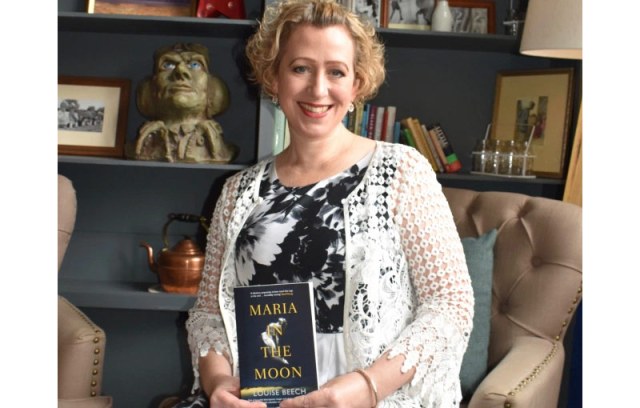
Louise-Beech

Today, an article all about “How I Got Published” by Louise Beech, which I hope you will agree is a very interesting read. Enjoy!

How did I get a book deal? It’s one of the things I’m frequently asked about at book events and festivals. How did I get published?

Unless the person asking – usually a hopeful writer, like I’ve been most of my life – has five hours, the determination to still keep writing despite my reply, and a pretty thick skin, I can’t respond fully. Time and a desire not to dishearten them prevents me answering in detail. Because my journey was long. Ten years long. People serve less time for serious crimes. It was littered with rejection upon rejection upon rejection. There was no satnav to tell me which way to go so that I arrived more easily at my destination.

There’s no magical right answer to the question of how to get published. Every single author will likely have a different tale to share. Some might have enjoyed a quick trip from writing a first novel to book deal, some may have got lucky with their tenth book, but most are probably still driving down the motorway, looking for the right exit.

All I can share is my story. And here it is. Are you ready?

I’ve been writing since I could hold a pen. I filled notepads and exercise books with entire novels (chapters and contents page included) from the age of nine. Writing was then – and still is – pure joy to me. The place I escape to, the place I feel safest, the only place in the world where I really feel I know what I’m doing, and that I’m doing what I’m supposed to be. As a teenager, I started my own magazine to rival the school one, and told anyone who would listen that I’d one day be a world-famous novelist. (That I’m still hoping for.) Then life took over a bit when I got pregnant at nineteen…

In my early thirties, I sent some pieces I’d written to our local newspaper and was offered my own column, Mum’s the Word, in which I wrote for ten years about being a parent. I also began to write short stories. Lots of them. I sent some out to magazines, entered some in competitions. Rejections came thick and fast. I cried the first time. But only once. I got up, wiped the tears away, and decided I had to improve. I wrote more. Slowly, they began being accepted. First by small ezines, and eventually by national magazines. I shortlisted twice for the Bridport Prize.

That was what gave me the confidence to write a novel. Every bit of advice I’d read suggested a writer hone their craft via the precise art of producing short stories, and by joining forums to gain harsh critiques in order to improve. I’d done both. So, after we flooded in 2007 and I had more time due to giving up work to care for my ill daughter, I started Maria in the Moon. It took me six months. It was a labour of not only love, but of tears. When I write, I give everything, and that can be draining afterwards. I let it ‘settle’ and then edited it some more. Then I sent it out to every agent and publisher. Over a period of a year, every single one of them rejected it.

I took time to recover – it’s hard, there’s no denying it, when your lovingly created work is rejected by everyone – and in 2009 I started a second novel, The Lion Tamer Who Lost. I tried to use all the advice I’d been given on forums, and all the tips I’d read by successful authors, but most of all I went back to the place where I knew I was supposed to be. Writing. Six months later I sent it out to every agent and publisher. They all rejected it.

In 2011, I went back to Maria in the Moon and tried to improve her. I tried a couple of new agents. Success! (Or so I thought.) A lady from United Agents invited me to visit her. Carol really liked it and took me on. She did everything, but – again – all the publishers she sent it to said no. One of them liked the style and asked if I had any more ideas for a novel. I told her about The Lion Tamer Who Lost but she didn’t like it. I mentioned one I had in my head, and she liked the sound of it. So, in 2012, I wrote The Mountain in my Shoe.

She said no. Carol sent it to other publishers. They all said no. Some had positive comments, but the general problem seemed to be what I was. Where I fit. I was that difficult creature – I didn’t fit into a genre. But I refused to conform. When I write I can only write what must be written. I can’t fit into some narrow niche. It isn’t me. But this was only going to make things harder.

Ironically, after being told that not fitting into a genre would hinder me, in 2013 I started the novel that was my most unusual and hardest to define – How to be Brave. This was one book that refused to kowtow to any market. I knew this would be my hardest sell, and yet I had to write it. Just as I finished, Carol told me she was retiring. She did everything to try and secure me another agent, but no one was interested. I was on my own again. I had written four books now.

I sent How to be Brave to every agent and publisher. They all said no. At the end of 2014 it shortlisted for a big competition. This is it, I thought. The prize was a book deal. And I was going to win. I wore my lucky red dress, told husband Joe that I knew someone in a red dress was going to win. We arrived at the prize-giving and another writer had on a red dress. She won. I was genuinely happy for her, because I knew how happy she must be. But I cried all the way back to the hotel. I was inconsolable.

I’ll admit, that was the hardest time. Friends asked how I could go on writing in the face of constant rejection. I said I did because I knew one day it would happen. I really did. But I began to lose my faith a little. I began to wonder if I could write a fifth book and go through it all again.

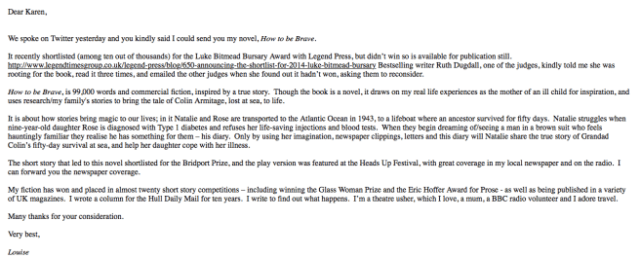
Then on Twitter I saw that a vivacious woman called Karen Sullivan was starting up Orenda Books. She wanted to publish beautiful books. Books she loved. I cheekily (this goes against all professional advice, folks!) tweeted her and asked if she would read How to be Brave. She said yes. She and slush reader Liz liked it. I had a tense wait for a definite answer, between Christmas 2014 and February 2015.

Louise Beech screen-shot-2017-07-03-at-11-11-45

Then on 9th February 2015 Karen emailed to say she loved the book, and of course it was a yes. I think, having read my journey, you can imagine how I felt. It makes me teary now to revisit. I know now that I only got rejected because I was supposed to be with Karen. She’s the only one who ‘got’ me. Got my books. Two years on, she has published the other novels no one wanted. Next year she will publish The Lion Tamer Who Lost too.

And I’m back to do doing what I love, but without all the tears. Writing. I’ve started book five, loosely titled Star Girl. And it’s exactly like when I was nine and filled notepads with words. It’s where I’m supposed to be. What I’m supposed to be doing. And I’m glad I never gave up.
Via: https://louisebeech.co.uk/2017/07/03/how-i-got-published/
This Is What Disabled Looks Like: Living With An Invisible Disability

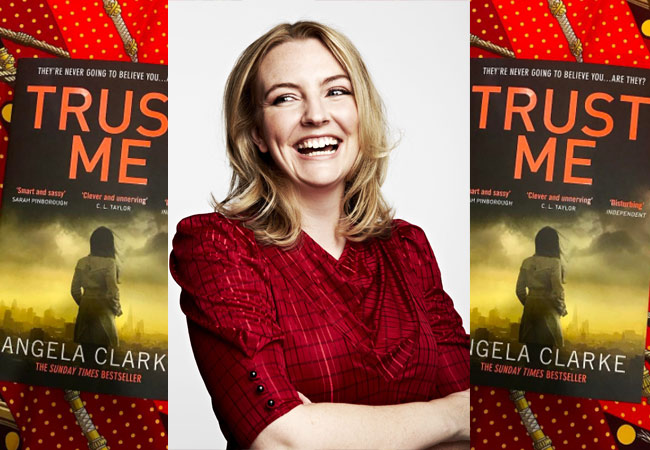
AngelaClarke-disability

Angela Clarke is a crime novelist, who also happens to have an invisible disability. Today, on Writer’s Blog, I wanted to share this important article she has written to highlight the plight being suffered by many people who also have disabilities that you cannot obviously see. Let it serve as a reminder that we should not judge a book by its cover!

The young woman twiddled her Edinburgh Festival staff lanyard and gave a loud, frustrated sigh. She was no more than 21, we were three-quarters into the August arts festival that colonises Scotland’s capital annually, and I could tell she’d had enough of unreasonable requests. Except I hadn’t made one.

Arriving to see a play based on Jurassic Park (if you don’t know the Edinburgh Festival, this is towards the normal end of the programme), I’d discovered the venue was up five flights of stairs. It happens. There are over 10,000 performers sprawling across the capital and it’s impossible to research every venue when you’re packing in five shows a day. No biggie, I just asked if there was a lift.”There is, but I’ll have to ask if you can use it,” the woman replied, before speaking into her walkie-talkie. “Wait here. I’ve called for the manager,” she added.Time ticked towards curtain up, and my friends were looking nervous.

“Can I just go in and use the lift myself?” I said hopefully.

The girl scowled at me.

I told my friends to go. My husband waited with me.

“Is anyone actually coming?” I asked the girl again.

“The disabled entrance opens directly onto the stage,” she replied as if in answer.

With a minute ’til the show started, I sent my husband running up the stairs to catch it. My door guard was still huffing and puffing. I knew what was coming. I’d had this before. Her whole reaction had been as if I were asking for something outrageous. With a triumphant look, she said, “You’ve missed the show. No late admittance.”

“I’d still like to speak to the manager,” I said, feeling myself blush. Alone on the street, I didn’t feel so confident asking for my rights.She gave me a long look up and down. I’m 35. I was wearing Zara denim cut-offs and a Marc Jacobs jumper (sale bargain). My hair is highlighted, and I’d blow-dried it. I wasn’t wearing much makeup but my nails were gel manicured. She thought I was a diva. A Mariah Carey wannabe who didn’t do stairs. Some kind of blagger. She raised an eyebrow and with pointed emphasis said, “Can I ask exactly what is wrong with you?”And I felt sorry for her. “I have a degenerative connective tissue disorder that, among other things, means I injure and dislocate easily, and my mobility is compromised. I find stairs very difficult.”

A FEW WEEKS AGO, A BARMAN REFUSED TO GIVE ME A KEY FOR THE DISABLED TOILET UNLESS I PRODUCED MEDICAL PROOF IN FRONT OF A PACKED PUB. SERIOUSLY, WHO THINKS HAVING A GO IN AN ACCESSIBLE TOILET IS A WINNING SCAM?

The moment the word ‘degenerative’ came out of my mouth, her face fell. She was mortified. She’d made a wrong assumption about me. She was young, she didn’t know better. It’s possible she’d never met anyone like me. Or more likely she had, and never realised. I am one of the 11 million people in the UK estimated to be living with a limiting long-term illness, impairment or disability. There are no statistics on how many of those 11 million have an invisible condition – the term used to describe a wide spectrum of hidden disabilities or challenges that are primarily neurological in nature. But based on similar data studies carried out in the US, we could estimate that 74% of those who live with severe disability do not use either a wheelchair, a walking stick or a cane. In other words, they, like me, often don’t have a visual “tell” that they are disabled. And that is at odds with what many people think someone with a disability looks like.

The Edinburgh Festival worker wasn’t the first to treat me as if I were trying to cheat the system. It happens all the time. Just a few weeks ago, a barman refused to give me a key for the disabled toilet unless I produced medical proof and history in front of a packed pub. (Seriously, who thinks blagging a ride in a lift and having a go in an accessible toilet is a winning scam?) People may think they’re doing a good thing – protecting services for those who they believe truly are disabled – but it’s time for greater awareness. It’s humiliating to have to share personal information just so you can pee. It marks you out as ‘other’. People look at you differently. You quickly become someone to pity, when all you wanted was a glass of wine and a whizz. Able-bodied people aren’t required to give intimate details about their health in front of strangers. Why should I have to justify my need to use a disabled bathroom or the lift? If someone has gone to the bother of queuing at a bar to ask for a disabled toilet key, as opposed to just nipping downstairs to the main toilets, chances are there’s a reason. You shouldn’t be made to feel as if you’re taking the piss when you’re simply trying to go for one.

NEWSFLASH: DISABLED PEOPLE AREN’T SOME DICKENSIAN THROWBACK STEREOTYPE. WE’RE CLEAN, WE TAKE PRIDE IN OUR APPEARANCE, WE LIKE GOING OUT FOR A DRINK AND A LAUGH.

As disability cuts are rolled out, and politicians talk in the rhetoric of “strivers” and “skivers”, there’s an increasing sense that those with disabilities are only ever a drain on society. In 2015, an open letter from Sam Cleasby to a woman who tutted at her using a disabled toilet went viral. Sam is a glamorous 33-year-old who suffers from the invisible condition ulcerative colitis and wears a j-pouch bag that collects faecal matter. In the same year, Corinna Skorpenske’s online response to this note left on her car went viral: “You should be ashamed!! When you take a handicap spot an actual disabled person suffers!” Corinna was with her 16-year-old daughter, who has the invisible but debilitating and painful condition lupus, which severely restricts her mobility. This was the third anonymous note Corinna had received.

Anyone with an invisible condition will recognise this attitude all too well. The reason the Edinburgh Festival worker couldn’t get her head round me being disabled is the same reason why people doubted Sam Cleasby, Corinna Skorpenske’s daughter and countless other sufferers of invisible conditions across the country. People expect those who are disabled to look like victims. Newsflash: disabled people aren’t some Dickensian throwback stereotype. We’re clean, we take pride in our appearance, we also like going out for a drink and a laugh. We have careers, deadlines, lives, loves, and family. We look just like you. Living with an invisible disability throws up enough challenges; don’t let your attitude be one of them.

***

Angela Clarke’s new book Trust Me is out now. You can get your copy here.

Via: http://www.refinery29.uk/amp/invisible-disability

Writers and Authors: 5 Reasons to Drop the Word ‘Aspiring’

Aspiring-Author

There is no such thing as an ‘aspiring writer.’ You are a writer. Period.” – Matthew Reilly

The term ‘aspiring author’/’aspiring writer’ is thrown about in literary circles without anyone giving it so much as a second thought.

It certainly seems like a harmless enough phrase. You’ve no doubt used it yourself, I certainly have. But harmless as it may seem, the term ‘aspiring writer’ is actually quite problematic, and could even be holding you back in your writing career. So the sooner you quit employing the phrase, the better.

Here’s five reasons why you should never refer to yourself as an ‘aspiring author’ ever again:

1. ‘Aspiring’ is an abstract term

Aspirations exist only in thought, not in actuality. To ‘aspire’ is to think, not to do. In this way, the term ‘aspiring writer’ allows for a state of inactivity. Or, as author Chuck Wendig puts it,

“Aspiring is a meaningless, null state that romanticises Not Writing.”

By dropping the term ‘aspiring’ and stating instead ‘I am a writer,’ you confirm to yourself, and to the world, that yes, you are actively working on a writing career. You are writing. You are a writer.

2. ‘Aspiring’ takes the pressure off

By describing yourself as an ‘aspiring writer’, you are essentially stating ‘I am not a writer now, but I would like to be one at some vague point in the future’. In doing this, you are reinforcing the notion in your head that all your writing efforts – all your physical, and actual hard work in pursuing your dreams – all lie beyond the present moment.

The pressure is taken off to write right now. In other words, what you are doing is permitting a ‘diet-starts-tomorrow’ mentality for your writing. But as a little, redheaded orphan once reminded us, ‘Tomorrow’ is always a day away.

Thus, ‘tomorrow’ never comes. So, if you truly want to be a writer, don’t wait until tomorrow, start today.

3. ‘Aspiring’ undermines self-esteem

Think of all the times you have described yourself as an ‘aspiring writer’. How often have you employed the term out of a lack of confidence or self-belief? Because you didn’t feel ‘qualified’ to call yourself a writer. But even if this is not the case, the term itself could be eating away at your self-esteem, without you even realising it.

As we have already established, ‘aspiring’ implies that the state of actually being is a thing of the future. In other words, stating you are an aspiring writer implies that you will not actually be a writer until some, unknown, future date.

In this way, when you use this term to describe yourself, you nurture the subconscious belief that your goal of becoming a writer will always lie just beyond your grasp – just out of reach. Such a belief is extremely demotivating, and can thus undermine your self-esteem.

So the next time you describe yourself, try using a more reaffirming phrase. Don’t say ‘I’m an aspiring writer.’ Say ‘I’m a writer.’

4. ‘Aspiring’ is a term to hide behind

Writing is a very difficult profession. Unfortunately, not all who turn their attentions to the written word succeed. For this reason, those of us who do feel the yearning to construct worlds out of words carry a great deal of anxiety.

We fear failure. We fear others seeing us as failures. And if we admit that we are writers, we must then own up to how much or how little success we have actually found.

Therefore, when we are faced with the judgemental eyes of a long lost acquaintance, probing us with the question, ‘And what do you do these days?’, we feel the need to apologise for the fact that we are not J.K. Rowling. We fear being labelled a failure or pretender, simply because we haven’t sold a million copies of that novel we’re drafting.

So we hide. We hide behind the term ‘aspiring.’ Because if we are merely aspiring, it’s okay if we haven’t found success yet. Because ‘aspiring’ means we aren’t necessarily trying. We are thinking, not doing.

But here lies the problem: if we never accept our title, if we do not stop hiding from our passions and begin at last to pursue them wholeheartedly, we will never find the success we so long for. It’s time we admit what we are. We are writers. No more aspiring. No more hiding.

5. Take yourself seriously

The moment you stop calling yourself an ‘aspiring writer’ and start calling yourself a writer, is the moment you begin taking yourself seriously. This is extremely important, as writers are constantly required to make others believe in them.

We must convince agents, editors, publishers, and readers that our writing is worth their time – that they should take us seriously. But this, of course, is impossible to do unless we take ourselves seriously, first.

So the next time you need to explain to anyone ‘what you do’, don’t shy away and hide. Have confidence in your abilities, and never refer to yourself as an ‘aspiring writer’ ever again. You are a writer. Period.

Via: http://writersedit.com/5-reasons-drop-aspiring-aspiring-author/

Author Interview: Allison Tait

Allison-Tait

Allison Tait describes herself thus on her website:

“I’m a freelance writer, author and blogger, living large(ish) in a small(ish) town. I write a lot. I combine my day job (feature articles & non-fiction books), with my night job (fiction), and my 24/7 job (family). Fortunately, I gave up sleep years ago!”

A professional writer for over 20 years, Allison started her career as a staff writer for magazines and newspapers, and in recent times has added online publishing to her list.

Allison’s latest incarnation is writer of children’s fiction. Her first book in a series – The MapMaker Chronicles – Race to the End of the World – is published by Hachette Australia, under the name A.L.Tait and was released in October 2014. It is the first in a trilogy that is already garnering her a legion of young fans across the country.

Congratulations on the release of the Mapmaker Chronicles. You changed your writing name for this novel. What was the motivation behind this decision?

I didn’t so much change my name as abbreviate it! I wanted to differentiate between the writing I do for adults and this book, which is for kids.

When did you decide to write children’s fiction? Or did it choose you? Can you outline the start of the creative process behind this project? Was there a light bulb moment?

I think The Mapmaker Chronicles chose me! I never imagined I’d be an author of children’s books. When I began writing fiction, I wrote women’s fiction (which I still write, and so far have completed two full-length (90,000+ words) manuscripts, one of which went very close to publication and the second of which I am redrafting).

But I have two boys, now aged seven and ten, and they are both fans of the ‘head-hurting’ question. We have long-and-involved conversations about where space ends, how high the stars are, whether there are any places in the world that remain unexplored, which dwarf from The Hobbit I would invite to a dinner party… you get the idea.

Several of those conversations, close together, led to one of those ideas that make you tingle all over.

“How far does space go?” asked Mr10, one night.

“Nobody knows,” I answered.

Then the next night: “How did they map the world?”

“Well, they had to go out there and find out,” I answered, distractedly.

“They must have been brave,” he answered.

“They were,” I said. “They would have felt exactly as we feel looking out into space, not knowing how far it goes or what’s out there.”

And just like that, in my mind I saw a race to map the world, and a boy who really didn’t want to go.

You have many writing projects on the go at any one time. How do you manage to delve in and out of genres and characters, fiction and non-fiction? Does one writing style provide relief for another?

Over many years of freelance writing, I’ve learnt to juggle lots of projects. I like to have one long-length manuscript on the go, and then I work on articles, corporate work, websites and other things as they come up, using the deadlines as the best way to prioritise work. I really like to work this way – it means I’m never bored and I don’t get writers’ block because I simply move on to something else for a while if the words aren’t flowing for one project. I don’t work on more than one fiction project at a time – I just push through until I have it completed, putting aside any other ‘brilliant ideas’ for later.

With so much on your calendar how do you manage your writing time? Do you have a strict routine? Do you have to make personal sacrifices?

I have a mammoth To Do list and the paid work always comes first. When you have so many deadlines, it’s a simple matter of prioritising what needs to be done each day to ensure those deadlines are met. I don’t have a strict routine for writing in that I just do what needs to be done each day – but I’m at my desk while the boys are at school and I often work at night.

What advice do you have for starting out writers when it comes to pitching stories and managing deadlines? How do you deal with rejection?

Oh, this is such a massive subject. I have a lot of information on my blog at allisontait.com that’s full of advice for freelance writers and my eBook Get Paid To Write: The Secrets of Freelancing Success is full of tips and tricks of the trade. But as a starting point:

  • A pitch is not just an outline of a subject you’d like to write about. You need to find the angle of the subject that is new and exciting and you need to sell it. It’s a real art form and it takes a lot of practice. I often suggest to my students at the Australian Writers’ Centre that they open a magazine, read a story and then try to write the pitch that got the story published.
  • Reliability is essential for any freelance writer, and to be reliable you need to be organised. When you get commissioned to write an article, start making phone calls and lining up interviews that day – even if your deadline is four weeks away. Things don’t always go to plan and you need to allow yourself time to change interviewees or find a new case study or hose down any other disaster that arises.
  • Rejection is part of the game. It’s no fun and I don’t think anyone ever grows to like it, but you do get used to it (sad but true). Remember that the editor is not rejecting you – it’s just that the particular idea you’re pitching is not right for that publication at that time. Have a look at your pitch, rethink it with a new publication in mind and try again. Don’t just send out one blanket pitch to six publications – that will result in a lot of rejection.

Do you have any remedies for writer’s block? (taking your cheeky puppy for a walk?)

Everybody deals with this in their own way. As I said, I don’t really get writer’s block per se, but I do allow myself a lot of thinking time when I’m writing a manuscript. I find that my mind works best when my body is involved in some kind of mindless, repetitive activity, so I walk (not with the puppy though – he’s too distracting!), I wash dishes, I weed the garden, I hang out washing… And I usually find that if I do that for a while, my mind busily unravels whatever plot problem I’ve struck.

Do you find the self-motivation and the discipline required difficult?

Honestly, no. I never struggle to motivate myself to write fiction because I love it. I’d rather be doing that than just about anything else. When it comes to the freelance work, my day job, I have been a fulltime freelance writer for more than 10 years now and I know how to get an article written. Yes, some days I’d rather faff about on the internet and tweet, but that just means that I sit down later that night and get the story done. If I don’t write the article, I don’t get paid – that’s a great motivator!

Writers these days have to be very technically savvy and keep an online presence. How do you juggle your social media commitments with writing?

I think that this comes down to time in the game, as well as time on the field. I have been blogging for nearly five years now and have worked through several different social media platforms to accompany that, whittling it down to the ones that I like. Over the years, I’ve built up an amazing community across my blog, Twitter and Facebook. I do a bit on G+ and Pinterest, but mostly I go to the others because I really like them. My advice to people in this area is two-fold: do what you like and, most importantly, what comes easily to you so that it doesn’t feel like work, and secondly, don’t expect miracles overnight – it takes time to find your networks and create a community.

Do you find writing a lonely experience? It can also be an anti-social exercise. How do the people in your life deal with that?

I like spending time by myself. I have a busy family and social life outside of my work, and I’m more than happy to be alone in a quiet house during the day. I don’t write when my boys are around – or try not to (there are occasions when deadlines need to be met) – and I don’t work on weekends.

Do you have a routine / a particular place and time when you write?

I write in my study. I’ve tried writing in cafes but they’re too distracting. I work while the boys are at school and at night after everyone goes to bed.

Who /what inspires your writing? Who are your favourite authors?

I’m inspired by everything around me. I’m inspired by the joy I get from bringing a story to life. I have so many favourite authors and favourite books that I don’t think I could even begin to name them.

Why writing? Have you always wanted to be a writer?

I think that writing is something that chooses you. I wanted to be an actor for a long time, but then I realised that the stage fright would kill me. I fell into magazine journalism and it kept me happy for a long time. And then I decided I was going to write fiction, so I sat down to give it a go. My first attempts were woeful, but you learn with every manuscript you write.

Do you have any further advice for starting out writers?

My main advice is to stop talking about writing and actually write. You’ll never get a book written if you don’t make the time to sit down and write it.

What is your next major writing project now that the Mapmaker Chronicles is released?

I’ve just completed the third manuscript in The Mapmaker Chronicles series, and I’m redrafting an adult novel that I’m hoping might be my first published in that area. That should take me to the end of the year. After that, who knows?

***

If you’d like to learn more about Allison Tait, you can check out her website here.

You can see the original article here