The Sound Of A Memoir | Article

Lyrics-in-novel-article

An interesting and useful article about using song lyrics in your novel. Makes for a very informative read. Enjoy!


Music is great for writing. Pop those headphones in, start up your two-hour Epic Music track or your carefully curated, book-specific playlist, get in your headspace and go go go.

Music is not great for reading. When I edit a manuscript with song lyrics used as epigraphs, or quoted from one character to another, or someone singing along, I have standard cut-and-paste language:

Consider whether these lines are necessary: using song lyrics falls under a specific copyright area that is not subject to fair use, and obtaining permission is tedious and can be difficult and expensive.

The short answer to “What about using some song lyrics in my memoir?” is “You can’t.” To elaborate, songs written after 1923-ish (depending on when you read this blog post) are almost certainly under copyright. The singer or band associated with the song may or may not be the writer(s). Once you google to find the writing credits, you’ll need to track down the publisher through ASCAP or BMI. The publisher does not want to talk to you until you have a publication contract, or specific, written publication plans including where you’ll be selling the book, the cover price, and how many copies you’re printing. Then the publisher bills you.

It can get expensive, Blake Morrison tells the Guardian:

I still have the invoices. For one line of “Jumpin’ Jack Flash”: £500. For one line of Oasis’s “Wonderwall”: £535. For one line of “When I’m Sixty-four”: £735. For two lines of “I Shot the Sheriff” (words and music by Bob Marley, though in my head it was the Eric Clapton version): £1,000. Plus several more, of which only George Michael’s “Fastlove” came in under £200. Plus VAT. Total cost: £4,401.75.

But what about “fair use”?

Fair use is the legal principle allowing us to quote lines or paragraphs from books under copyright. Quotations are fair use if the number of words used is a very small proportion of the total words in the original work; if the quote is properly attributed; and if it’s essential to the point you’re making in your own work. Song lyrics have not yet been held to a “fair use” standard. Arguably, even a line of a song is a fairly large proportion compared to say, 200 words from a 90,000-word novel. But poetry can be fairly used and often is. What makes songs different?

Publishers with deep pockets, excellent legal teams, and a strong precedent of defending their copyrights.

Beyond legal battles, it’s worth it to consider what impact the quoted lyrics will really have in your book. Does your reader associate “Janie’s Got A Gun” with that beautiful night you sat in a convertible, watching the ocean roll in below the hills? Or does she remember her school’s anti-violence initiative that used the literal message of the song? Will readers from another generation even know the song you’re quoting? Will they think of it as “Mom’s music” instead of “pulse-pounding jam”? Writers can’t control how readers react, so we might as well use words we can craft ourselves.

In the Brevity Podcast Episode 8, Geeta Kothari and I discussed using quotes within essays and stories. In her experience as an editor for Kenyon Review, lyrics often pull the reader out of the story on the page and into their own associations with the song. JoBeth McDaniel, from the Rush editorial board, mentions in the same episode that even quoting other non-song writing raises legal issues that editors just don’t want to deal with.

Sure, it’s a great feeling when a single lyric conjures up a world of emotion in our heart. But it’s both uncertain and a bit lazy to expect that line to do the same for every reader. Instead, ask yourself what emotional purpose that song serves, and put that feeling in the setting, in the narrative, in the dialogue. Or obliquely quote in a way that makes knowledge of the original song unnecessary:

He banged his head to Sweet Child O’ Mine and I wished hard I could like Guns N Roses. (Titles are OK!)

On the radio, Springsteen was on fire, singing his creepy lyrics about Daddy not being home.

We rolled down the windows and cranked up the stereo–GooGooDolls, The Cure, KLM, all the music everyone was listening to, the bass throbbing in my chest and making me feel like I was part of everyone.

You’ve got something important to say. Don’t lean on a song to say it for you. Use your words. Use your images. Use your experiences. Trust in your power to create your own music in the reader’s head.

***

Via: https://brevity.wordpress.com/2018/04/24/the-sound-of-a-memoir/

Create Compelling Characters With These 3 Types of Character Arcs

Characters2

We all know that crafting believable characters with strong motivations is vital in fiction writing. But how do you ensure that your characters remain compelling throughout the course of your story?

The answer is simple: make sure they all have strong character arcs.

What is a character arc?

A character arc is basically the journey a character undertakes over the course of a story. But this doesn’t mean a physical journey.

We’re talking about an inner journey: one that makes a character grow, learn, change, evolve, or even completely transform as the story unfolds.

Generally, this means that a character begins the story as one person, transforms, grows or changes throughout, and ends the story as a different sort of person. In other words, a round character.

Think of it this way: all good stories revolve around conflict. This usually comes in the form of obstacles, both external and internal, that a character must overcome. In order to overcome the obstacles, the character needs to grow or change in some way. And that’s where the character arc comes in.

Obviously, no two character arcs in fiction are exactly the same. But there are three basic archetypes that the majority of character arcs fall into.

Let’s take a look at those now.


The 3 basic types of character arcs

1. Change/transformation arc

The first and perhaps most common arc is one of change and/or complete transformation. It goes hand-in-hand with the hero’s journey – a plot structure found in more books and films than you can count.

This character arc involves a complete change from ‘regular’ person to hero or saviour. Usually reserved for main characters/protagonists, the change/transformation arc usually begins with a plain old ordinary person who’s something of an underdog, or at least seems rather unlikely to be saving the world anytime soon.

However, as the story unfolds, this character undergoes a transformation – usually quite a radical one. Drawing on some inner strength, talent or drive they didn’t know they had, the character ultimately achieves success in what they’ve set out to do – and basically becomes a completely different person in the process.

Well-known examples of this type of character arc include:

  • Harry Potter in the Harry Potter series
  • Bilbo Baggins in The Hobbit
  • Luke Skywalker in the Star Wars series
  • Katniss Everdeen in The Hunger Games series

As you may notice, this character arc is perhaps most common in genre fiction such as fantasy or sci-fi. This is largely due to the mythic/epic quality of the ‘hero’s journey’ narrative – the theory of which has its origins in studies of mythology.

Writing a change/transformation arc

Perhaps the most useful concept to keep in mind when writing this type of arc is that of the lie your character believes.

Most, if not all change arcs involve the character in question believing a particular lie or misconception about themselves or the world around them. The character then discovers the truth, and the way they react to this discovery – how they change in the face of it – forms the basis of their character arc.

This doesn’t necessarily have to be a single lie or misconception, especially if the character arc stretches across multiple books in a series.

In the Harry Potter series, for example, the initial ‘lie’ that Harry believes is a literal lie told to him by the Dursleys: that he is an ordinary boy whose parents died in a car crash. He soon discovers the truth: that he is actually a wizard, and that he survived an attack from an evil wizard who killed his parents.

This sets off Harry’s character arc – his transformation from ordinary boy to brave, world-saving wizard who defeats Lord Voldemort. However, there are many more ‘lies’ that shape and reinforce his arc throughout the series, such as his perception of Severus Snape and the major reveal about his fate as one of Voldemort’s Horcruxes.

So when writing a change/transformation arc, ask yourself: what lie or lies does my character believe? How will they discover the truth? And how will this discovery lead them to change or be completely transformed as a person?

2. Growth arc

This type of arc is different from the above, in that the character grows, but does not necessarily undergo a complete change or transformation.

By the end of the story, they are still essentially the same person, but they have overcome something within themselves. As a result, they are a better or more rounded person, or simply different in some way.

Growth can also be achieved by the character changing their perspective, learning something new, or having a different role by the end of the story.

Basically, this arc is a little more subtle than the ‘hero’s journey’-style arc; in a growth arc, the character won’t end up being the saviour of the universe, but they will have grown, developed and changed in some way.

Well-known examples of this type of character arc include:

  • Elizabeth Bennett in Pride and Prejudice
  • Nick Carraway in The Great Gatsby
  • Jaime Lannister in the A Song of Ice and Fire/Game of Thrones series
  • Samwise Gamgee in The Lord of the Rings series

Just as the change/transformation arc is used most often in sci-fi and fantasy, the growth arc tends to be more common in literary fiction (but, being perhaps the most ‘general’ type of character arc, it’s found across all genres and styles).

Writing a growth arc

Growth arcs work particularly well for secondary characters, especially if your main character is undergoing a complete change/transformation arc. Samwise Gamgee in The Lord of the Rings, for example, experiences a growth arc, while the main protagonist Frodo Baggins undergoes more of a transformation.

While Frodo is totally and irrevocably changed by his experience with the One Ring – symbolised by him leaving the Shire to find peace instead in the Undying Lands – Sam is essentially the same hobbit after his journey, albeit a wiser and more weathered one. He returns to life in the Shire, different but not totally transformed.

When writing growth arcs, compare your character at the beginning and end of the story and ask yourself: at their core, are they essentially the same person? Would they be able to return to ‘regular life’, just with a different perspective, worldview or way of doing things?

As long as your character has learned something, changed their perspective, or improved an aspect of themselves throughout the story, they’ve experienced a growth arc – even if, in their heart, they’re the same homely hobbit they’ve always been.

3. Fall arc

While the above two types of character arc are generally positive, this is a negative arc. It involves the decline or ‘fall’ of a character through bad choices they have made, which ultimately doom them (and potentially others).

By the end of this arc, the character has usually either died, become corrupted, or lost their mind (or if they’re lucky, all three). They have likely ruined their own life as well as the lives of others, and have experienced no redemption or salvation – only downfall.

In the most extreme form of the ‘fall’ arc, the character begins the story as a good/happy/successful person, but by the end of the story is completely unrecognisable – basically the polar opposite of the positive change/transformation arc we discussed above.

Well-known examples of this type of character arc include:

  • Walter White in Breaking Bad
  • Hamlet in Shakespeare’s Hamlet
  • Anakin Skywalker/Darth Vader in the Star Wars series
  • Dorian Gray in The Picture of Dorian Gray

This type of arc is seen a lot in classic tragedy, but is also common in modern literature and film.

Writing a fall arc

Author K. M. Weiland posits that there are three sub-types when it comes to this arc:

  • ‘Typical’ fall – the character changes for the worse through bad decisions.
  • Corruption – the character changes for the worse but ends up embracing the change.
  • Disillusionment – the character discovers a truth about the world that leaves them unhappy or bitter at the end of the story. (This type is sometimes better applied to the growth style of arc, as it doesn’t necessarily involve a complete transformation, just a change of perspective within the character.)

Fall arcs are perhaps most commonly used in creating villains. They’re particularly effective when the character begins as someone who could be perceived as the hero, but undergoes a negative transformation and becomes a villain or antagonist instead (plot twist!).

When writing a fall arc, it helps to consider whether you want readers to be sympathetic to your character. If so, perhaps go down the route of a traditional ‘fall’ arc or a disillusionment; if not, you can create a full corruption arc, in which the character is as terrible as they come!

Be sure to keep things realistic when it comes to character motivations, though – there’s no point giving a character a negative or ‘villain’ arc if there aren’t believable motivations behind it.


A note on flat character arcs

Something to remember: not all characters need to experience a major, defined character arc.

Flat character arcs, while much less common than the types we’ve discussed above, do exist. They involve no change or growth within the character, who’s exactly the same at the end of the story as they were at the beginning.

Flat character arcs are most often found within certain genres, such as mystery (e.g. Sherlock Holmes), adventure (e.g. Indiana Jones), and spy thriller (e.g. Jack Reacher, James Bond).

However, flat character arcs can and do exist within all genres and styles of story. Many minor characters experience flat arcs, leaving the more defined arcs for the protagonist and other main characters.

An important note, though: be careful not to confuse a flat character arc with a lack of development for your character. Sometimes, if your character’s arc appears quite static, it means they are underdeveloped and that their journey and characterisation need to be more compelling – especially if they are a major character.

***

Happy writing!

Via: https://writersedit.com/fiction-writing/create-compelling-characters-character-arcs/

Hemingway on Writing, Ambition, the Art of Revision 

Hemingway-writing

“As a writer you should not judge. You should understand,” Ernest Hemingway (July 21, 1899–July 2, 1961) counseled in his 1935 Esquire compendium of writing advice, addressed to an archetypal young correspondent but based on a real-life encounter that had taken place a year earlier.

In 1934, a 22-year-old aspiring writer named Arnold Samuelson set out to meet his literary hero, hoping to steal a few moments with Hemingway to talk about writing. The son of Norwegian immigrant wheat farmers, he had just completed his coursework in journalism at the University of Minnesota, but had refused to pay the $5 diploma fee. Convinced that his literary education would be best served by apprenticing himself to Hemingway, however briefly, he hitchhiked atop a coal car from Minnesota to Key West. “It seemed a damn fool thing to do,” Samuelson later recalled, “but a twenty-two-year-old tramp during the Great Depression didn’t have to have much reason for what he did.” Unreasonable though the quest may have been, he ended up staying with Hemingway for almost an entire year, over the course of which he became the literary titan’s only true protégé.

Samuelson recorded the experience and its multitude of learnings in a manuscript that was only discovered by his daughter after his death in 1981. It was eventually published as With Hemingway: A Year in Key West and Cuba — the closest thing to a psychological profile of the great writer.

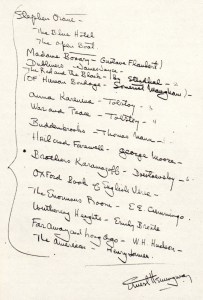
Shortly after the young man’s arrival in Key West, Hemingway got right down to granting him what he had traveled there seeking. In one of their first exchanges, he hands Samuelson a handwritten list and instructs him:

Here’s a list of books any writer should have read as a part of his education… If you haven’t read these, you just aren’t educated. They represent different types of writing. Some may bore you, others might inspire you and others are so beautifully written they’ll make you feel it’s hopeless for you to try to write.

This is the list of heartening and hopeless-making masterworks that Hemingway handed to young Samuelson:

hemingway_readinglist

  1. The Blue Hotel by Stephen Crane
  2. The Open Boat by Stephen Crane
  3. Madame Bovary by Gustave Flaubert
  4. Dubliners by James Joyce
  5. The Red and the Black by Stendhal
  6. Of Human Bondage by W. Somerset Maugham
  7. Anna Karenina by Leo Tolstoy
  8. War and Peace by Leo Tolstoy
  9. Buddenbrooks by Thomas Mann
  10. Hail and Farewell by George Moore
  11. The Brothers Karamazov by Fyodor Dostoyevsky
  12. The Oxford Book of English Verse
  13. The Enormous Room by E.E. Cummings
  14. Wuthering Heights by Emily Brontë
  15. Far Away and Long Ago by W.H. Hudson
  16. The American by Henry James

Not on the handwritten list but offered in the conversation surrounding the exchange is what Hemingway considered “the best book an American ever wrote,” the one that “marks the beginning of American literature” – Mark Twain’s Adventures of Huckleberry Finn.

Alongside these edifying essentials, Hemingway offered young Samuelson some concrete writing advice. Advocating for staying with what psychologists now call flow, he begins with the psychological discipline of the writing process:

The most important thing I’ve learned about writing is never write too much at a time… Never pump yourself dry. Leave a little for the next day. The main thing is to know when to stop. Don’t wait till you’ve written yourself out. When you’re still going good and you come to an interesting place and you know what’s going to happen next, that’s the time to stop. Then leave it alone and don’t think about it; let your subconscious mind do the work.

Then, echoing Lewis Carroll’s advice on overcoming creative block in problem-solving, Hemingway considers the practical tactics of this psychological strategy:

The next morning, when you’ve had a good sleep and you’re feeling fresh, rewrite what you wrote the day before. When you come to the interesting place and you know what is going to happen next, go on from there and stop at another high point of interest. That way, when you get through, your stuff is full of interesting places and when you write a novel you never get stuck and you make it interesting as you go along. Every day go back to the beginning and rewrite the whole thing and when it gets too long, read at least two or three chapters before you start to write and at least once a week go back to the start. That way you make it one piece. And when you go over it, cut out everything you can. The main thing is to know what to leave out. The way you tell whether you’re going good is by what you can throw away. If you can throw away stuff that would make a high point of interest in somebody else’s story, you know you’re going good.

He then returns to the psychological payoff of this trying practice:

Don’t get discouraged because there’s a lot of mechanical work to writing. There is, and you can’t get out of it. I rewrote A Farewell to Arms at least fifty times. You’ve got to work it over. The first draft of anything is shit. When you first start to write you get all the kick and the reader gets none, but after you learn to work it’s your object to convey everything to the reader so that he remembers it not as a story he had read but something that happened to himself. That’s the true test of writing. When you can do that, the reader gets the kick and you don’t get any. You just get hard work and the better you write the harder it is because every story has to be better than the last one. It’s the hardest work there is. I like to do and can do many things better than I can write, but when I don’t write I feel like shit. I’ve got the talent and I feel that I’m wasting it.

When Samuelson asks how one can know whether one has any talent, Hemingway replies:

You can’t. Sometimes you can go on writing for years before it shows. If a man’s got it in him, it will come out sometime. The only thing I can advise you is to keep on writing but it’s a damned tough racket. The only reason I make any money at it is I’m a sort of literary pirate. Out of every ten stories I write, only one is any good and I throw the other nine away.

Hemingway tempers this with a word of advice on ambition, self-comparison, and originality:

Never compete with living writers. You don’t know whether they’re good or not. Compete with the dead ones you know are good. Then when you can pass them up you know you’re going good. You should have read all the good stuff so that you know what has been done, because if you have a story like one somebody else has written, yours isn’t any good unless you can write a better one. In any art you’re allowed to steal anything if you can make it better, but the tendency should always be upward instead of down. And don’t ever imitate anybody. All style is, is the awkwardness of a writer in stating a fact. If you have a way of your own, you are fortunate, but if you try to write like somebody else, you’ll have the awkwardness of the other writer as well as your own.

In a sentiment that calls to mind Neil Gaiman’s magnificent commencement address on the only adequate response to criticism, Hemingway cautions Samuelson about the petty jealousies that arise with success:

When you start to write everybody is wishing you luck, but when you’re going good, they try to kill you. The only way you can ever stay on top is by writing good stuff.

***

Via: https://www.brainpickings.org/hemingway

7 Steps to Tackle Your Screenplay Rewrite

Screenwriting

The most important thing I tell any writer who is embarking on writing their screenplay is to just plow through and get that first draft done.  Here’s the rub though.  Finishing that first draft is only the beginning of the journey for you as a writer.

If there is one thing I know… it’s that the first draft of your script is ALWAYS going to be terrible. Don’t worry. That’s okay. Quality is never your goal with the first draft.  The goal is to scoop those ideas out of your brain, put them on paper and get the structure of your story on the page. When you finally get that glorious awful first draft completed, this is where the real work begins.

1) Put it in a drawer

The last thing you want to do is immediately re-read your goopy brain-droppings after you clickity-clack that final Fade to Black. Your mind needs time to decompress. So find a drawer, put your script in said drawer, and leave it alone until you have a nice solid layer of dust on the cover page which you can blow off like Indiana Jones finding an artifact in some cave in Indonesia.

2) Print that puppy out

It’s been a few weeks and you’re finally able to take a look at that crap you wrote. Don’t use the computer. Print it out. Find your favourite colored felt tip pen and mark that sucker up. You’re bound to find a billion grammar mistakes, missing words, wrong names, etc. But you’ll also figure out scenes that aren’t working and characters who need improvement. New ideas will pop out and make your story work better. You will punch yourself in the face for not thinking of them the first time you wrote this garbage pile, but that’s okay. This is the evolution of the rewrite.

3) Make a New Outline

As you prep to do your first rewrite, open up a notes doc and make an outline (or beat sheet) of everything currently happening in your scrip. This will help you discover everything you need to happen in your next draft. By giving yourself a thorough roadmap for your rewrite, when you dive in, you will know where you need to go to improve all your elements. That said, don’t be afraid to stray from your roadmap. It is good to create new scenes that flow from your fingertips stream of conscious. Some of your best ideas happen in the moment, and are unplanned. If you can surprise yourself, you can surprise your audience.

4) Lather, Rinse and Repeat

After you’ve gotten through that second draft, that now doesn’t completely suck, there’s one thing you need to remind yourself. This still is not good enough to show people. You need to put it back in that drawer. You need to go do something else for a few weeks until you’ve completely forgotten everything you did, and then pull it out and repeat Steps 1-3. How many times you’ll have to repeat these steps, I cannot tell you, but you’ll eventually know when your script is ready to show to someone.

5) Get Notes

Once you finally have a draft that feels pretty good to you, it’s time to show it to a trusted group of readers who know you well enough to tell you how awful your screenplay is without totally destroying your confidence. While you may think your ideas are amazing, if other people don’t find the execution of them equally as amazing… then they might not be to the level you need them to be. Getting people’s’ feedback and applying that feedback to your script is a crucial step.

You must be able to take constructive criticism. You don’t want someone to read your fourth draft script and say “that was great” and not get any notes. Your script always needs work. Most scripts are being worked on while they are shooting the movie. Yours is no different.

Now, that doesn’t mean you have to take EVERY note. A lot of times, I’ll use this rule: if someone gives me a note I don’t agree with, I’ll ignore it for the time being. However, if three people give me that same note, then I know there’s a problem that needs fixing.

6) Have a Reading

Now that you’ve applied all of your notes to the script, it’s time to assemble a group of actors and read your script out loud and have a discussion of the story. Many times, it is an actor who gets a script bought, sold, greenlit, etc. So you need to make sure EVERY character is attractive to the actors who will play the role. Sometimes, you’ll get a tiny note that will make a world of difference when your screenplay finds itself on the desk of a studio reader.

7) The Final Draft

After you’ve squeezed every last drop of creativity from your brain onto the page, and you have done your final grammar pass, and incorporated all of your friends notes, you are ready to give the script to your agent, or producer for review. If you have done your job, their notes will be minimal and getting it into the hands of people who want to buy your screenplay will be the next step to achieve the truly fun and exciting part of being a writer… and that’s doing another rewrite with a director and a star.

In conclusion…

This is the process that works for me.  I hope it works for you.  Good luck!  Now go write that terrible, horrible, no good, very bad first draft of your screenplay.

***

Via: https://screenwritingumagazine.com/2017/12/04/7-steps-tackle-screenplay-rewrite/


How To Edit Your Own Writing

edit-your-writing-705x220

The truth about a first draft is that it doesn’t need to be perfect – it just needs to be written. Even Hemingway claimed that “the first draft of anything is sh*t”. The first draft is where it starts, but even after you place the lid back on your pen, or press print – the process is far from over. The end of writing (and re-writing) marks the beginning of editing your work.

Writing and editing go hand in hand when it comes to producing masterpieces. When we talk about ‘great writing’, we’re also indirectly talking about ‘great editing’. While some writers have the privilege of working for a publishing company and have a professional editor to go through their work, other writers, particularly those just starting out, are their own editors. This article is for the latter. Read on for tips on how to edit your own writing…

Finish Your Work

Before we allow ourselves to be a critic of our work, we have to first finish being a writer. While the creative process can work in many ways, producing work is completely different from critiquing. Allowing both processes to intercede may demoralise the art of our writing. So always give yourself time to finish writing, and then edit it later.

Don’t look back until you’ve written an entire draft, just begin each day from the last sentence you wrote the preceding day. This prevents those cringing feelings, and means that you have a substantial body of work before you get down to the real work which is all in the edit.” — Will Self

Read It Aloud

One of the most effective ways of editing your work is to read it out loud. Reading aloud will force you to take note of your words – each and every one of them. This way, technicalities such as spelling, grammar and punctuation are magnified and more easily spotted. The trick to reading aloud is to read slowly. Speed-reading through your work will not help the editing process.

Reading your work aloud will also sound different compared to when you read it in your mind. When you speak aloud, you’ll begin to hear how your sentences are structured (for better or for worse). Ask yourself, does your work sound clunky? All the clumsy, unnecessary words should be then cut out. If you can imagine it, it’s like the way gardeners shape hedges into desired, quirky shapes; It’s a long process and takes a lot of detailed work.

Anyone and everyone taking a writing class knows that the secret of good writing is to cut it back, pare it down, winnow, chop, hack, prune, and trim, remove every superfluous word, compress, compress, compress…” – Nick Hornby

Take A Break

Editing your own work can be a tedious task. Writers don’t always have the privilege of time but when you do, let the editing process breathe. That means, walk away from your work, get some rest and focus on another activity for a while before coming back to your manuscript. If you find yourself constantly deleting and rewriting big chunks of work, or correcting a comma use, only to put it back again, then it might be due time to take that break.

After re-reading your work a couple of times, the structure and sentences of your work will become so familiar that the easiest mistakes will just slide past your eyes. Taking a break will allow you to come back to your work with a fresh perspective. 

The best advice I can give on this is, once it’s done, to put it away until you can read it with new eyes. Finish the short story, print it out, then put it in a drawer and write other things. When you’re ready, pick it up and read it, as if you’ve never read it before. If there are things you aren’t satisfied with as a reader, go in and fix them as a writer: that’s revision.” – Neil Gaiman

Read It Again And Again

There is no magic formula nor set amount of times a work should be edited before it’s ‘right’. While reading your manuscript slowly from front to back may help spot mistakes, another tip is to read it backwards. It may be confusing, but it will certainly help you be a forceful spell-checker on your own, as is makes you examine every individual word out of context.

Are there any words that you aren’t sure about? Get a dictionary. Use a standard dictionary such as The Oxford English Dictionary, or whatever equivalent is commonly used in your jurisdiction.

And look out for contextual errors that spell-check won’t necessarily pick up on. Some of the most common are:

  1. You’re/Your
  2. Affect/Effect
  3. They’re/Their/There
  4. Its/It’s
  5. Then/Than

These errors may be small, but they make all the difference as to how your work will pen out in its final form. It’s the smallest details that convey the type of writer you are and will be.

Be mindful of different perspectives. Ask yourself, how would you feel as the reader? How is what you’re saying conveyed? Sometimes as writers, we get so caught up in trying to account for our own understanding that we begin to lose sight how our work may be interpreted by our target audience.

Let Someone Else Read/Edit It

It is crucial that someone else, other than yourself helps you read through your work before you submit to any publications. Whether it is a professional editor or a trusted writer-friend, getting someone else to read and edit your work is always helpful, as they tend to be able to notice the mistakes that you’ve missed. They will also be able to give a different perspective without being emotionally biased towards your work. This helps prepare you for how your audience might interpret your story.

Editing is for anyone and everyone who writes, especially professionally. In an interview published in The Paris Review with Ernest Hemingway in 1956, Hemingway said that he rewrote the last page of Farewell to Arms 39 times before he was satisfied. The biggest problem, he admitted, was “getting the words right”.

The repetitiveness of re-reading and rewriting during the editing process can be brutal, demoralising and sometimes painfully slow, but it is always completely necessary for writers. When there comes a time when this process discourages you from writing, remember that heavy edit days make great writers.

Good luck!

***

Via: https://writersedit.com/fiction-writing/edit-writing/

Should You Write In The First, Second Or Third Person?

Which-person-do-you-write-in

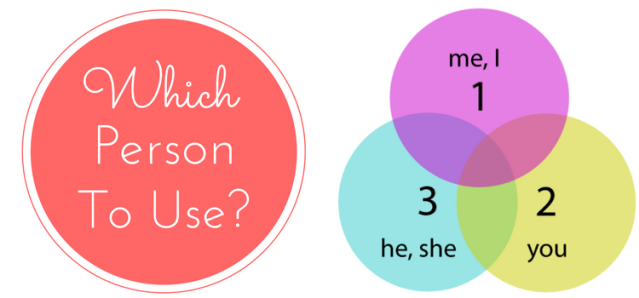
When writing your content, whether it’s a novel or an article, it can become confusing having to decide between the first, second and third person. Which you decide to use is completely up to you, but there is some method behind the madness. Let’s discuss all three options and see which would be the best for you.

The First Person

In a nutshell, first person is you and your views (or your character directly speaking and their views), and is expressed using the word ‘I’. What I like about this writing style is that you can easily express yourself and share your experiences the way it happened. It may be a bit more of a challenge when you are not writing about yourself, but still, the action is experienced in the moment as it is happening.

Many people believe that writing in the first person is the easiest way to write and perhaps they are right to a point. But beware that when you write in the first person as you can get very comfortable and sometimes overshare. If you find yourself doing this a text rewriter may come in very handy at this point.

The Second Person

Second person is where the narrator tells the story to another character using the word ‘you’. The story is being told in the voice of the onlooker, which can also be you, the reader. For instance, the text could read, “You went to school that morning. And whilst you were there you played with some play-dough.”

The second person point of view is rarely used in fiction because of its difficulty level. It is hard to develop a set of characters and a story in which the second person is appropriate. Saying that, however, you can find some fantastic stories that have been written this way if you go and look for them.

If you are writing non-fiction, you can use this style of writing when you are sharing information that does not pertain to your own experiences. For instance, this is handy when you are writing a ‘how to’ blog post or an instructional article of any kind.

If you are not familiar with this writing style, find a word rewriter and use any tools you might need until you get it right. It does take some getting used to, but it is a very effective writing style.

The Third Person

The third person point of view belongs to the person (or people) being talked about. The third person pronouns include he, him, his, himself, she, her, hers, herself, it, its, itself, they, them, their, theirs,and themselves.

You would usually associate this writing style with fiction and storytelling. It is also the preferred writing style for academic literature.

Plenty of stories and novels are written in the third person. In this type of story, a disembodied narrator describes what the characters do and what happens to them. You don’t see directly through a character’s eyes as you do in a first person narrative, but often the narrator describes the main character’s thoughts and feelings about what’s going on.

So in essence, you are a little more removed from the character in terms of direct thoughts and feelings, but you can be aware of more and inform the reader of things that your character could not do directly in first person unless they were actually experiencing them. This option gives you more choice and a greater possibility for knowledge during events, and about other characters.

The Best Choice

As you can see, there is a place for all three point of view writing styles, and one is not necessarily better than the other.

At the end of the day, we all have a different way of communicating, and you should find the style which suits you best. Think about what you have written thus far.Is there one particular style that you naturally gravitate towards?

Even though you might want to go for the easiest writing style, there is nothing wrong with stepping out of your comfort zone every now and then. It might take a little longer to write, but it will be worth the effort to get it right.

Conclusion

Writing is all about sending out good stories into the world, and this should be your principal focus.

If you are writing a novel, try writing a chapter in each different point of view and see what works best or your story. Each story you write may have a different point of view that works best for what you are trying to convey, so don’t assume that just because you usually write in one point of view that it will be the best one.

Read your work out loud, and see if it sounds right. If not, try changing the pronouns and see if it works better. Your story (and characters) will normally tell you how they want to communicate. So listen out for their voice and go with that.

If you are writing an article, write in the way that feels most natural to you. Then you can’t go wrong.

Ultimately, it does not matter if you write in first, second or third person, as long as you are writing authentically for yourself or your characters and connecting with your audience. Happy writing!

***

Via: https://www.justpublishingadvice.com/should-you-write-in-the-first-second-or-third-person/ and https://www.grammarly.com/blog/first-second-and-third-person/


10 Ways To Develop A Unique Writing Style

Unique-writing-style-blog2

Creating and refining your own unique style of writing is important, particularly in the modern Internet age, where a high content turnover means readers are constantly in pursuit of something original and clever. However, it’s often difficult – especially when you’re just starting out – to fine-tune the way you write and embody the qualities that make your voice distinct and innovative.

So how exactly do you tease out those qualities? How do you then apply them to the actual process of writing? Here are ten hot tips to get you started today.

1. Use experiences as a springboard

Start with what you know. If you begin your writing process in a world that you’re familiar with, it’ll generally be much easier for you to slip on your characters’ shoes and immerse yourself into the setting of your story. In fact, J. K. Rowling herself based one of her best-known and most complex characters, Professor Snape, on her chemistry teacher.

Be inspired by real people, real emotions and real events. Reflect on your own journey as a human being. Reflect on small moments that seem to have permanently burned themselves into your memory, and let those reflections guide the philosophy that underpins your writing. As author Kashmira Sheth points out:

The emotional growth of your characters is one place where you can use your own experiences much more deeply. If you are writing about the summer between sophomore and junior year, then you can go back to your emotional state of that summer. Was it the summer of heartbreak, angst, rebellion, disappointment, or sorrow? How did you survive and persist? How did your emotions manifest themselves in your interactions with others? What did you learn? How did that one pivotal summer make you grow and change?”

If the content of your writing leaves you with deep and nostalgic feeling of been there, done that, then it’ll more likely exude a profound sense of realism and empathy – one that will resonate and connect with readers more powerfully.

2. Be aware of what makes your observations unique

Everyone sees the world through their own unconventional lens, but not everyone is aware of the existence of those lenses. That’s when it becomes important to take a step back and become aware.

For instance, if you’re observing the way people engage in conversation, take note not only of the dialogue, but also of the silences, of the interruptions and of the speakers’ unconscious habits like pushing up their glasses, adjusting the collar of their T-shirt or tapping their foot against the carpet. Ask yourself why those habits are emerging in the first place. Are they nervous? Are they scared of the other person’s reaction to a particular piece of news? What does this say about their relationship with one another?

As writer Annie Evett argues in her article on observational writing,

Good observational writing utilises all of the senses in describing the event, character or item; transporting your reader easily into the world you are creating or describing.”

That being said, one question you may ask is: how exactly do you utilise these senses?

3. Awaken all senses

When the reader takes a dip into the waters of your writing, they want to feel something. They want to immerse themselves in imagery that extends beyond a mere description of what can be seen. So it’s your job as the writer to ignite as many of their senses as possible.

Let’s say that you’re writing about a bushfire approaching from the distance. You may initially choose to illustrate the way the fire rapidly gains speed, leaping from tree to tree, an angry flame that cannot be tamed. But wouldn’t your setting be much more evocative if you gave the reader the capacity to hear by assaulting their ears with the strange silence that falls upon the forest, with the sudden roaring of fire as it tears through this silence, with the protagonist’s faint coughs as her lungs choke up with smoke?

And wouldn’t your scene be even more vivid if you also engaged the reader with descriptions of the scent of smoke blowing into her cheeks, of the vile taste of charcoal in her mouth, and of the soft fabric of her blouse battering against her skin as it fights a battle it knows it cannot win?

Writer of the Udemy Blog Margo Jurgens provides some further tips and advice on how to best approach writing sensory imagery.

4. Show with a spin

One of the most common pieces of advice given to writers is ‘Show, don’t tell’ – but it’s also important that you enact the ‘show’ part with a twist. Avoid using the same old words to paint a picture. Try adopting a different approach or perspective.

Let’s take the bushfire example from above. Rather than using phrases like ‘The fire roared’ or ‘Smoke billowed up into the sky’, you might perhaps juxtapose the constant ticking of the clock inside the house with the comparatively erratic rhythms of the fire leaping from treetop to treetop.

You might also use a memory or an anecdote as the transition into your description of the fire’s sudden approach: perhaps the protagonist recalls a time she watched a juggler accidentally drop his flaming torches, and contrasts how quickly the torches were extinguished with how impossible it would be to put out this monstrous bushfire.

5. Avoid clichés

It’s sometimes very easy to fall into the trap of clichés – especially in times of doubt and uncertainty, when you find yourself borrowing the storyline of your favourite novel or imitating the writing style of your favourite author or poet. This can ultimately hinder your potential for originality.

How do you rid your writing of clichés? Writer’s Digest‘s Peter Selgin suggests that the best way to avoid cliché

… is to practice sincerity. If we’ve come by sensational material honestly, through our own personal experience or imagination, we may rightly claim it as our own. Otherwise, we’d best steer clear. Our stories should be stories that only we can tell, as only we can tell them.”

Brian A. Klems gives 12 examples of clichés that ‘need to be permanently retired’, while Writer’s Web provides some tips on how you can identify and avoid clichés.

6. Be intimate with details

Intimate details are the key to enhancing the vivid quality of your writing. Be specific in your characterisation and descriptions of setting. The subtlest of movements – your protagonist tugging at the hem of his shirt, your villain tapping two fingers against the table – can help build up the mood of your story or poem, accentuating the emotions experienced by your characters.

Being specific in your details means combing through your writing and paring it down, so that it includes only those words that (in some way or form) contribute to the meaning you’re trying to convey to the reader. Word choice becomes crucial here.

Author Kristen Lamb highlights the importance of diction: ‘She bolted from her chair’ is much better than ‘She stood quickly out of the chair’, because the word ‘bolted’ holds a powerful sense of action and urgency that the phrase ‘stood quickly’ simply does not have.

7. Turn objects into metaphors

If you’re looking for inspiration, an effective exercise to get your creative mind pumping is to turn random objects into quirky metaphors. Select any item in your line of vision – a pencil, a typewriter, a mug – and write about it in the greater context of life. This exercise gives you the opportunity to turn something mundane into something totally and utterly original.

For instance, you may decide to write about the blinds by your desk. Perhaps they represent the idea that we have control over the degrees of light and dark within us; when the world inside is cold and grey, all we have to do to warm ourselves up is pull open the blinds and let bars of light in.

Feeling creative enough yet?

8. Create strong, authentic voices

A classic example of writing with a strong, authentic voice is J. D. Salinger’s The Catcher in the Rye – when you read that novel, you cannot help but hear Holden Caulfield’s voice in your head. With the effective use of voice, the reader becomes so deeply submerged in the story, the characters and the underlying meanings that they forget a writer has fabricated this world.

Author Junot Díaz draws from his own characters as examples on how to strengthen the various aspects of voice. Blogger Lorrie Porter focuses more on how you can incorporate strong voice into dialogue.

9. Know the rules of writing, then break them

Don’t be afraid to experiment and to test the limits of what you think you are capable of writing. Take Kurt Vonnegut’s 8 tips on how to write a good short story, for instance. Once you understand his rules, you can start bending them and eventually start breaking them. As Vonnegut himself writes,

The greatest American short story writer of my generation was Flannery O’Connor. She broke practically every one of my rules but the first. Great writers tend to do that.”

10. Write a little every day

As the old saying goes, practice makes perfect! The more you write, the more you will grow conscious of your own writing style and thus be able to improve upon it. Blogger Leo Babauta presents a range of tips on how you can write daily.

You might end up writing a few sentences, a few paragraphs, even a few pages. Quantity doesn’t matter; frequency does. So set aside some time everyday and get writing! A world of words await you. Time to turn on your mind and let your creative juices run free.

***

Via: https://writersedit.com/fiction-writing/develop-unique-writing-style/

Effective Ways To Make Your Characters More Memorable

Memorable-characters

Characterisation is, without doubt, one of the most important elements to master when writing a novel or short story.

You may have dreamed up a plot of unparalleled genius or a storyline so amazing you have your readers drooling. However, if you don’t have authentic and compelling characters driving the story, no one will ever reach the final page.

If a story is a sailboat, characters are the rudder that steers the whole ship.

Clever’s not enough to hold me – I want characters who are more than devices to be moved about for Effect” – Laura Anne Gilman

Characterisation is defined by what the characters think, say and do. It’s about the writer developing the personality of the people in the story to make the work interesting, compelling, and affecting.

One could go so far to say characterisation is even more important than plot. If your character is fascinating, whatever they do will take on gravitas.

The best characters are the ones that seem to take on a life on their own. For example, when the reader is always drawn back to the book because they can’t help wondering what the character is up to. It’s not as hard as you think to create a character as memorable as Harry Potter or Sherlock Holmes.

Know Your Character

To allow the readers to engage with your characters, they need to become multi-faceted, living, breathing individuals. You have to know them as personally as you know yourself.

The best way to achieve this is by creating a complete character profile that you can always refer to. This way you can trace how a character might react to every situation and how they might feel about the things that happen to them.

Consider these major factors when formulating a character profile:

Develop A Thorough Backstory

For your character to function successfully as a reliable entity, they must possess a past that has shaped who they are when the reader meets them. You don’t have to reveal it all at once, or even reveal it at all. However, it’s important for putting the character’s actions into context. It’s also a very useful way of teasing out information throughout a story by allowing the reader to slowly learn more about the character.

The key influences on a backstory often include:

  • Where the character grew up
  • Family members
  • Past trauma
  • Religion
  • Socio-economic status
  • Job
  • School

The backstory will be a major influence on how the character moves through the story.

For example, if your character has a traumatic past, it will often result in an unresolved personal conflict when they are older. As outlined in his biography, Harry Potter’s experiences as a child directly affected him as an adult.

When he was a baby, Harry and his parents were attacked by Lord Voldemort. His parents were killed but Harry miraculously survived. When he was older, he continually came face to face with his nemesis. Over many years he began to learn more about why this happened and why other strange things were happening to him. This resulted in a growing motivation to pursue this knowledge, leading him into greater conflict, not only with Voldemort but other characters, include Professor Snape, the Malfoy’s and Slytherins.

For this reason, he reached out for allies. Since many of his allies didn’t survive, including Harry’s Godfather Sirius Black, Harry became angrier and more emotionally damaged. However, he was able to use the love his parents showed in protecting him as strength to overcome his obstacles.

Examine Your Character’s Personality

To some degree, the backstory shapes a character’s personality. However, the personality is also less concrete. Having a good grasp of your character’s personality will allow you to remain consistent throughout the novel and understand how events will have different impacts.

You might ask yourself whether your character is an introvert or an extrovert? Will they be funny, intelligent, kind, charismatic or cowardly? What part of their personality will you seek to emphasise in order to build a connection between them and the reader? Do they have hobbies that reveal more about their outlook?

You may also consider what kind of attitudes and opinions your characters have about life that make them intriguing. For example Mark Renton in Trainspotting, by Irvine Welsh, is a black-humoured heroin addict. His taste in anti-establishment music such as Iggy Pop, Lou Reed, and David Bowie, and his accompanying political views, set him apart as a dynamic, off-beat anti-hero.

Envision The Appearance Of Your Characters

If you yourself don’t have a clear sense of what your characters look like, then it’ll be near impossible for the reader to imagine them. You don’t have to list every specific detail. Allow the reader to use their own creativity.

However, it’s also vital to the overall impression of the character to know how they dress. Do they dress mostly according to their job? How do they display themselves in public, casual or fashionable. Is there something they wear that is of significant symbolic importance?

This will link into the character’s personality and provide the reader with greater insight into their mindset. The reader must be able to logically connect the various aspects of the character.

An example of clothing being a major signifier is the appearance of Jack Reacher in Lee Child’s novels. Reacher commonly wears very plain, practical clothes, often bought cheap so as to attract very little attention to himself. He uses clothes to downplay his size and strength. He wants to seem as ordinary as possible, so that when he gets into trouble he can completely surprise his opponents with his fighting ability.

Name Your Characters

Giving your character a unique or crazy name is a bit of a cheat to making them memorable. However, it’s still worth the thought. No one really gets excited by a character named John Smith. A name can also go some way towards shaping the general impression your character gives to the audience. For example, Inigo Montoya sounds flamboyant and heroic straight off the bat.

Consider this list of the fifty greatest literary character names as inspiration for your own characters. Furthermore, this in-depth character profile template will help you craft your characters more easily.

Write Your Character Into The Story

So now you know your characters, it’s time to integrate them into your story. As stated earlier, you can reveal your characters to the readers in three key ways:

Develop Interior Dialogue

Or more simply, thoughts. Literature has an advantage over film, in most cases, because it allows a writer to delve as deep as they like into the character’s head and directly relay their thoughts. Making use of internal dialogue is a quick way of giving the reader more information and understanding about a character.

Only the character and the audience knows what is going on in the character’s head. While you don’t want to over do it (show don’t tell!), it’s useful in circumstances where you want to show the opinions characters have of each other or the events that happen around them.

Inner dialogue is useful to contrast between what the character says out loud and what they are actually thinking.

Sherlock Holmes is famous for keeping a lot more within than he reveals to others. He holds his deductive reasoning in his head, leaving others puzzled as to how he’s joining the dots of the mystery at hand, until he is sure he has solved the problem. This is why he seems like such a genius when he reveals everything at the end of each story.

Create Authentic Dialogue

Dialogue is the most obvious way of displaying your character’s personality. Their delivery and vocabulary will reveal ample information to the reader, even through a simple conversation. How they converse with other characters is vital to their development and how the audience views them. Tone and inflection are everything.

In the dialogue of Arya Stark, it’s easy to identify her passion, petulance, and vulnerability, depending on where she is and who she is speaking to. In this excerpt she displays youthful innocence despite her otherwise feisty nature:

“I bet this is a brothel,” she whispered to Gendry.
“You don’t even know what a brothel is.”
“I do so,” she insisted. “It’s like an inn, with girls.”

– George R. R. Martin, A Storm of Swords

Talking to guards at a gate she displays her volatile temper:

“I’m not a boy,” she spat at them. “I’m Arya Stark of Winterfell, and if you lay a hand on me my lord father will have both your heads on spikes. If you don’t believe me, fetch Jory Cassel or Vayon Poole from the Tower of the Hand.” She put her hands on her hips. “Now are you going to open the gate, or do you need a clout on the ear to help your hearing?”

– George R. R. Martin, A Game of Thrones

Dive Into The Action

Action is a simple and effective way of coercing your character to give away aspects of themselves. Someone slams a door, they’re angry. They runaway, they’re scared or embarrassed. They sigh, they’re disappointed or sad. All of these actions require no speech, yet they still demonstrate to the reader what the character is feeling and thinking.

Action is a great technique to use because it lets the reader play detective. Let them figure out why the character did what they did. This will give the reader satisfaction, when they find out they were right, or surprise, if they were wrong.

In Toni Morrison’s Beloved, we learn that Sethe tried to murder all her children in the past. At first we we struggle to think why she would do this when she seems to love Denver so much. The other events and circumstances allow us to guess at her motivations before they are fully revealed to us. The conclusion provokes the realisation that she was actually trying to spare them a life of misery as slaves.

Don’t Make Them Boring!

Just because your characters seem life-like, it doesn’t mean they’re interesting. Unfortunately, real people can be boring sometimes.

“I don’t know where people got the idea that characters in books are supposed to be likable. Books are not in the business of creating merely likeable characters with whom you can have some simple identification with. Books are in the business of creating great stories that make your brain go ahhbdgbdmerhbergurhbudgebaaarr.” – John Green

You need to give your character a compelling desire or need, a goal that will reel the reader into their story. It might be a story of revenge or mystery, personal redemption or emotional catharsis.

It’s also a good idea to shroud them in some mystery, such that the other characters and the reader can’t quite decipher them. This will keep readers intrigued. For instance, Captain Nemo in Twenty Thousand Leagues Under The Sea by Jules Verne is surrounded by question marks. We know very little of his past or where he got the money to build the Nautilus.

A good character also has to be surprising and unpredictable at times. An effective way to achieve this is to give them some contrasting personality traits. For example, they might be funny but cruel, kind but violent. This just keeps the reader guessing and elevates the tension in the novel.

Danny Kelly in Barracuda by Christos Tsiolkas patiently cares for the handicapped but possesses a violent streak that lands him in jail. Not an evil or dangerous character by any means, yet his violent trait develops from his personal demons regarding his sexuality, and the confusion and stigma that came with it.

Vulnerability is another perfect way to get the reader to interact with your characters and story. If a character is in pain or danger, it’s a human reflex to be drawn to them.

Morn Hyland in Stephen Donaldon’s The Gap Cycle is a character that suffers horribly at the start of the first novel. From that point on we are behind her all the way as she fights through the rest of the harrowing series, finding incredible strength to keep from breaking down completely while trying to care for a son that was born of rape.

It’s important to remember your character doesn’t necessarily have to be likeable, even if they are your main character, as long as the reader becomes attached to their narrative. Alex, the protagonist in A Clockwork Orange by Anthony Burgess commits vile acts, including rape and manslaughter, but we still want to follow him to see if he can be redeemed.

Find Your Characters In The People Around You

When you think of all the different and interesting people in your life, it doesn’t seem so hard to dream up memorable characters. Family members, friends, acquaintances, enemies. All shapes, sizes, ages. You can take parts of all of them to help create authentic characters, while also drawing on your own thoughts and emotions.

In summary, the most important thing to consider can be summed up by Ernest Hemingway’s famous words:

“When writing a novel a writer should create living people; people not characters. A character is a caricature.”

The best way to do this is to make your character profile as detailed as possible, before you start your work. Happy writing!

***

Via : https://writersedit.com/fiction-writing/effective-ways-make-more-memorable-characters/

10 Things You Should Avoid As A New Writer

Ten-things-new-writers-should-avoid

You can write about any subject in any format, whether you’re a blogger, a playwright, a novelist, a freelancer, a screen writer, the list goes on and on.

However, if you’re new to the industry, you’ll have a long way to go before you become one of the best. As with any profession, you’ll experience hurdles and obstacles along the way in situations where you’ll have to learn from your mistakes.

To give you the best possible head start, we’ll explore ten key aspects of writing that you should avoid.

1. Don’t Set a Path

There’s no set path in the writing world. Imagine you wanted to be a lawyer. You’ll go to university, learn everything you need to know, get a job at the bottom of a firm and then you’ll work your way up.

The writing industry has no structure. One moment you could be writing as a freelancer and the next, one of your blogs has gone viral, and you’ve got blogging requests coming in from all angles. As a rule of thumb, do what works for you. Just take things one step at a time.

2. Don’t Be Someone You’re Not

Everybody is different. There’s no point in writing if you’re going to copy the same style and language as one of your writing idols because that’s not you, that’s copying.

Experiment with some different writing styles and formats and see what works best for you. Most importantly, find the style and format that you enjoy.

With this aspect of writing, you’ll get the chance to experiment to find your feet in what kind of writer you’ll be. The more you experiment, the more you’ll discover your own style, the more you’ll enjoy writing and the more productive and successful you’ll be.

3. Never Stop Brainstorming

Even when you’re applying for freelancing jobs, never stop thinking about what you can write about. Maybe you want to publish a book; maybe you want to become a food blogger, whatever you want to be, constantly be thinking about how you can move forward. Never forget to write your ideas down and keep referring to them.

Keeping a journal or ‘thought diary’ is one of the easiest ways to jot down your thoughts as they come to you. It’s also important that you refer back to these thoughts when you can. You never know when you’ll be able to combine two ideas into one winning idea.

4. Don’t Get Disheartened by Feedback

If you’re working as a freelancer, the chances are that not every job will be a five-star rating. When that inevitable low rating comes in, don’t let it break your stride. As with any business, your services won’t be for everyone. Simply take on board the advice, better your skills and move forward.

5. Never Forget the Basics

Spelling, grammar, punctuation, language, format and structure. These are just a few aspects of writing which are essential to master if you want to succeed. Even if you have deadlines closing in on you rapidly, never forget the basics.

Always take your time when checking over your work. One mistake to the wrong client and it can seriously damage your credibility and your reputation.

6. Don’t Get Envious

You may be reading a blog or an article by a writer, and you’ll notice thousands of shares and comments, don’t think ‘Damn, I wish I had that kind of engagement’, you’re just starting out, and it will come with practice.

Take on board the positives and move forward, don’t hate someone because of their success.

Every master of any skill started as a beginner at some point in their lives. As before, take each day as it comes and take your writing career one step at a time. Be open to new opportunities and really explore the multitude of options that are available to you.

7. Don’t Lock Yourself Away

As with any career, life is all about balance. It’s easy to take on a ton of work or to sit down to work on a bulk load of projects, but you’re confining yourself to your desk. Get outside, go for a walk, see some friends and family members. Don’t forget to live your life.

With mounting deadlines and pressure from clients, especially if you’re freelancing, it’s easy to get caught up with working all the time. However, if your aim is to work as a blogger for yourself, it’s important that you set aside time for yourself to explore your ideas and your own concepts.

One piece of advice to live by is to dedicate time aside every other day to write an article for yourself to go on your blog.

8. Never Stop Reading

Whatever format you love the most, whether it’s eBooks, stories, fan-fiction, articles, blogs or research studies, reading is your greatest friend as a writer. By exploring new worlds, concepts and ideas, reading can open your mind up in new and exciting ways.

Not only will reading teach you so much more about writing, as well as tips on aspects such as sentence structure and new concepts, it will also help you to take a break from everyday writing, giving you a chance to relax and to breathe.

One other piece of advice to live by is stepping out of your comfort zone now and then. You may like a specific genre of book or author, but it can change your world by going into a bookshop and asking for a random recommendation. You never know what you’ll be reading next, and you might even discover a new favourite.

9. Don’t Avoid Tips and Advice Pages

At the Olympics, there can only be one gold medallist. However, in the writing world, there is room for an infinite number of successful writers. It is one aspect you should never forget.

Many writers are happy to share their experience and advice with the rest of the community so take on board what they are saying and never dismiss it. One piece of advice could change your life.

Some websites, such as Writer’s Digest, are dedicated help you be the best you can.

10 Never Give Up

Nobody who wanted to get somewhere amazing ever had an easy ride. Whether you wanted to climb Mount Everest or become President, it’s a struggle to get to where you want to be.

No matter how hard life is for you and no matter what it throws in your face, never give up, keep digging, keep tapping, keep scribbling and stay motivated.

Via: https://www.justpublishingadvice.com/10-things-you-should-avoid-as-a-new-writer/