
In this week’s video, learn how to write backstory that matters to your story and entrance readers with its possibilities…
Via http://www.helpingwritersbecomeauthors.com/rule-backstory-matters/

In this week’s video, learn how to write backstory that matters to your story and entrance readers with its possibilities…
Via http://www.helpingwritersbecomeauthors.com/rule-backstory-matters/
You need to give your protagonist and your antagonist story goals. These story goals should be in conflict with each other. Tell a story where your readers can empathise with both your hero and your villain. Make both of them memorable and interesting. But how do you tell if you will have enough conflict in your novel? Answer our conflict test to find out.
Via http://writerswrite.co.za/the-12-question-fiction-writing-conflict-test
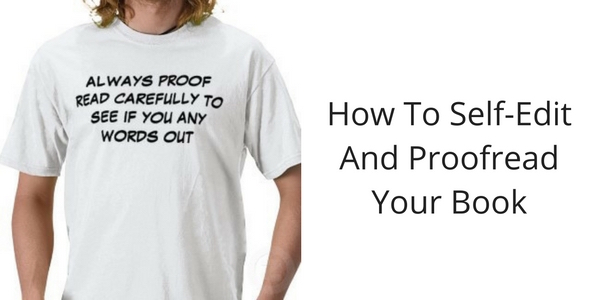
Self-publishing may be an inexpensive way to publish a book, but without thorough proofread and editing, it can turn out to be an embarrassing disaster.
While there is just no escaping the absolute necessity of having an independent pair of eyes at least proofread your book before publishing, you can save yourself a lot of money and embarrassment by doing some of the work yourself.
However, our brains are programmed in an odd way that can make it difficult to find errors in our own writing. So here are a few ways I have found that work effectively. This is not to say that you will achieve perfection, but I guarantee you will be very surprised by the number of errors you do find.
A reader walks into a bookstore. Spies an interesting book. What does she do? Picks it up. Flips to the first chapter. Or, if I can find the first chapter online somewhere, I’ll read it there. One way or another, I want to see that first chapter. Because that’s where you grab me by the balls or where you push me out the door. The first chapter is where you use me or lose me…
Via http://terribleminds.com/ramble/2012/05/29/25-things-to-know-about-writing-the-first-chapter/
When I told people that I’d gone from writing 2k words to 10k words per day, I got a huge response. Everyone wanted to know how I’d done it, and I finally got so sick of telling the same story over and over again that I decided to write it down here.So, once and for all, here’s the story of how I went from writing 500 words an hour to over 1500, and (hopefully) how you can too…

Would you like to know how to supercharge your writing?
Today, novelists are using cinematic technique to create visually dynamic scenes.
Readers, used to watching movies and TV, have come to expect a more ‘cinematic’ experience when they read.
They want to watch the story unfold before their eyes rather than be told what is happening in summary or exposition.

The show, don’t tell mantra haunts every writer, no matter how long they’ve been around. But what does it mean? It’s the used and abused phrase thats truth is lost among endless repetitions.
While this quick guide isn’t the easy-peasy formula for fantastic writing (since that formula doesn’t exist), this is an exploration of a few ways to craft more compelling stories. Follow these steps to show more, tell less and inspire your readers always.
Via http://writersedit.com/3-simple-tips-on-the-show-dont-tell-mantra/

Ah, the love triangle. For the romantically inclined, is there anything more enticing, more gut-wrenching? The passion, the torn desires, the often vastly different futures – it’s simply too much! *back of hand to forehead in fainting gesture!* Okay, I’ll stop. But in all seriousness, a well-written triangle can have your readers not only emotionally invested in the characters and their struggles, but also in you as the writer…
Via How to Write an Irresistible Love Triangle | A Writer’s Path

What is a plot point? Like scenes and the four stages of a novel (inciting incident, rising action, climax, and ending), plot points are another structural element of your story which you’ll need to keep track of. For the writer, plot points are destinations. We write with the purpose of moving the characters towards the plot point. For the character, however, the plot point is a beginning…
via Writing Fundamentals: Plot Points | Truth, Fact, and Fiction

Knowing how to approach your plot will help you work out many things in the rest of your work, from what to research, to chapter length and even the impact of your ending.
Most stories can be classified as plot-driven or character-driven (and sometimes a mash-up of the two). But what do these terms really mean? A lot of websites provide conflicting definitions and examples, but here’s what it boils down to…
 Writer's Blog