
This week, as an extended Bank Holiday Bonus, we will be looking at how to outline your novel:
Taking the time to outline your novel can save you grief in the long run. An outline helps keep your story on-track and progressing past the initial thrill of beginning your work. Maybe you can’t wait to start writing, or maybe you’ve already started but are running into problems. This guide will explain all the techniques you’ll need to craft an effective outline for your novel.
***
Constructing a Timeline
The first step is to create a timeline or plot skeleton with your plot ideas. Be sure to include back story elements, both before the novel’s events and at the point they are revealed to the reader. Don’t worry if you have little to start with, it’ll quickly build up. Make sure to leave space for more details.
There are many ways to construct your story outline. Try a few techniques and see what works for you. You could start by writing out key events, or by writing a short paragraph for each narrative arc within your novel. Either way, you’ll eventually need to look at your novel as a compilation of separate events and as a whole.
If you’re stuck with what to do in the middle, or even at the beginning, try starting with what you want to happen at the end and then reverse engineer a path to reach that result. I call this method ‘The Stephen King” because he famously writes that he begins a new novel by writing the last scene, and then works backwards.
This works within minor plot points as well. For instance, if you know you want character B to disappear and the other characters to end up in a boat before moving onto the next scene, brainstorm with that ending in mind.
Depending on your story and how you like to work, the timeline could take on several forms. A dot-point list, an actual timeline or a mind-map are the most common, though there are other forms you can use. Often in the planning stage, it’s easier to use pen and paper so you can draw arrows and cross things out. This leaves a reminder of what you’ve tried and what hasn’t worked.
Technique: Write a List
If your story is relatively simple and short, the list-form is often the best way to start your outline. Focus on the core points of the story and jot down any additional ideas as you go. If you were writing “Little Red Riding Hood”, your list-form timeline may look something like this:
- Grandma makes a red coat for her granddaughter
– The granddaughter is called Little Red because she always wears red- Little Red goes to visit Grandma, who’s sick (novel opening)
– Her mum asked Little Red to deliver food (or medicine?)- On the way, she meets Wolf and tells him what she’s doing
– Wolf runs ahead, eats Grandma and disguises himself as her- Little Red is distracted by flowers along the way
– Wolf wears Grandma’s nightcap and glasses, then hides the rest of himself under the covers- Little Red arrives, but notices that Grandma looks different
– Wolf imitates Grandma’s voice- Little Red notices unusually big: ears, eyes, teeth
- The Wolf reveals himself, Little Red screams and a nearby woodsman runs to her aid and kills Wolf
Currently, this is a basic outline and needs a lot more work if it wants to be novel-length. Writing prompts can often help you flesh out your story. Use your imagination and check out Part Four (coming on Thursday) for notes on characters, setting and plot.
Technique: Map the Events on a Line
For stories that span several weeks, months or years, time becomes a big consideration when placing events. Simply writing the same points you’d write on a list along a line can help create a realistic sense of time.
When deciding the duration between events, remember realistic limitations of time. For example, there is time lost when travelling, and there are only so many meals a person can eat or disasters a person can prevent realistically in one day. Many other factors change with time, such as characters’ ages and the seasons.
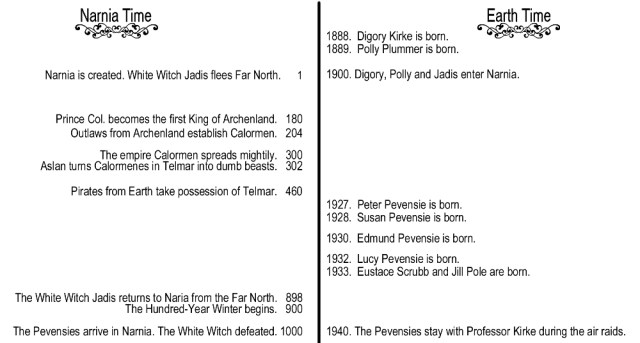
Line-form can also help when comparing two separate time streams, such as in The Lion, The Witch and The Wardrobe.
Lines are more difficult to edit than lists, but a good trick to keep your line flexible is to use index cards or sticky notes that can be easily shuffled and switched around – This is a personal favourite trick of author Julie Cohen (to whom I refer as “The PostIt Queen”). If you are limited for space, Scrivener and Aeon Timeline are two programs popular with writers for this and other purposes.
Technique: Master the Mind-Map
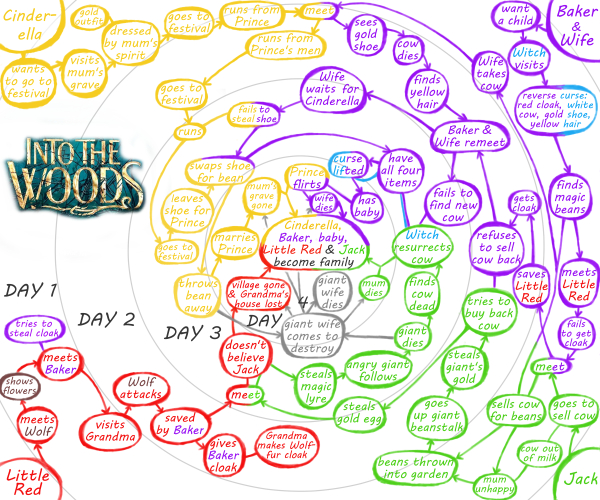
Mind-maps work well for stories that start with a single point and then diverge into several threads, often alternating between characters. Alternately, the story could be several threads converging to one point, like the musical Into The Woods.
To depict the passage of time in a mind-map and be able to easily compare one thread’s time state with another’s, put the point of convergence at the centre, and then draw circles going out. Just like tree rings, each circle you draw can represent another segment of time. When you expand your mind-map, the points in each thread can be placed in its ring-like time “zone”.
***
Explore Your Character Arcs
Character profiles are useful in the initial planning stage. However, when outlining your novel, you need to go beyond this static document. Character arcs show the change or growth a character goes through, and the stages required to get there. The changes could be greater or smaller self-esteem, mastering that ninja technique or realising that money doesn’t solve all your problems.
“Change, transformation, is a constant in our lives and if you can impel some kind of emotional change within your character, it creates an arc of behaviours and adds another dimension to who he or she is” – Syd Field, The Screenwriter’s Workbook
First, determine exactly what part of the story is reflected by the character profile. Often this is the start of the novel. Make a list of any changes you want the character to go through, or changes they need to go through to achieve their profile. Then, check the plot and make another list of possible changes that story events could cause in your character, making note of which changes you want.
If the two lists are contradictory, you may need to reassess your character or plot, or be prepared to work hard and write a character that is believably contradictory. From here, you can continue with the list form, or use a line, mind-map or paragraph to detail out your character arc.
For characters that go through significant change, or for stories that look closely at the human psyche, you may want to do several mini-character profiles. Consider dropping aspects that won’t change, such as physical appearance, unless your character becomes severely ill or can shape-shift.
Another way to use character arcs is to compare them to each other. Firstly, make sure all your characters don’t share the same arc, unless you’re purposefully trying to make a point. If a few characters have similar arcs, try to use one as a comment or opposite reflection on the other, or demonstrate the difference a decision can make.
Also check if any character arcs can assist or become an obstacle for another character’s arc. This can add a new depth to characters’ relationships, and maybe spark off a subplot.
Character arcs can then be used to flesh out your plot. Once you’ve done the arc, make sure the plot supports every small change the character undergoes. If it doesn’t, use this guide to inspire several new plot points.
***
If you are enjoying this post and finding it useful, then don’t forget to check back tomorrow for the next instalment…
Category Archives: Writing
Writing tips, techniques, advice, devices and the like…
7 Must Do Tasks When Your Manuscript is Finished

Your manuscript is finished – so now what?
You’ve sent it off to your editor, proofreader or beta readers, so you can kick your shoes off and relax, right?
No way! You’ve got a lot of work to do.
There are 7 very important tasks you can get to work on while your finished manuscript is in the hands of others, and you will be so busy, you won’t have time to worry about how long your beta readers take in getting back to you.
So, let’s get you to work. (You can follow the links in each section for more detailed information.)
1. Research your book title
Your book title is going to be more important than anything else in attracting potential readers, so it is time to do some serious research into it. You might love your working title, but that means nothing until you are certain it is going to work. You need to know how to find a great book title that is unique, and will attract readers’ interest.
Not only that, you (could, should, ought to) have a sub-title. Why? Because your title and sub-title are your most important pieces of metadata, and metadata is what is used by the Internet and Amazon in their search algorithms. A title and sub-title that are highly searchable will attract more people to your book. More on metadata later.
The most important issue when deciding on your book title is to make sure it is as unique as possible. Joining a long list of books with the same or a very similar title is not going to get you many sales.
2. Get a killer cover.
No, don’t even think of creating your book cover yourself unless you are a graphic designer and an expert with Photoshop. Get a cover or a series of covers designed professionally (but stay within your budget). Great book covers are second only to your title in importance, so don’t take cheap shortcuts.
One simple factor that is often overlooked when deciding on a book cover is how it will look as a small thumbnail image. This is what potential book buyers see first, so it is vitally important that your cover is just as appealing as a thumbnail as it is in full size.
Do your research again, and check the top selling books in your genre to see what their covers are like, and again, how appealing and eye catching they look in small sizes. Another factor to check is the colours that are used by popular books in your genre. You may get a surprise here, as many popular genres use a very small range of colours. For example: Think ‘chic-lit’ – Pastel pinks, blues and green.
3. Write your book description.
Yes, I know. Every author hates this task. However, it must be done, and again, it is going to be a vital part of your book’s metadata so it needs to be extremely well written. Writing a great book description is not an easy task, but again, check top selling books in your genre and make a few notes. Unlike your book of thousands of words, your book description needs to hook a reader’s interest inside 15 seconds, or 150 words. It should be longer of course, but those first words and seconds are the most important of all.
4. Research your categories and keywords.
Without these seven elements, your book will be lost, so choose them extremely carefully. These, along with your book title are the most important pieces of metadata, and researched and selected well, they will allow readers to find your book. They are so important that their power to sell books is greater than you can achieve with paid advertising, blogging or social media. You can expect to have an online audience of your own numbering in the hundreds or thousands. But your carefully selected categories and keywords will give you access to millions of online book buyers.
5. Start your book promotion.
Do not wait until your book is finally published to get the word out about your new book. Build some momentum through your blog and social media and give your audience information about why, how, where and when you wrote your book. If you have a selection of cover ideas, why not ask for opinions on which one people like? Involve your online audience and keep them informed of your progress.
6. Plan your book launch.
Will you make your book available by pre-order? Will you purchase paid advertising? Will you make your book exclusive, or will you open publish? Ask your beta readers for their book reviews so you can add them to your book sales page. Plan ahead and ask book bloggers if they would be willing to help you with your book launch. Do you want to do a virtual book tour? Do not press the publish button without planning your launch. You only get once chance to launch your book, so plan it carefully and well in advance.
7. Decide on your price.
Setting the price for your ebook and/or paperback is crucial. Having a clear book pricing strategy is not as simple as it sounds. There are many factors to consider, such as competitiveness in various geographic markets, differential between ebook and paperback, as well as pricing for turnover or pricing for profit. Book prices are never set in concrete, so think about when you might discount, or increase the price. Are you going to offer a free ebook, and on what schedule? Should you increase your price before offering your ebook for free, and then reduce it afterwards? Again, do some research and write a brief pricing plan for your new book.
With all this work to do, you won’t have time to worry about when your manuscript will come back to you for your last read through and edit before publishing. You will be far too busy, won’t you?
Via :https://www.justpublishingadvice.com/7-must-do-manuscript-tasks
Procrastination: Why Writers Do It
“The thing all writers do best is find ways to avoid writing.” – Alan Dean Foster
For us writers procrastinating can easily become an occupational hazard. It’s very common for us to go out of our way to avoid writing; with procrastination being an enemy of productivity.
When blogger and journalist Megan McArdle researched the topic one of her colleagues told her:
“Well, first, I put it off for two or three weeks. Then I sit down to write. That’s when I get up and go clean the garage. After that, I go upstairs, and then I come back downstairs and complain to my wife for a couple of hours. Finally, but only after a couple more days have passed and I’m really freaking out about missing my deadline, I ultimately sit down and write.”
Sound familiar? Steven Pressfield the author of War of Art believes it’s a form of resistance. In his book he identifies the enemy all of us must face. There is a naysayer within all of us that prevents us from achieving our goals. Whether it be writing a novel, or painting a masterpiece. Pressfield then continues to outline a battle plan to conquer our internal foes.
For many of us this foe can be procrastination. Truthfully there are a million reasons we lack the motivation or inspiration to fill our blank pages and we’re all different, but here are a couple of common ones:
Because we’re afraid
Fear is one of the biggest reasons we procrastinate. Dr. Carol Dweck, a psychologist studying motivation at Stanford University believes that writers are often paralysed by the prospect of writing something that isn’t very good. However, the fear of turning in nothing by a deadline usually outweighs the fear of handing in something terrible. Dr. Dweck believes this is because we regard our failures as growth because when we’re failing, we’re learning. It’s also believed that the “fear of being unmasked as the incompetent you ‘really’ are is so common it actually has a clinical name: Imposter Syndrome“. We spend so much time worrying our writing won’t be good enough, but we need to remember that at the end of the day we’re always our own worst critics and our fears are usually unwarranted. You can find out more on her thoughts in Why writers are the worst procrastinators.
Because we lack inspiration
When we don’t know what to write or we lack inspiration, our motivation can be severely impaired inhibiting our potential to create the art we we’re destined to produce. As mentioned above, sometimes this lack of inspiration stems from our desire to be perfect, but all you need is an idea. Once you have an idea you have the potential to create something amazing.
To overcome a lack of inspiration you need to actively engage with what you’re doing. If you’re writing a book about a prison go interview some inmates or correctional officers, or go visit a prison so you can get the feel for what you’re writing about by submerging yourself in the world of your writing. Sometimes you need a change of scenery, or just a short break. There’s a million different ways to get inspired but we all do this differently, Psychology Today have some good examples in their article ‘Lacking Motivation and Inspiration? 5 Secrets to Get Unstuck’ with everything from finding a muse, to shattering your self doubts, these ideas can help you find some much needed inspiration.
Identifying methods of procrastination
According to author Joanna Penn, procrastinating takes many forms. It isn’t just playing a dozen games of angry birds, it often looks more like this:
- Reading blogs about writing
- Buying more books about writing
- Tidying your desk so that you’ll be ready to write… really soon…!
- Hanging out with other writers (offline or online) and talking about writing.
We spend a lot of time thinking about writing without actually writing, this is a key sign of procrastination and we need to use this knowledge to our advantage.
How to fight it
Being well versed in the art of procrastination is understandable given the culture of constant distraction we live in, but procrastination can be an important part of the writing process.
“It’s folly, what we do, if you think about it – to make something out of nothing, to spin a story or an argument, to ask a reader to give up his or her time and share with us a fantasy, a dream, a conversation, to seize the moment (for a moment) and try to hold it before it slips away”- David Ulin on procrastination as a creative tool.
Procrastination is often used as a defence mechanism, an idea and a blank page is perfect, but once we begin putting that idea into words that perfection can dwindle leaving us raw and exposed. We use it as a strategy for mitigating fear and anxiety.
To overcome this fear we need to follow the advice Annie Dillard provides in her work The Writing Life and understand that we need to write in spite of problems we may encounter. The tension between what we wish for and what we achieve can only be overcome if we work to achieve something. After all Hemmingway himself claimed “The first draft of anything is shit” but as writers we work to overcome this by re-drafting and editing.
If you are stuck in the procrastination bubble, here is some further reading that might help you break free:
Literary Devices: How To Master Flashback

This week Writer’s Blog will be exploring literary devices to help you along with your writing. Literary devices are techniques and structures writers employ to convey their message and story. When done well, the use of literary devices can alter, manipulate and challenge the way a reader perceives any work. Used masterfully, literary devices influence how a story or essay can be interpreted and analysed, as well as how much the reader enjoys the work. Today’s device is Flashback:
How To Master Flashback
A flashback involves (as the name describes) a scene that moves from the present to the past to reveal something about a character or event within the narrative. Generally in fiction, the use of a flashback constitutes using white space to separate the past from the present, to signal to the reader that there has been a change in time and/or place. In some cases, a writer may choose to use italics (usually if the scene is more of a memory snippet than an actual fully-developed scene, as lots of italicized text irritates some readers and editors).
The best flashbacks are set up by the previous paragraph. In the lead up to the flashback, there is generally a ‘trigger’ – something that causes the protagonist/narrator to recall a particular event or detail of the past. The trigger is explored/explained in the flashback itself which then also reveals new information to the reader.
Flashbacks are an opportunity for the author to provide insight into situations that would otherwise be left unexplained…
Used in short stories, poems, novels, plays and movies, it is one of the most common and most recognisable writing techniques, and when executed well, one of the most effective.
Examples:
- The Road (film): The director has used flashbacks throughout the whole film to reveal to the viewer how in a post-apocalyptic world, a father and son came to be on the road, homeless and unprotected.
- Breaking Bad (television series): This series is renowned for doing things differently, and the use of flashback here is no exception. In Breaking Bad, the flashbacks often come first and are then later explained and explored in the next few episodes, setting up a sense of intrigue within its viewers.
- Harry Potter (book series): Yes, even the Harry Potter novels use flashback. Remember the Pensieve that Dumbledore uses? The reader (and Harry) are transported back in time to relive the memories of Dumbledore and others.
***
Tips for Using Flashbacks:
- Use a trigger to justify taking the reader back into the past. This is the most natural way to introduce scenes from the past as this is actually how we recall memories in real life – we see something that reminds us of an event, person or detail that occurred in the past.
- Also ensure that you use another trigger or event to bring your character (and reader) back to the present. This gives your reader clear signals as to when you are changing from past to present and present to past, in order to keep them immersed in the story, but not disorientated and confused.
- Think of these triggers as ‘bookends’ to your flashback – they need to be there to keep this scene neat and tidy, but also shouldn’t stand out like a sore thumb (excuse the cliche).
- Don’t overdo it. Don’t litter your narrative with multiple flashbacks, this becomes irritating and confusing for the reader, but also questions the validity of you setting your story in the present when more is actually happening in the past… If you find you are doing this often, you might want to have a think about changing when you set your story.
- Ensure that each flashback contributes to your story in someway or another, whether it reveals something about a particular event, builds upon your characterization of the protagonist or sets up something for further down the track in the narrative – it has to propel the story forward, even though you’re looking back.
For some fantastic tips for writing successful flashbacks, check out this article at Writer’s Digest.
Literary Devices: How To Master Dialogue

This week Writer’s Blog will be exploring literary devices to help you along with your writing. Literary devices are techniques and structures writers employ to convey their message and story. When done well, the use of literary devices can alter, manipulate and challenge the way a reader perceives any work. Used masterfully, literary devices influence how a story or essay can be interpreted and analysed, as well as how much the reader enjoys the work. Today’s device is Dialogue:
How To Master Dialogue
What is dialogue?
“Dialogue is not just quotation. It is grimaces, pauses, adjustments of blouse buttons, doodles on a napkin, and crossings of legs.” – Jerome Stern, Making Shapely Fiction
Not all of the following are used together, however, dialogue consists of four main elements:
- Spoken words – the direct speech or the words within the quote marks.
- Speech tags – the words that tell the reader who is speaking and how they are speaking.
- Actions of the speaker – a description of the speaking character’s actions before, during and after speech.
- Thoughts or emotional state of the speaker – a description of the speaking character’s emotional state before, during and after speech.
When characters start talking to each other, the story comes to life. A reader can gain a far deeper understanding of a character through their words and actions than they can from the narrative text. A couple of sentences of dialogue can reveal much about the background of a particular character. Are they wealthy or poor? What is their country of origin? Have they been well-educated? Are they feeling happy or sad? All of these questions can be answered with effective dialogue.
***
What should dialogue do?
- Reveal emotions
- Draw the reader into the characters’ lives
- Show the reader how the character reacts to different situations, such as pressure, intimacy, hate, love or fear
- Move the story forward – every piece of dialogue should have a purpose
- Hint at or tell of coming events
- Give balance to a story after a long section of narrative
- Increase the pace of the story
- Contribute humour
- Reflect the changes in emotions and lifestyle of your characters
What should dialogue not do?
- Summarise action that could otherwise be exciting
- Force-feed information to the reader – tell a character something they would already know, purely to fill in background to the reader
- Act as padding to achieve a word count
- Ramble on without the characters learning anything knew or achieving something
- Sound exactly like real speech, with interruptions, rambling, repetitions and stutters, although these have their place
***
Tips for Writing Dialogue
Remember, most people speak quite simply. If you dress up a character’s speech too much it will sound unrealistic.
“If you are using dialogue, say it aloud as you write it. Only then will it have the sound of speech.” – John Steinbeck
Better yet, grab a few friends and act it out, taking note of the speech tags and the actions of the speaker. This can be very entertaining and you’ll be able to see very quickly where your dialogue falls down.
Now over to you.
Literary Devices: How To Master Prologue
This week Writer’s Blog will be exploring literary devices to help you along with your writing. Literary devices are techniques and structures writers employ to convey their message and story. When done well, the use of literary devices can alter, manipulate and challenge the way a reader perceives any work. Used masterfully, literary devices influence how a story or essay can be interpreted and analysed, as well as how much the reader enjoys the work. Today’s device is Prologue:
How To Master Prologue
“What’s past is prologue” – William Shakespeare
This comes from Shakespeare’s play, The Tempest, spoken by the character Antonio who suggests that the events of the past set the stage for the present. The quote is engraved on the National Archives Building in Washington, DC, which houses the most important of the United States’ historical documents. But in a literary work, while the prologue itself precedes the beginning of the story, it can contain events of the past or the future.
What is a prologue?
The prologue serves as an introduction, giving readers important information from the past or the future about the text that follows. It may establish the setting, introduce the characters or indicate a theme or moral in the story. Generally, the prologue is short and will only cover one or two pages. Most prologues are written by the author of the work.
A prologue can foreshadow events and conflict in a way that beginning in the middle of the action can’t. It is used when material that you want to include in the opening is out of time sequence with the rest of the story, giving readers information that is otherwise unobtainable within the normal structure of the novel. A prologue must also be a vital part of the whole text, not just added on before the opening chapter for no reason.
The Redwall Series
Popular children’s author Brian Jacques used both a prologue and an epilogue to frame each story in his Redwall series. Jacques uses the prologue effectively to establish the setting and introduce readers to minor characters with a meaningful story to tell. In these opening scenes, the dialogue between the characters is intended to draw the reader in, as much as it does to the characters who are listening in the story.
The Noon Lady of Towitta
In Patricia Sumerling’s mystery, The Noon Lady of Towitta, the unusually long prologue describes the events leading to the arrival of the police on the farm at Towitta, an isolated town in the Flinders Ranges of South Australia. The prologue is straight-forward and written in third person. The story that follows is told from the first person perspective of Mary Schippan, the lady suspected of murdering her younger sister. Mary Schippan could not have given readers a clear picture of the events preceding the police investigation as she was not present, so the author chooses to employ a prologue. Without it, readers don’t have the necessary background required to understand the story and so obtain it outside of the first person structure of Mary’s narrative.
The Da Vinci Code
In Dan Brown’s The Da Vinci Code, the prologue is employed firstly to establish the plot and setting of the book. Opening at the Louvre Museum in Paris, readers are presented with an event at a specific time and place around which the entire novel is plotted. Jacques Sauniere, the curator of the museum, is shot by a mysterious man and must use his dying breaths to keep his secret alive.
“A collection of the world’s most famous paintings seemed to smile down on him like old friends.” – Dan Brown, The Da Vinci Code
The prologue also establishes a significant theme throughout the novel – the importance of art. As he bleeds to death, Sauniere is surrounded by many famous artworks, one of which, we can assume, is Da Vinci’s Mona Lisa, a painting that plays a critical role in the author’s plot.
***
Writing an effective prologue
The most important feature of a prologue, like any literary device, is that it serves a purpose. Check to see if your prologue is doing a job. Does it establish the setting? Does it introduce characters, or a theme, or a moral? What does it add to the whole work? If it doesn’t have a clear purpose, you don’t need it.
Tip: Read prologues written by your favourite authors
Search for prologues written by the authors on your bookshelf. They’ve been published, so you can assume that the prologue is well written and employed. Look at the length and the style of the writing. The more prologues you read, the better you will understand when and how to use them effectively, if at all.
Tip: Practice writing first lines
Essentially, if you’re using a prologue, you are starting your book twice so you’ll need two great opening lines. It can be useful to practise writing clever opening lines, enticing the reader to continue. If you’re already working on something, ask yourself if the first line is the best it can be. Shuffle the words around. Try a selection of synonyms. Work with it and keep practising.
Tip: Write a prologue for a book that doesn’t have one
Choose a novel without a prologue and consider how one could be used. Try to find something in the text to link with your prologue – a theme, the setting, or even some additional background information. Be creative! You could give a character a secret that affects how they respond to events in the story. Don’t feel discouraged if you find that your new prologue doesn’t work – this just means that you are improving your ability to detect ineffective use of the device.
Literary Devices: How To Master Alternate Point of View

This week Writer’s Blog will be exploring literary devices to help you along with your writing. Literary devices are techniques and structures writers employ to convey their message and story. When done well, the use of literary devices can alter, manipulate and challenge the way a reader perceives any work. Used masterfully, literary devices influence how a story or essay can be interpreted and analysed, as well as how much the reader enjoys the work. Today’s device is Alternate Points of View:
How To Master Alternate Point of View
Alternate Point of View (POV) is a complicated narration form, but, if done the right way, it can make for a captivating read.
This technique combines the depth of a single character’s perspective with the versatility of switching between characters. You can alternate between two characters, or several – but the more you use, the more work you will need to do.
This narration form is paired with either first person POV or limited third person POV. Most commonly, first person alternate POV switches between two characters, but there is nothing stopping you adding more if you can handle it.
You may have heard alternate POV referred to as switching POV, dual POV or multiple POV. ‘POV’ is also sometimes interchanged with ‘perspective’.
Let’s dive into what it all means and how you can use this technique…
When should I use alternate POV narration?
A good way of deciding when to use alternate POV is this: if the story doesn’t need it, stick to single perspective.
Alternate POV is still uncommon enough to distract your reader a little, and some find it frustrating. To avoid this, you want to make sure your story really needs it, and that you do it really well.
This form of narration is all about contrast. The contrast could be in personality, culture or ideology. Whatever the reason, make sure it’s key to the story. If your narrative doesn’t gain anything from each new perspective, cut it back to just one.
Alternate POV is more common in some genres than others. For example, it’s a popular choice in both YA fiction and romance.
“This method allows readers to enjoy getting to know both the hero and heroine intimately by seeing their relationship through both characters’ thoughts.” Gail Gaymer Martin
It’s important to spend a little time thinking about the market and how you’d pitch your alternate POV story, even in the early stages of writing.
If you’re thinking about alternate POV for its practical use of access to different action or location points, it’s worth doing some serious work on the perspectives to make them really pop. This isn’t a narration form that blends in the background; it stands out. So you may as well make the best of its features.
Switching POV within a series
If you’re writing a series, alternate POV can be useful to change things up and sustain interest throughout multiple books.
It’s okay to shake up your pattern a bit with each book. Some series add a new character’s perspective to the mix in the second or third novel as they become more relevant to the plot. Other authors start a series as single-person perspective, and end it alternating between two or more.
As always, you must keep the story’s best interests in mind.
* * *
How to use alternate POV effectively
As we mentioned above, managing alternate POV can be a complicated task. When writing, there are some important considerations to keep in mind to ensure you’re using this technique as effectively as possible.
Here are a few must-dos:
Develop distinctive character voices
Particularly when using first person POV, you want your characters to have clear, distinct voices. This is probably the most important factor of alternate POV, and is a common criticism of stories using this form.
The same way dialogue is tailored to each character, so should their introspection and description of the outside world.
“What’s the point of telling a story from multiple perspectives if the voices aren’t different?”- S. E. Sinkhorn
In alternate POV, character voices drive the story. Make sure your characters don’t just have strong voices, but memorable ones. Giving each character a distinctly different perspective is important to add something unique to the story and help the reader identify who they’re following.
Establish a pattern for your changing POVs
Ideally you’ll want to keep to a pattern, such as character A, then B, then A, then B and so on. Breaking out of a pattern will jar the reader. Sometimes, of course, that’s what you want. The end of Allegiant by Veronica Roth does this particularly well.
Even more important than having a pattern is deciding what POV provides the best tension for each particular moment in the story.
If you find that some chapters are just filling space so you can keep up a pattern, you might want to consider no pattern at all. Repeating the same scene in a different character’s perspective is highly unusual and not recommended, so you need to get it right the first time.
“I ask myself, ‘Who has the most to lose in this situation?’ This question usually makes the best POV character obvious.”- Lisa Walker England
It’s all about reader expectations. If your story starts alternating POV in a set pattern, stick to it. But if there is no clear pattern from the start, you’ll have more freedom to choose who each scene is told through.
Outline your story well before writing
The golden tool for working out your story pattern is doing up an outline. Not only do you need to have clear plots, character arcs and climaxes for each perspective, they need to parallel each other.
Looking at the story as a whole, you should see what character perspective pattern works the most naturally with your story – if you need a pattern at all.
Mark POV switches clearly
Always have a cue when you switch character perspectives, such as the start of a chapter, scene or line break.
“The last thing you want is for the reader to be confused about whose head she’s in. So make sure you give clues right away with setting and internal dialogue before you jump in.” – Lisa Gail Green
Don’t switch too often. The minimum length to keep the same perspective is one scene. However, if your scenes are short, and you change with each scene, this can be taxing on the reader.
For stories in first person POV, switches should occur only with chapter breaks, and generally each chapter is titled after the perspective character.
When writing in third person POV, it’s good to use the perspective character’s name as soon as possible after the change.
Whether you’re writing in first or third person, make sure to go straight to the character whenever you make a switch. Scenery description can happen in a couple of sentences. Grounding the reader is your biggest priority.
* * *
Pros Of Using Alternate POV
As with any choice you make with your story, each technique has pros and cons. Here are three big pros to consider when thinking about using alternate POV.
1. It allows flexibility
Alternate POV offers a combination of depth and flexibility that is hard to find in any other form.
The plot is progressing in two or more places at once? Just switch over to the other character. You need someone to push the big red button to advance the plot, but your lead character needs to be struggling with self-doubt? You can still take your readers through the thrill of the moment inside another character’s head.
Having said this, it’s important to stick to your characters. You can’t just bring along character perspectives for the sake of convenience. But having multiple character perspectives allows you to weave a bigger, more complicated and diverse story.
2. It can help create tension
Tension is important in any story, and alternate POV has a couple of handy features that make it a little easier. Complicating a situation is one technique that can increase tension. Having different perspectives, with different opinions and worldviews all looking at the same thing, can really ramp things up.
“You don’t want your readers bored, and this POV lets you shift heads and keep the reader on their toes.” – Mac Hopkins
You’re not in the one character’s head all the time. That means the reader will miss bits. And you, as the author, can deliberately conceal parts of the story or character to be revealed when you want; the tension of revealing information can be brought out whenever it suits.
3. It gives you control over pacing
With alternate POV, you have full control over your story’s pacing. The simple techniques of shortening the space between each switch can increase the pace.
At times you can put different character’s climaxes side-by-side. And other times you can splice quieter moments of one character with a character facing something more intense.
Cons Of Using Alternate POV
As with any choice regarding literary techniques, there are also a number of cons to using alternate POV. Here are three of the main disadvantages and difficulties…
1. A lot more character development is needed
A challenge with alternate POV is the amount of foundational character development you need to get started.
A single POV means you dig deep in one character. A broader POV, such as omniscient, means you can work just with characters’ external mannerisms. But in alternate POV, you need to be an expert on any and all characters you alternate between.
“More POV characters means the reader has less of a connection to any one character. It’s a price that must be paid.” – Glen C. Strathy
In many ways, your characters will make or break your story. Of course, you need to pay close attention to plot and all other literary features. But your reader needs to know your perspective characters, and fall in love with them – all of them. In the same space you would use for a single POV story.
2. It can be hard to keep track of things
Just as complication can add tension, if you can’t harness the spirals of thoughts and plots, it can be a struggle to pull together a cohesive story. Alternate POV will be very difficult for anyone who isn’t used to planning, scheduling and keeping track of everything.
It’s easy to lose focus, which can lead to character voices sounding too similar, characters with incomplete arcs, or unbalanced tension across the perspective characters.
3. There’s a risk of head-hopping
Head-hopping is an easy mistake for new writers when using third person alternate POV. Head-hopping refers to changing the perspective character within a scene. If you’re alternating with chapters, it also includes accidentally changing perspective within a chapter.
“When the narrator switches from one character’s thoughts to another’s too quickly, it jars the reader and breaks the intimacy with the scene’s main character.” – Joe Bunting
Mastering the switch point between perspectives is important; it will help you avoid the mistake of head-hopping when you intentionally want to switch.
You’re less likely to unintentionally slip if you focus well on the perspective character. Having clear, distinct characters will help you stay in one head.
* * *
Examples of Multiple POV
Alternate/multiple POV has been around for a long time, but has become more common over the last several years. Reading is one of the best ways to become familiar with a writing technique or form.
Below is a list of novels with alternate POV for you to start cultivating your reading list with:
- Jodi Piccoult’s My Sister’s Keeper
- Audrey Niffenegger’s The Time Traveler’s Wife
- George RR Martin’s A Song of Ice and Fire series
- Erin Morgenstern’s The Night Circus
- Paula Hawkins’ The Girl on the Train
- Maggie Stiefvater’s Shiver series
- John Green’s & David Levithan’s Will Grayson, Will Grayson
- Gillian Flynn’s Gone Girl
- Jane Hamilton’s A Map of the World
- Sarah J. Maas’ Throne of Glass series
Alternate POV is an advanced and specialised literary device. But if your story calls for it, and you have a flair for character voices and planning, it can really make for a gripping novel.
Via: https://writersedit.com/literary-devices-alternate-point-view
Literary Devices: How To Master Setting

This week Writer’s Blog will be exploring literary devices to help you along with your writing. Literary devices are techniques and structures writers employ to convey their message and story. When done well, the use of literary devices can alter, manipulate and challenge the way a reader perceives any work. Used masterfully, literary devices influence how a story or essay can be interpreted and analysed, as well as how much the reader enjoys the work. Today’s device is Setting:
How To Master Setting
On its most basic level, the setting of your story is simply the location at which your story takes place, like a set to a stage show. This includes the location, the immediate surroundings, the weather and the time. But quite often, the setting is much more than just the ‘where and when’ of your story.
The setting will show much about your characters – their lifestyle, how they respond to recognisable and unfamiliar environments and how they are feeling. The description of an environment familiar to the reader can even direct them to special memories of their own. Rather than simply throwing your characters into an apartment building ‘just because’, consider how that setting will affect your characters and your plot. Think about how the location and time can be symbolic or metaphorical.
Genre
The type of story you are writing will have a significant impact on the way you describe your setting. In a thriller, the author employs dark imagery and metaphor to evoke a feeling of discomfort in the reader.
In a fantasy, the setting is full of mystery, twinkling lights and tree trunks so thick you can’t wrap your arms around them. The characters may stumble upon a misty swamp, escape from a gloomy dungeon or ride on a dragon’s back amongst the orange clouds of an evening sky. The magic is never too far away.
* * *
Research
If your story happens in a real place, be sure to research that place. Many readers love to read about towns and cities where they have lived or places they have visited. It is essential, therefore, that you get your facts straight. If you make up a new building, great, but don’t be too specific about its location. If you go one step further and make up an entirely new place, of course you can do what you like with it but make sure the general geographic details are realistic.
If possible, it helps to spend time in your setting. Absorb the sounds, the sights, the smells and the feelings caused by your environment. Be there at different times of the day. A city street at nine o’clock in the morning on a weekday looks very different on a Saturday night. Check that any flora or fauna you mention can realistically be found in that region of the world. You won’t find a polar bear in the Australian outback (unless your character builds a zoo in Coober Pedy). Also check that your weather patterns are feasible.
* * *
Observation
Observing your environment forms part of your research. You should be on the lookout for ideas whenever you visit a new place. In fact, you should be on the lookout for ideas whenever you visit a familiar place! You might just spot the perfect place for a… [insert action here!]
Many writers, especially those who like to go through rigorous planning stages before starting to write, develop a template on which they write notes about a new setting. These notes can include general impressions at first sight, sensory impressions, climate, style and age of the buildings and even types of transportation. If you do decide to develop such a sheet, you don’t have to fill in every detail for every piece of writing. Or, you might just need to modify your sheet to suit the genre. Nevertheless, the more details you remember, the more realistic your setting will be when you sit down to write. If you’re not into note-taking, newspaper clippings, travel brochures and your own photographs are excellent memory-joggers.
* * *
Escape
Vivid descriptive passages give readers a chance to escape to a totally different world. That is the beauty of reading! You might see the inner-workings of unusual occupations or delve into a dark sanctum with a team of cave divers, facing your own fear of the underground. How does the CEO of a multimillion dollar company survive the rigours of the daily grind? Many authors sprinkle inside information into their settings, details that might otherwise be overlooked by a writer who hasn’t done their research or lacks life experience in the subject on which they are writing.
* * *
Character’s Viewpoint
Try not to spend too many precious words on descriptive passages without showing the setting from your character’s viewpoint. Not only will this keep your readers entertained but they will also understand your character’s mood without telling them directly. If your character wants to be alone, the never-ending line of apple trees in the sun-kissed orchard looks pretty good. But if they’re searching for someone or hiding from a murderer, the apple trees may take on a different, more sinister appearance.
* * *
“As a writer, I’m driven by settings. Others are driven by characters or predicaments, but with me, settings come first” – Jim Lynch
The setting might be the catalyst on which your story is developed. Author Jim Lynch starts writing once he has chosen a ‘where’. But no matter where you choose to start writing, crafting your setting skilfully can take your story to the next level.
Literary Devices: How To Master Theme

This week Writer’s Blog will be exploring literary devices to help you along with your writing. Literary devices are techniques and structures writers employ to convey their message and story. When done well, the use of literary devices can alter, manipulate and challenge the way a reader perceives any work. Used masterfully, literary devices influence how a story or essay can be interpreted and analysed, as well as how much the reader enjoys the work. Today’s device is Theme:
How To Master Theme
In my time as an intern at a publishing house, themes emerged as an unlikely yet important factor in defining the most enjoyable and publishable reads. At once simple yet difficult to define, themes are the conceptual framework that ideas spring from and exist in. Despite being typically associated with the realm of readers and critiques rather than writers, they are an essential tool to understand and keep at-the-ready in your writer’s tool kit. Let’s look more deeply into this underrated literary device…
***
What Are Themes?
Themes are your story’s message, morals, lessons, driving concepts, key ideas and big questions. They can stem from something concrete such as war, money or family, but they are abstract in nature.
“While the subject of a work is described concretely in terms of its action (e.g. ‘the adventures of a newcomer in the big city’), its theme or themes will be described in more abstract terms (e.g. love, war, revenge, betrayal, fate, etc.).” – The Oxford Dictionary of Literary Terms
Most themes are “universal”, meaning they can be understood in concept by almost everyone, regardless of race or nationality. They stem from basic human experiences, understanding and lack of understanding. While tricky to pin down with a definition, most people understand theme innately – but it’s important to know that theme is not plot, premise, conflict or concept.
***
Why Are They Important?
Whether you’ve planned it or not, chances are your story has at least one theme. And that theme affects everything: the characters, the plot and the setting. Such a powerful and natural device deserves all the attention you can give it.
“The theme of any literary work is the base topic or focus that acts as a foundation for the entire literary piece. The theme links all aspects of the literary work with one another and is basically the main subject.” – Literary Devices
Readers
Thanks mainly to our education system, most readers process stories through themes, so it’s important to be aware of them when you’re writing. Readers may not know what it’s like to be a super-spy, but they understand love and betrayal. Themes are the key to connecting your reader with a foreign experience.
Coherence and Unity
Themes can bring plots, subplots, scenes, settings and characters together as a whole, coherent piece of work. If your work is long enough to have subplots and side characters, they shouldn’t be there just to fill in pages. A subplot’s purpose could be to develop characters or setting, but for it to really feel a part of the story, it should work to develop the same theme/s as the main plot.
***
Using Themes
Most writers don’t write with a theme in mind. There’s no rule about when you should start thinking about themes. For a first draft, not thinking of them can be beneficial. Themes emerge naturally in stories, and focusing on other literary devices at first can help you stop sliding into cliché. But if you write a draft and then realise your themes are all over the place, it may take a fair bit of work and reimagining to fix them. The first step when working with themes is, obviously, identifying them. From there, you can make sure they’re performing their role as the story’s framework.
Identifying Themes
More likely than not, high school English has you well-equipped for identifying themes. A theme can be described as a key lesson or question that drives your story or characters. But sometimes you’re so close to the story that it’s harder to see the bigger picture. This is one of those cases where it’s useful to have a writing buddy, but in the circumstance that you’re lacking one, most people should be able to identify a theme in a story.
“Theme doesn’t have to be profound, but it must always be true to the storyteller. One of the most fundamental motives for writing novels is to reveal the truth as you see it, to share your life experiences and show people what this world looks like through your eyes.” – Harvey Chapman
Sometimes the theme you identify doesn’t ring quite right. Trust your writer’s instinct and take some time to ponder the concept and what it means to you regardless of the story. Then, with a new theme (or simply a new angle on the theme), get writing.
Multiple Themes
Sometimes themes are related and work together to strengthen each other, such as the themes of friendship, love and betrayal; others such as family, the environment and life purpose can detract from each other if not well thought out.
Combining too many non-related themes in one work can be messy. When was the last time you read a story that successfully contained the themes of loyalty, friendship, religion, time, the environment, loss, the law, racism and health? Maybe three or four themes from this list could play out in a story, with additional related minor themes. But stretching a story across too many unrelated themes can lead to confusion, superficiality and a lack of unity.
Thematic Write / Edit
Now you know your themes, it’s time to write or edit with these firmly in mind. If you find a scene or a side-comment from a character touches on another theme, seriously think about whether it is necessary. If not, change or delete it. If it is, think of ways to achieve the same goal without involving a new theme.
Everything can build and develop theme. Plot, motifs and characters are great places to start, but the list is endless. Even setting can tie into theme through the way it affects atmosphere and meaning. If your theme’s idea of “love conquers all” reaches its peak in a graveyard, you’d want to be aiming for a Romeo & Juliet style of “love conquers all, even death”.
“If you’re working on a theme involving sacrifice, you don’t want to have your characters making sacrifices in every chapter. Theme works best when it’s subtle.” –Melissa Donovan
Sticking to your themes is important but, having said that, so is subtlety. Theme is important, but so are plot, characters and plausibility. A useful tip for not getting too repetitive with your theme is to look at it from different or opposing perspectives. Consider the different ways love is portrayed in Pride and Prejudice, all the while leading to the one idea of marrying for love.
“Theme is life itself, as manifested in our stories, as seen through our characters, and as experienced through our plots.” – Courtney Carpenter
Themes are the framework of stories – a literary device that shouldn’t be forgotten. They add meaning to your work, draw your reader in and pull everything together as a whole. Be sure to keep this tool close by whenever you write.
Literary Devices: How To Master Structure

This week Writer’s Blog will be exploring literary devices to help you along with your writing. Literary devices are techniques and structures writers employ to convey their message and story. When done well, the use of literary devices can alter, manipulate and challenge the way a reader perceives any work. Used masterfully, literary devices influence how a story or essay can be interpreted and analysed, as well as how much the reader enjoys the work. Today’s device is Structure:
How To Master Structure
Structure, or form, is the arrangement of story elements according to purpose, style and genre. Structure doesn’t just happen on it’s own. Rather, it’s carefully considered by the author to make sure their intended meaning is conveyed.
In order for a story to be truly immersive, the structure must play the part of a skeleton. In other words, the structure supports the story to ensure the most powerful delivery of elements, yet in a manner unseen and not easily identified by the reader.
“Fiction is supposed […] to be entertaining and narrative, so structures have to be buried a little bit. If they become foregrounded too much, it stops being fiction and starts being poetry – something more concrete and out of time.” – Eleanor Catton
Structure may be confused with plot. While the plot is the events in the story itself, heavily affected by character, setting and theme, the structure is how these elements are presented to the reader.
***
Why do we need structure?
Structure is the literary device that turns words and sentences into a story. It aims to present that story in the most favourable way, for a specific audience. The writing process is more than simply piecing together words on a page:
“[…] turning all that raw material into a novel isn’t simply a matter of putting it into words on a page or screen. You have to ‘translate’ it into a form that readers can relate to. That’s what structure does. And if you ignore it or mess with it, you risk frustrating – or worse, losing – readers.” – James Scott Bell
Consider this very article. If we opened with the ‘tips’ section, and finished with a definition, readers would become frustrated, scrolling up and down to make sense of the information. If all the quotes were lumped in a pile right in the middle of the article and sub-headings placed at the end of their sections, instead of at the start, would the article be easy to read? No.
It doesn’t matter if your sentences alone read like golden honey. Your story must have a readable and engaging structure or your readers will switch off.
***
Types of structure
Most stories can be either rigidly or loosely aligned to a particular structure and these can be expressed through simple diagrams.
A common example of structure in modern fiction is The Fichtean Curve, involving moments of rising and falling action, a climax at the height of the curve and a resolution, may it be a happy ending or a tragedy.
Perfect for fantasy or science fiction, the Hero’s Journey begins with an interruption to a protagonist’s everyday existence by an opportunity for adventure. They journey into the unknown, facing obstacles and undergoing a gradual metamorphosis. After overcoming every hurdle, they return to their old world with a new mindset. Tolkien’s The Hobbit, is a fine example of this structure.
Another common structure, In Media Res, means ‘in the middle of things’. If your story begins on the third or fourth crisis point of a Fichtean Curve, the stakes are very high already. You hook your readers in from the first word. Events prior to the start of the story are revealed gradually through the narrative or through flashbacks, like in the movie Vantage Point. Alternatively, any boring introductory scenes can be dismissed entirely, like in William Golding’s The Lord of the Flies or Hatchet, by Gary Paulsen.
Frame narratives are, as the name suggests, stories told within stories. Useful for setting the stage or casting doubt on the reliability of a narrator, this structure is more common in the crime, adventure or fantasy genres. The Farm, by Tom Rob Smith and every title in the Redwall series, by Brian Jacques, are frame narratives.
Historically, the popularity of different types of structures has fluctuated. Of course, as story-telling continues to evolve, structures are constantly reworked, simplified and deconstructed, according to the writer’s target audience and purpose.
***
Working with structure
The way that writers approach structure can vary. At one end of the spectrum are the strict planners. Before they begin a first draft, these writers spend hours constructing each scene, and the order in which these scenes will appear.
“Some writers can produce marvellous plots without planning it out, but I can’t. In particular I need to know the structure of a novel: what’s going to happen in each chapter and each scene.” – Emma Donoghue
At the other end are the writers who leave the story in charge, writing without the ‘restriction’ of a preconceived plan.
“I don’t plot the books out ahead of time, I don’t plan them. I don’t begin at the beginning and end at the end. I don’t work with an outline and I don’t work in a straight line.” – Diana Gabaldon
And then there are the authors who occupy the middle ground.
“I always have a basic plot outline, but I like to leave some things undecided while I write.” – J.K. Rowling
Newer writers need time to discover how they work best when it comes to planning. On the other hand, you might already know where you stand, so it’s best to go with what works best for you.
Identifying structure
In some instances, such as children’s picture books, the structure will be fairly straightforward. Other books are more expansive, such as David Mitchell’s Cloud Atlas or The Lord of the Rings trilogy.
“I first read The Lord of the Rings as an adolescent. It’s a dense novel, a sprawling, complex monster of a book populated with a prolific number of characters caught up in a narrative structure that, frankly, does not lend itself to conventional storytelling.” – Peter Jackson
Tip: Reflect on some of your favourite poems or books and see if you can identify the structure. In most novels, you should be able to plot a graph of the structure and locate critical turning points.
Using structure to edit
The first stage in the editing process is called a structural edit. This only highlights the importance of a strong structure. Even before an editor looks at a manuscript at the sentence level, they start by gauging whether the structure is logical and appropriate for the intended audience.
Tip: Before you send your work to a professional, you too should consider structure when you first edit your text. Read through your work from start to finish, checking that sentences, paragraphs and chapters flow with logic and clarity.
Furthermore, you can check the pace of your story through a broad lens. Is one chapter far longer than most of the others? Are some chapters too short in comparison?
Approaching structure in different ways
Some authors may choose to toy with structure. Understanding your purpose is important. However, it’s also crucial to note that straying from the norm might not be as popular as sticking to well defined conventions.
This doesn’t mean that you should shy away from experimentation. When practising your craft simply for your own benefit, not for publication, you might choose to remove a critical turning point or write a story so convoluted that readers can’t make sense of it.
Tip: Try planning and/or writing your story from the end. Understanding the fate of your characters will strengthen their personality and motivations when the story is read from the beginning. And as you track backwards towards the beginning you’ll know for sure that the end of the book is supported by every word that comes before it.
“Structure is translation software for your imagination.” – James Scott Bell
***
At first, structure might not seem like the most important device, but imagine if you had no skeleton. Imagine if your car had no chassis, your bridge no pylons. Your story will fall and fail. This device is a must-have for your literary toolbox. Now it’s over to you!
Via the amazing resource that is Writer’s Edit: https://writersedit.com/literary-devices-master-structure
 Writer's Blog