Cassandra Clare: ‘We need more gay relationships in young adult fiction’

Cassandra-Clare

(Photo by Rex/Moviestore)

Found this article very interesting, it raises a good point. Enjoy!


Cassandra Clare, the New York bestselling author of the Mortal Instruments series, has called for more representation of homosexual relationships in Young Adult fiction.

Clare told the teenage visitors to the Hay Festival that publishers turned her award-winning novels down because one of its main characters, Shadowhunter Alec Lightwood, was gay and embarked on a relationship with another young man, Magnus Bane.

“If publishers are throwing up roadblocks to wider representation of different parts of society, then we need to try harder to write books about them,” she said.

Answering a question from the audience, Clare explained that she knew it “would be a problem” to have a gay character in her novels, but that the character Alec developed his homosexuality as she wrote.

“Sometimes characters tell you things about themselves,” she said, “Alec was angry, and I realised he was in love with [his adopted brother] Jace”.

Clare’s books portray the ostracism some young homosexual people sometimes face. Alec is excluded by his people for being gay. After he made his relationship with Magnus public, he inspired other young Shadowhunters to open up about their sexuality.

Magnus and Alec’s relationship is popular with readers of The Mortal Instruments series. During her talk, Clare read from part of the forthcoming Bane Chronicles which detailed voicemail messages that had been left on Magnus’s phone after the end of his relationship with Alec.

Clare admitted that even she found it difficult to remember aspects of the unwieldy universe she had created for her novels, and that she had made a ‘Shadowhunter Codex’ full of “family trees and massive amounts of notes” that she now uses as a research tool.

***

Via: https://www.telegraph.co.uk/Cassandra-Clare-we-need-more-gay-relationships-in-young-adult-fiction.html

The Rejection Letters: How Publishers Snubbed 11 Great Authors

books-rejected

After nine years of rejection from publishers, Eimear McBride’s debut, A Girl is a Half Formed Thing, won the 2014 Bailey’s Prize. But the Irish writer won’t be the last to laugh in the face of those publishing houses who won’t take a punt on an experimental or challenging novel.

From Gertude Stein and William Burroughs to recent rags-to-riches writers such as J.K. Rowling and Cassandra Clare, there have been brutal rejection letters to accompany most bestselling novels. Here are extracts from some of them:

1. “Overwhelmingly nauseating, even to an enlightened Freudian…the whole thing is an unsure cross between hideous reality and improbable fantasy. It often becomes a wild neurotic daydream… I recommend that it be buried under a stone for a thousand years.”

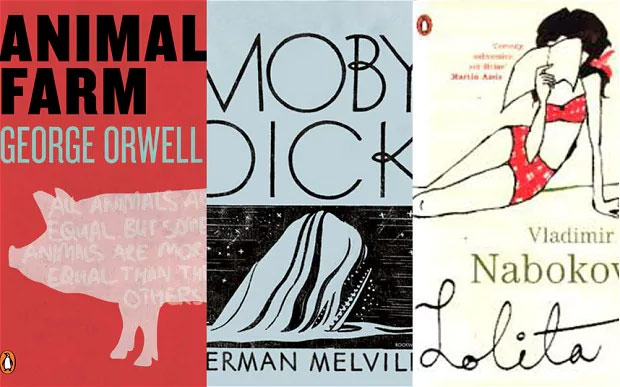
Thankfully, for both Vladimir Nabokov and literature as a whole, Lolita wasn’t buried, but published in France after two years of rejections by New York publishers such as Viking, Simon & Schuster, New Directions, Farrar, Straus, and Doubleday. When Graham Greene got hold of it, shortly after its French publication, he reviewed it in The Sunday Times, describing it as “one of the three best books of 1955”.

Despite this, the novel still wasn’t published in the UK until 1957, because the Home Office seized all imported copies and France banned it. When British publishing house Weidenfeld & Nicolson took it on, it was at the cost of Nigel Nicolson’s political career.

2. “The girl doesn’t, it seems to me, have a special perception or feeling which would lift that book above the ‘curiosity’ level.”

One of the 15 publishers who didn’t think The Diary of Anne Frank was worth reading.

3. “First, we must ask, does it have to be a whale?

“While this is a rather delightful, if somewhat esoteric, plot device, we recommend an antagonist with a more popular visage among the younger readers. For instance, could not the Captain be struggling with a depravity towards young, perhaps voluptuous, maidens?”

Herman Melville’s leviathan novel was rejected, as above, by Peter J Bentley. However, Richard Bentley, of the same London publishing house, eventually offered him a contract in 1851. Moby Dick was published 18 months later than Melville expected and at great personal expense, as he arranged for the typesetting and plating of his book himself to speed up the process. Young, voluptuous maidens never made the final edit.

4. “For your own sake, do not publish this book.”

One publisher turned down DH Lawrence’s Lady Chatterley’s Lover, first published in 1928. Perhaps they had predicted the furore that was unleashed when the full novel did hit the British bookshelves in 1960.

5. “Do you realise, young woman, that you’re the first American writer ever to poke fun at sex”

This was what Anita Loos received before her novel, Gentlemen Prefer Blondes, was successfully published in 1925. It was part of a rejection note, although by today’s standards it sounds quite the accolade.

6. “Miss Play has a way with words and a sharp eye for unusual and vivid detail. But maybe now that this book is out of her system she will use her talent more effectively next time. I doubt if anyone over here will pick this novel up, so we might well have a second chance.”

An editor at Knopf in 1963 rejected Sylvia Plath’s The Bell Jar when it was submitted under the pseudonym Victoria Lucas. After realising it had been written by Plath, who had already published a couple of poetry collections, the same editor read and rejected it again – and managed to spell her real name three different incorrect ways in the process. His assertion that “she will use her talent more effectively next time” is poignant, as Plath had committed suicide six weeks earlier.

7. “You’re welcome to le Carré – he hasn’t got any future.”

A fantastically incorrect prediction by one publisher, sent to his colleague, upon turning down The Spy Who Came in from the Cold

8. “Your pigs are far more intelligent than the other animals, and therefore the best qualified to run the farm – in fact, there couldn’t have been an Animal Farm at all without them: so that what was needed, (someone might argue), was not more communism but more public-spirited pigs.”

The poet TS Eliot, editor of Faber & Faber, was one of the many publishers, including George Orwell’s own, Victor Gollancz, who rejected Animal Farm. When it was published, in 1946, Orwell’s original title, Animal Farm: A Fairy Story was amended.

9. “We are not interested in science fiction which deals with negative utopias. They do not sell.”

Stephen King received this letter about Carrie. His first published novel was rejected so many times that King collected the accompanying notes on a spike in his bedroom. It was finally published in 1974 with a print run of 30,000 copies. When the paperback version was released a year later, it sold over a million copies in 12 months.

10. “I am only one, only one, only one. Only one being, one at the same time. Not two, not three, only one. Only one life to live, only sixty minutes in one hour. Only one pair of eyes. Only one brain. Only one being. Being only one, having only one pair of eyes, having only one time, having only one life, I cannot read your M.S. three or four times. Not even one time. Only one look, only one look is enough. Hardly one copy would sell here. Hardly one. Hardly one.”

So Arthur Fifield, founder of the British publishing house AC Fifield, wrote to Gertrude Stein after receiving one of her manuscripts in 1912.

11. “If I may be frank, Mr. Hemingway — you certainly are in your prose — I found your efforts to be both tedious and offensive. You really are a man’s man, aren’t you? I wouldn’t be surprised to hear that you had penned this entire story locked up at the club, ink in one hand, brandy in the other.”

Mrs Moberley Luger, of Peacock & Peacock, didn’t realise how accurate she was in her 1925 rejection letter of Ernest Heminway’s The Sun Also Rises.

***

So if you’ve been rejected don’t be disheartened, it might be you one day who is able to look back and laugh at the publisher who didn’t want your bestseller!

Happy writing x

***

Via http://www.telegraph.co.uk/The-rejection-letters-how-publishers-snubbed-11-great-authors

How To Plan Your Novel Using The Three-Act Structure

Three-act-structure_1

Writing a novel is hard, especially if you’ve never done it before. You’ve spent hours researching, building your world and becoming an expert on your characters. Now you’re ready for the next step: planning (also known as plotting).

While some people like to write organically (letting the story take you in whatever direction feels right), having a detailed outline can help make the novel-writing process a lot less daunting and overwhelming. But how exactly do you plan a novel?

Essentially, there is no right or wrong way to outline your novel. Each story is different and needs to be told in a different way.

However, if you need a bit more guidance on how to plot out the next bestseller you know you have inside you, the three-act structure might be for you.

Defining The Three-Act Structure

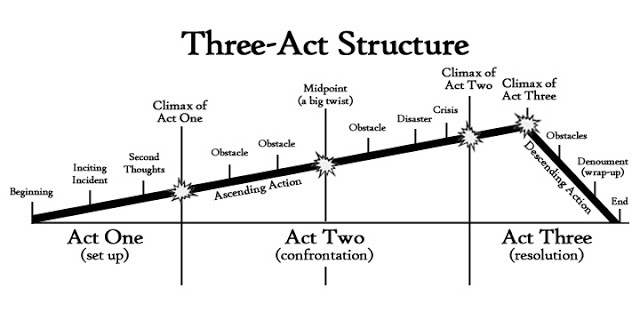
The three-act structure is a popular screenwriting technique that revolves around constantly creating set-ups, conflicts and resolutions. With this structure, a novel is divided into three acts: a beginning, a middle and an end.

There are many versions of the three-act structure. In some, the middle is the same size as the beginning and end put together.

However, when you’re first starting out, it’s much easier to plan each act to be the same length. In this version of the three-act structure, each act is divided into nine chapters for 27 chapters in total. The nine chapters in each act are also split into three blocks of three chapters each.

This version creates a fast-paced novel that invites readers to keep turning your pages. If you’re still unconvinced, for an example Suzanne Collins’ bestselling young adult Hunger Games trilogy follows this structure almost perfectly.

Throughout this article, we’ll take a look at what each section of the three-act structure involves, using examples from The Hunger Games to demonstrate each element. (SPOILER ALERT: If you haven’t read or seen The Hunger Games and don’t want key plot points spoiled, read on at your own risk!)

Act One (set-up)

The first act is used to introduce the reader to the world your characters live in and to set up the coming conflict.

Block One – Introduce Hero in Ordinary World

  • Chapter 1: Introduction (set up)
  • Chapter 2: Inciting incident (conflict)
  • Chapter 3: Immediate reaction (resolution)

In the first chapter, you need to set up your hero in their ordinary world. Introduce us to your characters and the relationships and conflicts between them. In The Hunger Games, the first chapter introduces the dystopian world and the Reaping.

The inciting incident in Chapter Two is the event or decision that sets your hero along the path of your narrative. The inciting incident is really important – without it, your story would not occur. The inciting incident in The Hunger Games is Katniss volunteering herself for the Hunger Games to save her sister; if Katniss didn’t volunteer, the rest of the novel would not have happened.

In the third chapter, the hero reacts to the inciting incident. The immediate reaction in The Hunger Games is when Katniss’ family and friends come to say goodbye to her before she leaves for the Games.

Block Two – Problem Disrupts Hero’s Life

  • Chapter 4: Reaction (set-up)
  • Chapter 5: Action (conflict)
  • Chapter 6: Consequence (resolution)

Chapter Four is where the hero reacts to and reflects on the long-term impacts of the inciting incident. In Chapter Four, Katniss reflects on the impact her death would have on her community, especially her mother and sister. Katniss also starts to discuss strategy with Haymitch, her mentor.

As a result of their reflection, the hero decides to take action and do something to change their situation in Chapter Five. In The Hunger Games, Katniss takes her first step towards winning the Games in the parade of tributes. Her fiery dress and attitude win over the crowd.

Chapter Six details the immediate consequences of the action the hero took in Chapter Five. In The Hunger Games, Katniss discusses the success of the parade with Haymitch. She also reflects on her past and the difficulty of rebellion.

Block Three – Hero’s Life Changes Direction

  • Chapter 7: Pressure (set-up)
  • Chapter 8: Pinch (conflict)
  • Chapter 9: Push (resolution)

The hero’s life has changed as a result of the action they took in Chapter Five, and this creates a lot of pressure and stress in Chapter Seven. The pressure is obvious in Chapter Seven of The Hunger Games. Here, Katniss has her demonstration where she shows the Gamemakers her archery skills by shooting an arrow towards them in frustration.

In Chapter Eight, the first pinch – or plot twist – occurs. A good plot twist is something completely unexpected for the reader. The first pinch in The Hunger Games is Katniss receiving a score of 11, something completely unexpected.

As a result of the pinch, the hero is pushed into a new world in Chapter Nine. The majority of this chapter in The Hunger Games centres around the television interviews with Caesar, the last formality before the tributes are sent into the Games. Here, Peeta declares his love for Katniss.

Act Two (conflict)

The second act is full of conflict. Character development is crucial in the second act; the hero at the end of Act One does not yet have the tools (whether those tools be emotional, physical or literal items the hero must retrieve) to succeed in the third act, so Act Two is all about the journey.

Block Four – Hero Explores New World

  • Chapter 10: New world (set-up)
  • Chapter 11: Fun and games (event/conflict)
  • Chapter 12: Old world contrast (resolution)

Chapter 10 allows you to introduce the reader to the new world. What has changed, and how does the hero feel about it? In Chapter 10, Katniss finally enters the Hunger Games.

In Chapter 11, the hero can take a break and have a little fun. Maybe they have a date with their new lover, or maybe they do something they’ve never done before. Here, Katniss travels through the arena looking for water, and while she is still in an intense environment, she has a bit of a break.

Chapter 12 is time for the hero to compare their current world to how things were at the novel’s beginning. After realising Peeta has teamed up with her enemies, Katniss reflects on their relationship and compares this Peeta to the person she was friends with.

Block Five – Crisis of New World

  • Chapter 13: Build-up (set-up)
  • Chapter 14: Midpoint (conflict)
  • Chapter 15: Reversal (resolution)

The fifth block is all about the midpoint, or the main crisis or conflict of your novel.

Chapter 13 is the build-up to the midpoint and Chapter 14 is the midpoint itself. A good midpoint will dramatically change the hero or impact their life in a negative way. In The Hunger Games, Katniss is pushed towards the Career tributes in Chapter 13, and escapes from them after Peeta saves her in Chapter 14.

Chapter 15 is the immediate reaction or consequence of the midpoint. Here, Katniss makes an alliance with Rue and they formulate a plan to take down the Career tributes.

Block Six – Finding a Solution

  • Chapter 16: Reaction (set-up)
  • Chapter 17: Action (conflict)
  • Chapter 18: Dedication (resolution)

In Chapter 16, the hero reflects on the long-term impacts of the midpoint. In The Hunger Games, Katniss realises that to take down the Careers, they need to stop their food supply.

In Chapter 17, the hero decides to take action to resolve the problem created by the midpoint; however, they realise the enormity of their task when things don’t necessarily go to plan. In Chapter 17, Katniss blows up the Career’s food supply, but before she and Rue can celebrate, Rue is attacked by another tribute.

Despite the set-backs, in Chapter 18 the hero decides that they will succeed no matter what. Rue dies in Chapter 18, and Katniss promises to win for her.

Act Three (resolution)

The final act is all about resolutions. In the third act, the hero needs to find solutions to the conflict created by the midpoint, and you as the author need to make sure you tie up all the loose ends.

Block Seven – Victory Seems Impossible

  • Chapter 19: Trials (set-up)
  • Chapter 20: Pinch (event/conflict)
  • Chapter 21: Darkest moment (resolution)

In Chapter 19, the hero faces significant trials. These trials are extremely difficult for the hero and is something the hero has never experienced before. Here, Katniss races to find Peeta and struggles to help save his injured leg.

Chapter 20 is the second pinch, where the hero experiences something completely unexpected that makes everything even worse. In Chapter 20, Peeta’s injury leads to blood poisoning.

This plot twist leads to the darkest moment in Chapter 21 where the thought of success is incomprehensible. Here, Katniss risks everything to get medicine for Peeta, and the chapter ends with her passing out from her own injuries.

Block Eight – Hero Finds Power

  • Chapter 22: Power within (set-up)
  • Chapter 23: Action (conflict)
  • Chapter 24: Converge (resolution)

Having hit rock-bottom, the hero remembers their desire to succeed in Chapter 18 and finds the power within to continue on. In Chapter 22, Katniss and Peeta both start to recover from their injuries.

After deciding they can do it, the hero takes action in Chapter 23, and this action causes the plotlines to converge and come together in Chapter 24. In Chapter 23, Peeta and Katniss realise how close they are to winning, and in Chapter 24 all of the tributes are pushed towards the lake by the Gamemakers for the final battle.

Block Nine – Hero Fights and Wins

  • Chapter 25: Battle (set-up)
  • Chapter 26: Climax (conflict)
  • Chapter 27: Resolution (resolution)

Block nine is the finale. In Chapter 25, the character has one last battle. This doesn’t have to be a physical battle – it could be a fight between friends or lovers, or a mental battle your hero has with themselves. Here, Peeta and Katniss try to survive the freezing night and kill Cato.

Chapter 26 is the final climax. The decisions the hero makes here will impact the rest of their life; it is the point of no return. In The Hunger Games, Katniss and Peeta pretend to eat the poisonous berries, which leads to President Snow stopping them by declaring them both winners. However, Katniss realises that despite winning the Games, she’s now in even more danger.

Chapter 27 is the resolution or the immediate reaction to the hero’s decision in the last chapter. Here, Katniss and Peeta finally get to go home.

The way you end your novel is up to you. You might choose to explain everything, or leave some things (or a lot of things) up to your reader’s imagination. It could be a happy heroic ending, or it could be a tragedy where everyone dies.

Either way, congratulations! You’ve planned a novel.

***

One last thing to note: When you start to plan your novel using this structure it’s important to remember it’s just a guideline. You don’t have to change your story to suit the structure; you can change the structure to suit your story. If your plot twist would make more sense earlier or later, move it. These aren’t hard rules. Do what is right for your story.  So take a deep breath, set yourself up in your favourite place to write and start planning!

Via: https://writersedit.com/plan-novel-using-three-act-structure/

How to Work Through Difficulty: Lewis Carroll’s Three Tips for Overcoming Creative Block

Lewis-Carroll-Charles-Dodgson-631

When you have made a thorough and reasonably long effort, to understand a thing, and still feel puzzled by it, stop, you will only hurt yourself by going on.”

In addition to having authored one of my all-time favourite books, Alice’s Adventures in WonderlandLewis Carroll (January 27, 1832 – January 14, 1898) was a man of extraordinary and frequently prescient wisdom on matters of everyday life — his nine commandments of letter-writing offer timely insight into how we can make modern digital communication more civil, and his four rules for digesting information are a saving grace for our age of information overload. In The Life and Letters of Lewis Carroll, this blend of timelessness and timelines so characteristic of Carroll’s thinking comes vibrantly ablaze, but nowhere more so than in an 1885 letter to one of his child-friends, a young lady named Edith Rix.

Carroll addresses the age-old question of how to overcome creative block. More than a century before psychologists identified the essential role of taking breaks in any intense creative endeavor, and long before our earliest formal theories about the stages of the creative process, Carroll offers spectacularly prescient counsel on how to work through creative difficulty and seemingly unsolvable problems — a testament to the fact that in the study of creativity, psychology often simply names and formalizes the intuitive insights artists have had for centuries, if not millennia.

Carroll offers young Edith three tips:

When you have made a thorough and reasonably long effort, to understand a thing, and still feel puzzled by it, stop, you will only hurt yourself by going on. Put it aside till the next morning; and if then you can’t make it out, and have no one to explain it to you, put it aside entirely, and go back to that part of the subject which you do understand. When I was reading Mathematics for University honors, I would sometimes, after working a week or two at some new book, and mastering ten or twenty pages, get into a hopeless muddle, and find it just as bad the next morning. My rule was to begin the book again. And perhaps in another fortnight I had come to the old difficulty with impetus enough to get over it. Or perhaps not. I have several books that I have begun over and over again.”

His second tip is particularly noteworthy for the way it compares and contrasts Carroll’s two domains of genius, writing and mathematics — for, lest we forget, behind the pen name Lewis Carroll always remained the brilliant mathematician and logician Charles Dodgson. He writes:

My second hint shall be — Never leave an unsolved difficulty behind. I mean, don’t go any further in that book till the difficulty is conquered. In this point, Mathematics differs entirely from most other subjects. Suppose you are reading an Italian book, and come to a hopelessly obscure sentence — don’t waste too much time on it, skip it, and go on; you will do very well without it. But if you skip a mathematical difficulty, it is sure to crop up again: you will find some other proof depending on it, and you will only get deeper and deeper into the mud.”

In a way, this dichotomy also illuminates the difference between reading and writing. Writing is almost mathematical, in the sense that it requires a clarity of logic in order for the writer to carry the plot forward. A reader may be able to read over a muddled sentence and still follow the plot — but only if that sentence was unmuddled for the writer in carrying the plot forward. In that sense, while Carroll’s advice to Edith considers her experience as a reader, his advice to a writer regarding creative block would be more closely aligned with the mathematician’s experience — if a writer were to skip over a difficulty in the construction of a story, which is essentially a logical difficulty, it too “is sure to crop up again.”

Carroll’s third tip is at once remarkably simple and remarkably challenging to apply for anyone who has ever tussled with the mentally draining but spiritually sticky process of creative problem-solving:

My third hint is, only go on working so long as the brain is quite clear. The moment you feel the ideas getting confused leave off and rest, or your penalty will be that you will never learn Mathematics at all!”

***

Via: https://www.brainpickings.org/lewis-carroll-creative-block-letter/

Hemingway on Writing, Ambition, the Art of Revision 

Hemingway-writing

“As a writer you should not judge. You should understand,” Ernest Hemingway (July 21, 1899–July 2, 1961) counseled in his 1935 Esquire compendium of writing advice, addressed to an archetypal young correspondent but based on a real-life encounter that had taken place a year earlier.

In 1934, a 22-year-old aspiring writer named Arnold Samuelson set out to meet his literary hero, hoping to steal a few moments with Hemingway to talk about writing. The son of Norwegian immigrant wheat farmers, he had just completed his coursework in journalism at the University of Minnesota, but had refused to pay the $5 diploma fee. Convinced that his literary education would be best served by apprenticing himself to Hemingway, however briefly, he hitchhiked atop a coal car from Minnesota to Key West. “It seemed a damn fool thing to do,” Samuelson later recalled, “but a twenty-two-year-old tramp during the Great Depression didn’t have to have much reason for what he did.” Unreasonable though the quest may have been, he ended up staying with Hemingway for almost an entire year, over the course of which he became the literary titan’s only true protégé.

Samuelson recorded the experience and its multitude of learnings in a manuscript that was only discovered by his daughter after his death in 1981. It was eventually published as With Hemingway: A Year in Key West and Cuba — the closest thing to a psychological profile of the great writer.

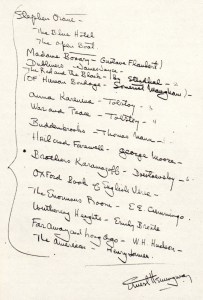
Shortly after the young man’s arrival in Key West, Hemingway got right down to granting him what he had traveled there seeking. In one of their first exchanges, he hands Samuelson a handwritten list and instructs him:

Here’s a list of books any writer should have read as a part of his education… If you haven’t read these, you just aren’t educated. They represent different types of writing. Some may bore you, others might inspire you and others are so beautifully written they’ll make you feel it’s hopeless for you to try to write.

This is the list of heartening and hopeless-making masterworks that Hemingway handed to young Samuelson:

hemingway_readinglist

  1. The Blue Hotel by Stephen Crane
  2. The Open Boat by Stephen Crane
  3. Madame Bovary by Gustave Flaubert
  4. Dubliners by James Joyce
  5. The Red and the Black by Stendhal
  6. Of Human Bondage by W. Somerset Maugham
  7. Anna Karenina by Leo Tolstoy
  8. War and Peace by Leo Tolstoy
  9. Buddenbrooks by Thomas Mann
  10. Hail and Farewell by George Moore
  11. The Brothers Karamazov by Fyodor Dostoyevsky
  12. The Oxford Book of English Verse
  13. The Enormous Room by E.E. Cummings
  14. Wuthering Heights by Emily Brontë
  15. Far Away and Long Ago by W.H. Hudson
  16. The American by Henry James

Not on the handwritten list but offered in the conversation surrounding the exchange is what Hemingway considered “the best book an American ever wrote,” the one that “marks the beginning of American literature” – Mark Twain’s Adventures of Huckleberry Finn.

Alongside these edifying essentials, Hemingway offered young Samuelson some concrete writing advice. Advocating for staying with what psychologists now call flow, he begins with the psychological discipline of the writing process:

The most important thing I’ve learned about writing is never write too much at a time… Never pump yourself dry. Leave a little for the next day. The main thing is to know when to stop. Don’t wait till you’ve written yourself out. When you’re still going good and you come to an interesting place and you know what’s going to happen next, that’s the time to stop. Then leave it alone and don’t think about it; let your subconscious mind do the work.

Then, echoing Lewis Carroll’s advice on overcoming creative block in problem-solving, Hemingway considers the practical tactics of this psychological strategy:

The next morning, when you’ve had a good sleep and you’re feeling fresh, rewrite what you wrote the day before. When you come to the interesting place and you know what is going to happen next, go on from there and stop at another high point of interest. That way, when you get through, your stuff is full of interesting places and when you write a novel you never get stuck and you make it interesting as you go along. Every day go back to the beginning and rewrite the whole thing and when it gets too long, read at least two or three chapters before you start to write and at least once a week go back to the start. That way you make it one piece. And when you go over it, cut out everything you can. The main thing is to know what to leave out. The way you tell whether you’re going good is by what you can throw away. If you can throw away stuff that would make a high point of interest in somebody else’s story, you know you’re going good.

He then returns to the psychological payoff of this trying practice:

Don’t get discouraged because there’s a lot of mechanical work to writing. There is, and you can’t get out of it. I rewrote A Farewell to Arms at least fifty times. You’ve got to work it over. The first draft of anything is shit. When you first start to write you get all the kick and the reader gets none, but after you learn to work it’s your object to convey everything to the reader so that he remembers it not as a story he had read but something that happened to himself. That’s the true test of writing. When you can do that, the reader gets the kick and you don’t get any. You just get hard work and the better you write the harder it is because every story has to be better than the last one. It’s the hardest work there is. I like to do and can do many things better than I can write, but when I don’t write I feel like shit. I’ve got the talent and I feel that I’m wasting it.

When Samuelson asks how one can know whether one has any talent, Hemingway replies:

You can’t. Sometimes you can go on writing for years before it shows. If a man’s got it in him, it will come out sometime. The only thing I can advise you is to keep on writing but it’s a damned tough racket. The only reason I make any money at it is I’m a sort of literary pirate. Out of every ten stories I write, only one is any good and I throw the other nine away.

Hemingway tempers this with a word of advice on ambition, self-comparison, and originality:

Never compete with living writers. You don’t know whether they’re good or not. Compete with the dead ones you know are good. Then when you can pass them up you know you’re going good. You should have read all the good stuff so that you know what has been done, because if you have a story like one somebody else has written, yours isn’t any good unless you can write a better one. In any art you’re allowed to steal anything if you can make it better, but the tendency should always be upward instead of down. And don’t ever imitate anybody. All style is, is the awkwardness of a writer in stating a fact. If you have a way of your own, you are fortunate, but if you try to write like somebody else, you’ll have the awkwardness of the other writer as well as your own.

In a sentiment that calls to mind Neil Gaiman’s magnificent commencement address on the only adequate response to criticism, Hemingway cautions Samuelson about the petty jealousies that arise with success:

When you start to write everybody is wishing you luck, but when you’re going good, they try to kill you. The only way you can ever stay on top is by writing good stuff.

***

Via: https://www.brainpickings.org/hemingway

Writing Prompt: Digital Assistant POV

Digital-Assistants

Most of us are aware that we now live in a modern age, where digital assistants live in our smart homes and can take all kinds of instructions.

Some of us find them amazing and couldn’t do without them, others of us wouldn’t trust them an inch and don’t want them in our house.

But have you ever wondered what it’s like on the other side of the coin?

Is Siri secretly an evil genius?

Is Alexa a dumb idiot who wonders why you’re always asking her questions she doesn’t understand?

Write a piece from the point of view of Siri or Alexa. Give them personalities and decide exactly how clever they really are.

This could get scary really fast!

Happy writing 🙂


20 Inspiring Quotes to Boost Your Confidence

Does your writing never feel not quite good enough?

You are not alone.

All writers feel like that at times.

And there is a simple reason why.

Hidden within us is the writer we are born to become. And this inner writer urges us to improve our craft.

That’s a good thing.

But the process starts unraveling when the gremlins of fear, doubt and shame start to bombard us with negative messages:

“You haven’t got what it takes!”

“You’re hopeless!”

“You can’t write!”

“Everyone else writes better!”

Are these thoughts familiar to you?

I bet they are!

The question is, would you talk so harshly to someone else?

If a new writer were to show you her or his work, how would you respond?

Most likely you respond with kindness and support.

And that’s exactly how you need to treat yourself.

Because as a writer, you’ll always have doubts about whether you are good enough. It doesn’t matter how successful you are, you’ll still feel inadequate at times.

Elisabeth George wrote the following in her journal (after publishing twelve bestsellers):

I’m reading John Le Carré’s The Constant Gardener right now. Frankly, it’s making me feel more inadequate than I’ve felt in a long time.

As you can see, at times even successful authors doubt their ability to write. If there is only one thing you take away from this post, let it be this:

Your feelings of inadequacy have no bearing on your talent as a writer.

The messages that the inner gremlins of fear, doubt and shame give you are the negative voices of the past. Voices of your parents, care-givers or teachers. They had a huge impact when you were little – and you still believe them, don’t you?

It’s time to free yourself from these gremlins!

It’s time for an antidote.

The antidote of inspiring quotes from writers who have gone through their fear, doubt and shame, and have come out the other side with some wisdom.

Here are some such inspiring quotes to help you on your way:

This slideshow requires JavaScript.

I hope you feel inspired by these quotes and are encouraged to keep going.

Best of luck!

***

Via: https://writetodone.com/boost-your-confidence-as-a-writer/

Writing Prompts: Birthdays

Birthdays can hold amazing memories and sometimes contain embarrassing and even tragic recollections. People all over the world have different traditions for celebrating birthdays. You may even celebrate your birthday in a unique way with your own family. Here are some fun creative writing prompts about birthdays:

1. Write a story that begins with a character suffering from a terminal disease. The scene begins with the character celebrating what he/she believes is their last birthday. What happens next?

2. Write a story where two main characters (who do not yet know each other) are preparing for their big birthday bash. However reservations get mixed up really quick and the two characters end up sharing the same party.

3. Write a story about a couple that are having a very difficult time in their marriage. One spouse decides to throw an amazing surprise party. What unexpected surprises occur?

4. Write a story about a child’s birthday gift which becomes alive. For instance, a child receives a large stuffed unicorn that comes alive and talks.

5. Write a story about being trapped in birthday-Groundhog day and reliving your own birthday over and over again.

6. Research some amazing and generous things that people have done for others for their birthday. Write a story based on these incredible stories.

7. Write a story that begins with the character celebrating their 90th birthday.

8. Write a story about a man who can change any given birthday in their life. Which birthday do they choose and how do they change it? How does this impact the rest of their life?

I hope these prompts inspire some amazing writing!

Via: http://www.litbridge.com/creative-writing-prompts-about-birthdays/

How to Get Your Writing Out There

writing (1)

Founding Editor of Writer’s Edit, Helen Scheuerer, shares advice on how to get your writing out there…


Don’t be afraid to take yourself seriously

Whether you come from a creative writing background or you’re new to the game, I’m sure you’ll be aware of the judgment that awaits writers. Not just from editors and other writers, but also from our colleagues and friends. A lot of people, amidst their own self-consciousness poke fun at those of us who try, those of us who take our work seriously, even if we haven’t yet been published or won an award. There are always going to be people who laugh at your efforts, and believe themselves to be superior in comparison to whatever it is that you’re doing. You don’t need these people, and you certainly shouldn’t shy away from your writing because of them.

It’s taken me a long time to learn this lesson. Because of these people, and the fear of their comments and judgment (never constructive in any way), I never used to promote and share my work. I would keep my projects to myself. But recently, I’ve let myself become confident in my knowledge and if not in my talent, in my perseverance. It’s the first time in years I’ve let people know just how seriously I take my writing. And while some people may have scoffed, many more have actually been impressed and have been inspired to do the same.

Create a website/Author Platform

The online world has changed the way us writers get exposure, gain a following and join communities. Creating a website, or an ‘Author Platform’ is just one of the ways you can get a readership going, even before you publish your book. Blog about the process, give away snippets, share your latest reads, and engage in conversation. One of my favourite author platforms is Chris Cleave’s (have a look, here). He blogs about book tours, ongoing projects, answers questions – it’s very simple, very casual, but it’s a great way to give his readers a little insight into his world of writing. Another author who’s taken her platform to the next level is Joanna Penn, the fingers that are rapidly typing behind The Creative Penn. You only need to take a quick trip to her site to see what I mean. You can also check out our Writer’s Edit interview with Joanna, here.

What I love about creating an author platform besides the fact that it connects you with readers and like-minded folk, is that you get to document your journey. I’ve recently started blogging about the challenges that have come with editing my novel, it’s a great release and it also lets people in on what’s gone into the product they have (or will have) in their hands at the end. You can check out my platform, here.

Some tips for creating your website?

  • Get a proper domain name. By this I mean a .com or a .com.au – not a .weebly or a .wix. This is just personal opinion, but it doesn’t look professional. Domain names are inexpensive for the most part, and cheap web hosting can be found as well. It really is worth having your own individual platform, you are after all, creating an author brand.
  • Go WordPress. It’s one of the most widely used content management systems out there, it has thousands of free and cheap themes available for download that are user friendly. I’m no internet/computer expert, but I’ve definitely got the hang of it now.
  • You need to be yourself, but professional as well. Let your personality shine through the website, but ensure that your content remains courteous, relevant to your writing, and if you choose to have images – no ‘selfies’ (if there’s a place for that, it’s not on your author platform).
  • Get some content on there before you start promoting it across social media platforms and telling all your friends about it. It needs to be impressive. This is the space where eventually, people will purchase your books from. Give it time to grow first.
  • Include your short stories, novel excerpts, poetry and writing news, regularly.
  • Ensure that your website has a ‘shop’ feature. If not, as the very least make sure you link to any pages from other websites where your books are sold, you’d be surprised at how many new authors forget to do this.

Become a regular contributor somewhere

This was something that was never stressed enough to me, but I would advise that every writer contribute to some kind of blog/magazine/forum. Becoming a regular contributor somewhere allows you to establish yourself as an author, as an authority on a certain topic/in our industry, it also connects you with other writers who are interested in the same things, it gets a conversation going! Many authors, myself included, hate the idea of ‘networking’… It’s got some negative connotations doesn’t it? But think of contributing as becoming a part of a community. You want a voice and friends in this community, because it’s here that you will get advice, it is here that you will sell your novels and start to get your name out there.

Contributing to publications is also valuable just for the experience, as well as keeping you on track with your writing. If you’ve promised an article to a publication and you’re working to deadline, there’s no more procrastinating. When you’ve committed to writing something for someone else, you’re so much more likely to stick with it. Any writing is better than no writing, it’s great to keep yourself in the discipline even if you’re not currently working on your own project.

Pay it forward

Us writers are all in the same boat, which is exactly why we need to support each other. The online world makes this so much easier than ever before. With author platforms, social media pages, sharing links, it’s never been this simple to help a writer pal out. Have they published an article lately? Have they got a new website? Are they hosting an event? Like/Share/Comment on everything! Obviously, you want to contribute, not just click buttons for the sake of it, but a lot of authors don’t understand the power of the online world.

I don’t necessarily mean that these same people are going to Like/Share/Comment on everything you ever post, but it’s being a good sport, and hopefully some social media karma will come your way when you need it most, ie. when you’re launching a book, or trying to get people to come to an event… This is certainly one major lesson I’ve learnt in recent months. We’re a very supportive bunch when we want to be, and ‘paying it forward’ also enables you to become part of a much larger community than imagined.

Things You Should Try

  • Going to a writer’s festival.
  • Starting a blog or website.
  • Sharing your work and accomplishments on social media.
  • Getting together with writer friends (and actually talk about writing).
  • Reading books and writing reviews.

***

Via: https://writersedit.com/fiction-writing/get-your-writing-out-there/